Best 24 Volt Lithium Charger Options for 24V LiFePO4 Batteries
Finding the right 24-volt lithium charger means matching charging speed, protection features, and compatibility with LiFePO4 cells. This guide highlights five dependable chargers suited for 24V LiFePO4 or lithium packs, with clear guidance on who benefits most from each option. Best for RVs, off-grid systems, or boats, these chargers balance fast charging with battery health safeguards and practical connection options.
Buyer’s summary table
| Product | Best For | Key Benefit | Limitations |
|---|---|---|---|
| LiTime 24V (29.2V) 40A Charger | Large packs, frequent use, off-grid | High output, sleep-mode wake, 3-stage charging | Bulkier; higher power draw |
| HERISKEER 24V 10A Charger | Moderate-capacity packs, quick top-offs | 2-stage charging, fast top-up | Lower current for very large packs |
| YUANRI 24V 25A Charger | Rugged outdoor use, IP67 protection | 3-color indicators, robust housing | Higher price for intermediate output |
| RALBIL 24V 10A Charger | Compact setups, versatile connections | 0V wake-up, two connection methods | Mid-range efficiency |
| BROODAY 24V 30A Charger | Fast charging, LiFePO4 only | 30A, safety protections, LiFePO4 tuned | Not suitable for non-LiFePO4 chemistries |
LiTime 24V 40A Smart Charger

This charger targets 24V LiFePO4 batteries with the goal of minimizing downtime. It offers up to 40A output and a 3-stage charging profile to protect battery health while delivering faster replenishment. Best for users who need rapid recovery of larger 24V packs in RVs, off-grid cabins, or extended power systems.
Who it’s best for: users with 24V LiFePO4 systems that require frequent charging or fast recharges. Why selected: the 40A output reduces charging time significantly while maintaining long-term reliability.
Caution: activation features for deeply depleted batteries depend on the BMS; ensure your system supports wake-up and do not rely on it to revive severely damaged packs.
HERISKEER 24V 10A Charger

Designed for LiFePO4 packs from 30Ah to 150Ah, this charger uses a 29.2V, 10A output with a two-stage charging process for safe, efficient replenishment. It’s a solid choice for mid- to large-capacity 24V deployments where space and simplicity matter.
Best for: owners with 50–120Ah LiFePO4 packs who want a compact, dependable charger. Why selected: straightforward two-stage charging supports battery longevity without complex configuration.
Caution: with a 10A rating, charging very large packs can take longer than higher-current options.
Mebilee 24V 5A LiFePO4 Maintainer

This 5A charger acts as a trickle maintainer with multiple protections and a cooling fan for quiet operation. It’s best for seasonal storage or small 24V systems where ongoing floats are needed without heavy current draw.
Best for: long-term storage or small 24V packs. Why selected: reliable constant voltage maintenance with protective features. Caution: slower charging if you need quick top-ups in active use.
YUANRI 24V 25A IP67 Charger
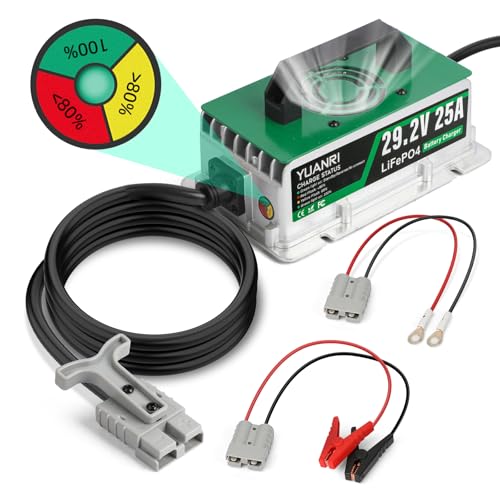
With a robust IP67-rated aluminum housing, 25A output, and 29.2V maximum, this charger is built for outdoor and marine environments. It features a three-color indicator system to quickly read charging status and a wide input range for frequent power changes.
Best for: outdoor, marine, or rugged installations needing waterproof protection. Why selected: strong protection with clear status indicators aids in remote or harsh locations.
Caution: the three-color LED indicators are helpful, but rely on proper interpretation in bright sunlight to avoid misreading status.
Buying Guide
What should you consider when choosing a 24V LiFePO4 charger?
- Battery capacity compatibility: Match charger current (A) to your pack size. Larger packs benefit from higher amperage for reasonable charging times.
- Charging profile: Look for multi-stage charging (pre-charge, CC, CV) to protect long-term battery life.
- Protection features: Prioritize over-voltage, short-circuit, reverse polarity, and overheat protections for safety and reliability.
- Wake-up and BMS compatibility: If your battery has a BMS that locks at low voltage, a wake-up function helps re-engage charging.
- Environmental conditions: For outdoor or marine use, IP rating and rugged housing improve durability.
- Connection options: Chargers offering multiple connections (Anderson, M8 terminals, alligator clips) provide flexibility for different installations.
- Indication methods: Clear indicators (LED, color codes) help you monitor status without opening panels.
How to compare specific features?
- Output current vs. time to full: A higher current reduces charge time for large packs, but ensure your BMS supports it.
- Wake-up capability: For batteries that auto-cut off under low voltage, wake-up can reduce downtime but requires compatible BMS.
- Ingress protection: IP67 or better is preferable for outdoor or water-adjacent installations.
- Physical build: Aluminum housings dissipate heat better and resist corrosion in harsh environments.
Safety and maintenance tips
- Only use chargers designed for LiFePO4 chemistry to prevent improper charging.
- Inspect connectors and cables regularly for wear or corrosion.
- Avoid charging in extreme temperatures outside the manufacturer’s recommended range.
- Disconnect from power after charging completes when possible to prolong life.
FAQ
- Q: Can I use a 24V LiFePO4 charger on a different chemistry battery?
A: No. Use chargers specifically rated for LiFePO4 or the battery chemistry you have to avoid damage. - Q: What is wake-up, and do I need it?
A: Wake-up reactivates a battery after BMS cutoff. It’s helpful for stored or deeply discharged packs that must be revived before charging. - Q: How do I know which charger is right for my pack size?
A: Compare charger amperage to your pack capacity (Ah). Higher Ah packs generally need more current for reasonable charging times. - Q: Are IP67 chargers suitable for boats?
A: Yes, IP67-rated housings provide protection against water immersion and dust in marine environments. - Q: Do chargers have to match exact voltage?
A: Yes. Use a charger with the correct nominal voltage (29.2V for 24V LiFePO4 systems) to ensure proper charging voltage. - Q: Should I rely on a charger for long-term storage?
A: A charger with a maintenance or float mode can keep a full battery ready without overcharging, especially in storage conditions.