Best 220V Baseboard Heaters With Built-in Thermostats for Precise Comfort
Answering the common search for a 220V baseboard heater with a built-in thermostat, this guide highlights five excellent options and explains who they’re best for. If you want a quiet, steady heat without a separate wall thermostat, these units offer integrated controls suited for different room sizes and installation needs. The top picks cover Cadet and Stelpro products, balancing ease of installation, reliability, and energy-efficient temperature management for both new builds and retrofit projects.
Overview at a glance: the table below summarizes the five products chosen for this guide, focusing on suitability, key installation notes, and best-use scenarios.
| Product | Best For | Notes |
|---|---|---|
| Cadet F Series Built-In Thermostat (BTF2W) | Cadet F series baseboard heaters | Easy end-mount, 45–80°F range |
| Stelpro Brava 1000W (AB41001W) | Medium rooms up to 100 sq ft | Hardwired, built-in thermostat kit options |
| Stelpro Brava 500W (AB0501W) | Smaller spaces, quiet heat | Hardwired, room-control options |
| Stelpro Brava 300W (AB03029W) | Compact layouts, 240V/208V needs | Hardwired, compact profile |
| Cadet Built-In Thermostat Kit (BTF1W) | Cadet baseboards requiring internal control | Simple, end-mount kit |
Cadet F Series Double Pole Built-In Thermostat (BTF2W)

The Cadet BTF2W is a double-pole thermostat designed for Cadet F series baseboard heaters. It offers a wide 45°F to 80°F temperature range and uses a large dial for simple manual adjustments. Best for buyers who already use Cadet F series baseboards and want to streamline wiring by mounting at either end of the heater. This model is best for installations where a built-in control is preferred to minimize external wiring. A key limitation is that it’s specifically built for Cadet F series models and may not fit other manufacturers without adapters.
Stelpro Brava 1000W Baseboard Heater (AB41001W)

This Stelpro Brava 1000W heater is designed for quiet, even heating of spaces up to about 100 square feet. It’s a hardwired unit with optional built-in thermostat kits (electronic or mechanical). Best for rooms where a wall thermostat isn’t preferred or where a seamless cabinet look is desired. It’s not a plug-in model, so plan for permanent wiring. The built-in thermostat kits provide flexible control, but you’ll want to confirm compatibility with your home’s electrical system and local codes.
Stelpro Brava 500W Baseboard Heater (AB0501W)
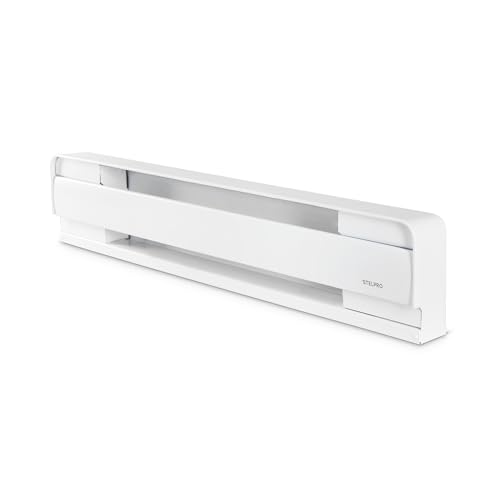
The 500W Stelpro Brava provides steady heat for smaller spaces, with a similar hardwired installation requirement and options for built-in thermostat kits. It’s better for compact rooms or offices where you want efficient, quiet heat without an external thermostat. A limitation to note is that the unit itself requires a separate thermostat kit for on-unit temperature control, so expect additional components if you need on-board adjustment.
Stelpro Brava 300W Baseboard Heater (AB03029W)

This 300W Stelpro Brava is a compact option suitable for smaller rooms or tight spaces. It’s designed for hardwired installation and can be paired with a wall thermostat or optional on-unit control kit. Choose this if you need a slim footprint while maintaining reliable convection heating. A potential limitation is that its smaller wattage may require multiple units for larger areas or higher heat loads.
Cadet Built-In Thermostat Kit For Cadet Heaters (BTF1W)

The Cadet BTF1W kit integrates a built-in thermostat with Cadet baseboard heaters, ideal for users who want straightforward, end-mount installation. Best for Cadet users who prefer single-pole control and simple operation. A caution: compatibility is limited to Cadet models designed to accept this kit, so verify compatibility with your specific baseboard unit before purchasing.
Buying Guide: Key Considerations For 220V Baseboard Heaters With Built-In Thermostats
What voltage and wiring do you need? Most baseboard heaters in this guide operate at 220V (or 208V/240V in some models). Confirm your circuit can safely supply the correct voltage and current for the heater’s wattage.
Is a hardwired or plug-in installation required? Several models here require permanent wiring, while others offer plug-in options. If you’re replacing an existing system, plan for hardwiring to maintain consistent temperature control and code compliance.
What thermostat type fits your space? Built-in thermostats offer on-unit control, while separate wall thermostats provide centralized room management. Consider single-pole vs. double-pole control for safety and performance.
How big should the heater be for the space? Estimate heat load by room size and insulation. Higher wattage (like 1000W) covers larger areas, while 300–500W units suit smaller rooms. Multiple units can be used for larger layouts.
Are there compatibility considerations? Some thermostats are model- or brand-specific. When mixing components, ensure the thermostat kit matches your baseboard heater model to avoid fit or control issues.
FAQ
- What does “built-in thermostat” mean for baseboard heaters? It means the thermostat is integrated into the heater, providing on-unit temperature control without a separate wall thermostat in the immediate installation.
- Can I install these heaters myself? Many units are designed for straightforward installation, but hardwired models typically require electrical work and adherence to local codes. When in doubt, hire a licensed electrician.
- Are these 220V heaters suitable for all rooms? They are well-suited for spaces with adequate electrical capacity and insulation. For very small rooms, consider lower-wattage models to avoid overheating.
- Do built-in thermostats affect energy efficiency? Yes. Integrated controls help maintain stable temperatures, reducing swings and potentially lowering energy use compared to uncontrolled heaters.
- Can I mix different brands in the same system? It’s best to pair matching components designed for the same heater series to ensure reliable operation and warranty compatibility.
- What maintenance is required? Baseboard heaters with built-in thermostats typically require minimal maintenance beyond periodic dusting and ensuring vents remain clear for efficient airflow.