Best 220 Volt LED Light Solutions for Indoor and Outdoor Use
Answering the common buyer question, these 220-volt LED options cover outdoor flood lighting, panel lights, and indicator signals. They’re ideal for property security, utilities, and workshop projects where 220V is standard. The top picks below are best suited for installers seeking reliable voltage compatibility, clear visual signals, or energy-efficient lighting. The following table summarizes the selected products for quick comparison.
| Product | Brand | Key Use | Voltage Range | Notable Benefit |
|---|---|---|---|---|
| HOOK 100W LED Flood Light | HOOK | Outdoor flood/landscape lighting | AC 220V-240V | High energy efficiency; IP65 waterproof |
| Gebildet 5pcs 10mm LED Indicator Light | Gebildet | Signal indication for panels and machines | AC 110V-220V | Multiple units; visible status cues |
| ALIVIM 110V-220V Surface LED Panel | ALIVIM | Ceiling or wall lighting | 110V-220V | Long lifespan; safe design |
| DMWD 2PCS LED Indicator Light | DMWD | Marine, automotive and outdoor signaling | 110V-220V | Waterproof IP67; durable |
| OMTO E26/E27 A19 LED Bulbs | OMTO | General 220V residential lighting | 85-265V | Flicker-free and true color rendering |
HOOK 100W LED Flood Light—Outdoor 220V-240V LED Flood Lamp

The HOOK flood light is designed for outdoor use with a 180-degree beam angle and an IP65 waterproof rating. It claims energy savings of about 80% versus traditional halogen lamps and uses high-quality chips with a solid ABS lampshade for durability. This light is best for exterior security lighting, driveways, and landscape illumination where a bright, wide spread is needed. Choose this if you want a powerful, weather-resistant option that runs directly on 220-240V AC. A limitation is the note that it should not be submerged in water, so placement should avoid direct immersion or deep-water exposure.
Gebildet 5pcs 10mm LED Indicator Light (Green) 110V-220V

These 10mm panel-mount indicator lights operate across a 110V-220V range and draw about 0.5W with a 20mA current. They are intended to provide a clear visual status cue for signals, indexing, announcements, or alarms. They’re best for control panels and equipment dashboards where compact indicators are required. Best for projects needing multiple status lights in a 220V system. A potential drawback is that color options are limited to the listed variants, so match to your system’s color-coding scheme.
ALIVIM 110V-220V Surface LED Panel Ceiling Light
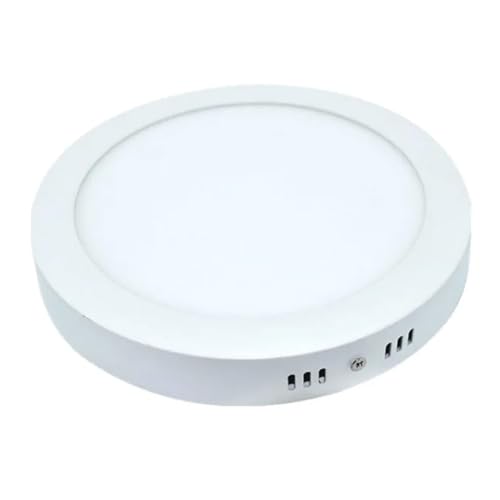
This round ceiling LED panel is designed for indoor lighting with a natural white tone and a driver for 110-220V operation. It emphasizes a long lifespan (over 20,000 hours) and a safe, glass-free design. It’s well-suited for kitchens, hallways, and offices where a low-profile, steady light is preferred. The main limitation is that it requires proper mounting and may not be ideal for very small rooms if one panel cannot meet brightness needs.
DMWD 2PCS LED Indicator Light—IP67 Waterproof

This pair of indicator lights is built for outdoor and marine environments with IP67 waterproofing. They support 110-220V AC operation and feature a sturdy nickel-plated brass body for long service life. They are best for signaling on vehicles, boats, or weather-exposed equipment. A noted limitation is that easier installation requires a proper through-hole mounting and secure wiring to avoid moisture ingress in harsh conditions.
OMTO E26/E27 A19 LED Bulb 9W (White 6000K)

OMTO A19 LED bulbs provide about 800 lumens, equivalent to a 60W incandescent with 80% less energy use. They offer flicker-free operation and true color rendering inside the home, suitable for general indoor lighting in a 220V system. Best for room-by-room upgrades where existing E26/E27 sockets are standard. A caveat is that color temperature is fixed at 6000K (cool white), which may not suit mood lighting needs in all rooms.
Buying Guide: 220V LED Lighting Essentials
What should you consider when selecting 220V LED lighting? The following practical questions help guide a buyer’s decision.
- Where will the light be used? Outdoor fixtures require weatherproof ratings (IP65 or IP67) and durability, while indoor panels emphasize color rendering and installation ease.
- What is the voltage compatibility? Most listed options support 110V-220V or 220V-240V. Confirm your supply and any required transformers or adapters.
- What brightness and beam angle do you need? Flood lights typically offer wide beams for large areas; indicator lights are for status signaling and are not designed for illumination of large spaces.
- Is color temperature important? Warmer whites (2700K-3000K) feel cozy, while cool whites (4000K-6000K) improve alertness and visibility. Panel lights often provide neutral to cool tones.
- Durability and installation considerations: IP ratings indicate water and dust resistance; ensure mounting methods match the product design and intended environment.
- Lifecycle and maintenance: LEDs offer long lifespans, but consider warranty, replacement costs, and ease of access for maintenance in hard-to-reach locations.
FAQ
- What does IP65 vs IP67 mean for 220V LED lights?
– IP65 indicates protection against water jets from any direction and dust resistance; IP67 means temporary immersion in water. Choose IP67 for boats or severe weather exposure, IP65 for typical outdoor use. - Can I use 220V LED indicators in a 110V system?
– No. They are designed for 110-220V ranges; using them on 110V without proper design can prevent operation. - Are 220V LED panels suitable for kitchens and offices?
– Yes. Panels designed for 110-220V are suitable for ceiling installations in these spaces, offering low profile, flicker-free light. - What should I consider when pairing indicators with main lighting?
– Ensure indicator lights share common wiring practices, voltage range compatibility, and that installation does not interfere with safety ground and enclosure rules. - Do high-winity flood lights save energy?
– LED flood lights typically save more energy than traditional halogen lighting, while delivering strong illumination for outdoor areas. - Is color important for indicators?
– Yes. Color-coding helps distinguish statuses at a glance in control panels and machinery.