Best 220V to 110V Step Down Converters for Travel and Home Use
When you need to power American 110V devices on European 220-240V mains, a reliable 220V to 110V step-down converter is essential. This guide highlights five well-rounded options suitable for travelers and small-home use, with clear notes on best-for scenarios, cautions, and practical considerations. Ideal buyers include frequent travelers seeking compact USB and plug options, families with multiple devices, and those who need safe, multi-port charging while abroad.
| Product | Best For | Key Benefit |
|---|---|---|
| BESTEK 220V to 110V Converter | Travelers with multiple devices | 5 universal plugs; USB-C PD 20W |
| HYTED 1600W Pure Sine Wave Converter | High-wattage appliances | Pure sine wave; 1600W continuous |
| Kruuue 220V to 110V Travel Converter | Global adapters on a budget | 200W/2000W dual areas; multiple plugs |
| TESSAN 220V to 110V Adapter with 4 USB | Light-weight, all-in-one travel | Not for hair dryers; 2000W/200W dual areas |
| VINTAR 2000W Universal Travel Converter | Versatile 7-device charging | 7-in-1 with USB-C and USB-A ports |
Note: All devices are intended for 220V-240V regions to output 110V-120V. Check device labels and avoid high-wattage appliances beyond each converter’s rating. This article presents objective, fact-based summaries to help you compare options without endorsing any single product.
Best Overall 220V To 110V Converter For Travel

BESTEK 220V to 110V Converter offers a compact travel-ready design with 3 AC outlets and 4 USB ports, including a USB-C PD 20W port. It supports 100-240V worldwide input and 50/60Hz output, making it suitable for charging multiple devices during international trips. Best for travelers who need to power several devices at once, including phones, tablets, cameras, and small electronics. A caution: its 300W maximum means high-wattage devices such as hair dryers or coffee makers are not suitable.
High Wattage Pure Sine Wave Converter

HYTED 1600W 220V to 110V converts 220-250V down to 120V with a pure sine wave output, making it compatible with sensitive electronics like CPAP machines and certain hair appliances. It includes international plug adapters (Type C, G, I, E/F) for Europe, UK, Israel, and more. Best for travelers who need stable power for high-wattage and sensitive devices. Limitation: the 1600W rating covers most household appliances but may still be insufficient for very power-hungry devices like large coffee makers or high-wattage kitchen appliances.
Budget-Friendly Global Travel Converter

Kruuue’s 220V to 110V travel converter features both a 200W adapter area and a 2000W converter area with multiple plug types (A, E/F, G, I, L). It’s designed to work globally, including Europe, the USA, Asia, and beyond. Best for budget-conscious travelers who want a single device for occasional high-wattage needs, though it’s not suitable for hair dryers or 0-5W devices in some configurations. Consider the 200W side for laptops or phones and the 2000W side for simple appliances; avoid high-power, motorized tools on the 2000W port if not rated for peak loads.
Comprehensive Travel Converter With USB-C

TESSAN combines 4 USB ports (including a USB-C) with 3 AC sockets and a universal plug set. It is marketed for travel and is not compatible with hair dryers. The dual-area design provides up to 2000W for higher-power devices and 200W for low-power devices, making it ideal for charging laptops, tablets, and small appliances while abroad. Best for travelers who want a compact all-in-one with clear limitations clearly stated. Caution: Not for hair dryers or other high-power devices pushing past 2000W peak.
Versatile 7-Device Charging Converter
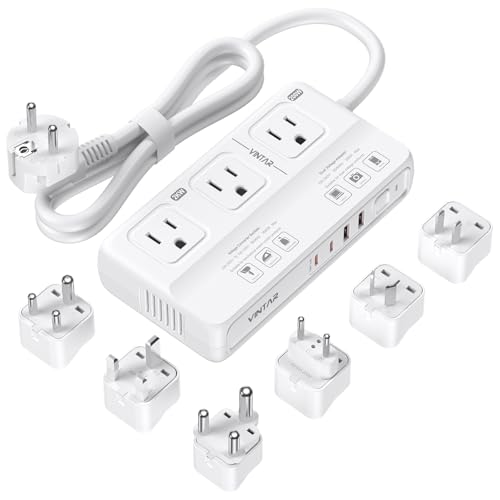
VINTAR offers a 7-in-1 setup with a 2000W peak converter and a 200W dual-mode adapter, including six international plugs (A, C, D, G, I, M). This arrangement supports high-demand devices like irons or kettles on the 2000W side while keeping laptops and small electronics on the 200W side. Best for travelers needing a single device that powers multiple devices across many regions. Limitation: The 2000W outlet is not suitable for devices with cooperative motor loads or high surge currents; verify device wattage before use.
Buying Guide: Key Considerations For 220V To 110V Converters
- Power rating: Match the converter’s wattage to the device’s startup and running wattage. If in doubt, choose a higher rating to avoid overloading.
- Pure sine wave vs modified sine wave: Sensitive electronics perform better on a pure sine wave. If your device is a simple heater or motor, a modified sine wave may suffice, but check device requirements.
- Plugs and adapters: Ensure the unit includes the plug types you’ll encounter in Europe, the UK, and other regions you visit. Look for USB-C PD support for fast charging.
- Safety: Look for overload protection, over-temperature protection, short-circuit protection, and CE/UL certifications where available.
- Usage limitations: Many compact converters are not suitable for hair dryers, kettles, or other high-power appliances. Always confirm device wattage and peak draw.
FAQ
- What wattage should I look for if I want to run a hair dryer? A: Hair dryers typically exceed 1000W; choose a converter rated well above the dryer’s wattage, or avoid using a travel converter for high-powered appliances.
- Is pure sine wave necessary for all devices? A: Not always; most modern electronics work with modified sine wave, but sensitive devices like CPAP machines or certain printers may require pure sine wave.
- Can I use a universal travel adapter to charge my phone? A: Yes, most USB ports will charge phones and small devices; check the USB-C PD wattage for fastest charging.
- Are there safety concerns when using a converter abroad? A: Use the unit within its rated limits, keep away from moisture, and unplug when not in use to avoid overheating.
- Should I buy a converter or a transformer? A: A converter is typically suitable for most consumer electronics, while a transformer is better for devices with high startup surges or specific motor loads. Always verify device requirements.
- Do these devices work in the US with 110V outlets? A: Some devices can function in both regions if the converter supports dual voltage; verify the device’s label and the converter’s capabilities.