Best 208 to 400V 3-Phase Transformer Solutions for Industrial Power
Answering the need for reliable 208V to 400V three-phase transformations, these options cover autotransformers and isolation transformers suitable for various industrial setups. Best for machine shops, CNCs, HVAC systems, and automation lines where stable 3-phase voltage is essential. This guide highlights which model fits different environments, from compact step-up/down units to larger commercial transformers.
| Product | Brand | Primary/Secondary | Capacity |
|---|---|---|---|
| 30 kVA 208V to 400V, 3-Phase Step Up Transformer | XING LASER | 208V → 400V, 3-Phase | 30 kVA |
| 1 pcs New 10 kVA Isolation Transformer, 3 Phase, 400V to 208V | IYFDDKI | 400V → 208V, 3-Phase | 10 kVA |
| 30 kVA 208V to 380V, 3-Phase Step Up Transformer | XING LASER | 208V → 380V, 3-Phase | 30 kVA |
| GoHz 4 kVA 3 Phase Isolation Transformer (400V to 208V) | GoHz | 400V → 208V, 3-Phase | 4 kVA |
| GoHz 8 kVA 3 Phase Isolation Transformer (400V to 208V) | GoHz | 400V → 208V, 3-Phase | 8 kVA |
30 kVA 208V to 400V Step Up Transformer

Product: 30 kVA autotransformer converting 208V to 400V in a 3-phase setup. Best for heavy equipment that requires a higher line voltage on a 3-phase system. The unit supports maximum resistive load to 24 kVA and maximum inductive load to 18 kVA, with recommended operating limits of 80% and 60% respectively to maintain stability. Choose this if your application demands a robust inline voltage increase for multiple motors or CNC drives.
Best for: Industrial facilities needing a reliable, higher-voltage supply for 3-phase motors and equipment designed for 400V. Better for environments with consistent load profiles.
Caution: Respect 80/60% loading guidelines to avoid overheating or voltage drift during peak loads.
10 kVA Isolation Transformer, 400V to 208V
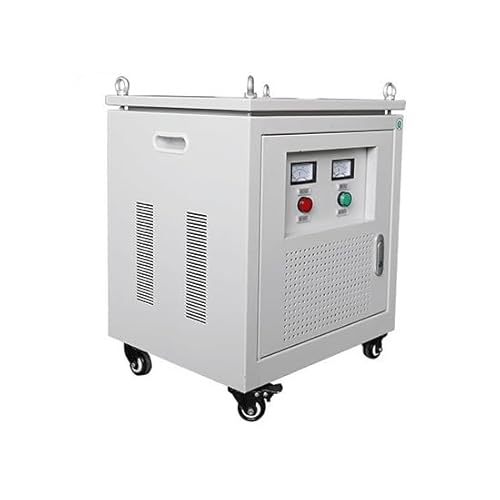
A 10 kVA isolation transformer designed for clean, isolated 208V output from a 400V three-phase input. This unit is sealed and factory-new with a one-year warranty, suitable for industrial automation applications where electrical noise isolation and phase stability are critical. Best for sensitive equipment in control cabinets or benchmarking setups where galvanic isolation improves performance and safety.
Best for: Shops or labs needing electrical isolation for precision equipment and reducing mains interference. Better for small-to-midsize automation panels.
Caution: Isolation transformers are not intended to increase voltage; use only as specified to avoid overloading secondary circuits.
30 kVA 208V to 380V Step Up Transformer
This unit matches 208V input to 380V output in a 3-phase arrangement. It shares the same capacity and load guidelines as the 30 kVA 400V variant, emphasizing safe operation at 80% resistive and 60% inductive loads. It’s well-suited for facilities that run equipment calibrated for a 380V third-phase anchor, offering solid performance in production lines or machine rooms.
Best for: Facilities needing a specific 380V 3-phase supply from 208V sources, with similar protection and efficiency expectations as other autotransformers.
Caution: Verify downstream equipment compatibility with 380V prior to installation to prevent phase mismatch issues.
GoHz 4 kVA 3 Phase Isolation Transformer (400V to 208V)

4 kVA 3-phase isolation transformer with copper windings. Suitable for smaller CNC machines, control panels, or lab setups that require clean, stable 208V outputs from higher-voltage 400V three-phase supplies. Best for compact installations where noise suppression and galvanic isolation improve equipment longevity and performance.
Best for: Small workshops needing isolation rather than voltage boosting. Better for precision equipment that benefits from clean power and reduced interference.
Caution: Capacity is limited to 4 kVA; avoid overloading by adding higher-power devices or parallel units without proper engineering review.
GoHz 4 kVA 3 Phase Isolation Transformer (480V to 208V)
4 kVA isolation transformer configured for 480V input to 208V output, 3-phase with copper windings. This model emphasizes stable stepped-down voltage with isolation, suitable for equipment that relies on delicate control electronics or sensors operating at 208V. It complements applications where a 480V supply exists but equipment requires 208V clean power.
Best for: Applications where 480V mains must be stepped down to 208V with galvanic isolation for sensitive automation components.
Caution: Ensure downstream devices are compatible with 208V output to avoid under-voltage or performance issues.
GoHz 20 kVA 3 Phase Isolation Transformer (400V to 208V)
20 kVA 3-phase isolation transformer designed for robust, stable 208V output from a 400V three-phase input. Ideal for larger automated lines, CNC suites, HVAC installations, and industrial machinery that demands consistent power isolation and phase stability. The dry-type copper-wound configuration supports efficient operation in demanding environments.
Best for: Large workshops or manufacturing lines needing a higher-power isolation solution to protect sensitive equipment and ensure consistent voltage delivery.
Caution: High-capacity units require proper enclosure, ventilation, and safety measures to manage heat and electrical clearance.
Buying Guide: Key Considerations for 208V to 400V 3-Phase Transformers
- Autotransformer vs. Isolation Transformer: Autotransformers boost or reduce voltage within the same winding, conserving weight and cost for straightforward voltage changes. Isolation transformers provide galvanic isolation, reducing electrical noise and improving safety for sensitive equipment.
- Voltage Range and Phase: Confirm the primary and secondary voltages match your supply and load. Ensure a true 3-phase configuration if your motors or equipment require balanced 3-phase power.
- Capacity and Load Type: Distinguish between resistive and inductive loads. Adhere to recommended loading percentages (often around 80% for resistive and 60% for inductive) to prevent overheating and voltage drop during peak demand.
- Winding Material and Efficiency: Copper windings and high-efficiency cores (e.g., silicon steel) reduce losses and heat, improving performance in continuous-duty scenarios.
- Physical Footprint and Ventilation: Larger kVA units demand adequate space and airflow. Plan for enclosure space, clearance, and mounting options in the installation area.
- Protection and Compliance: Check for certifications, enclosure IP ratings, and appropriate protection features (fusing, overload protection) to align with facility safety standards.
- Installation Considerations: Ensure proper wiring, phasing, and grounding per local electrical codes. Hire a qualified electrician for installation and commissioning.
Frequently Asked Questions
- What is the difference between an autotransformer and an isolation transformer?
– An autotransformer changes voltage within a single winding and is generally lighter and cheaper, while an isolation transformer provides galvanic isolation to reduce electrical noise and improve safety for sensitive gear. - Can I run 208V equipment directly from a 400V supply?
– Only with a transformer designed to step down from 400V to 208V. Do not connect 208V equipment to 400V without proper voltage conversion. - What should I consider when choosing capacity?
– Match the transformer capacity to the continuous load expected on the system. Avoid exceeding 80% of resistive and 60% of inductive ratings for sustained operation. - Is isolation always necessary for industrial equipment?
– Isolation is beneficial for reducing electrical noise, protecting equipment, and improving safety for sensitive control systems; however, it may add cost and size. - How do I know if a transformer is suitable for CNC machines?
– Look for stable 3-phase output, appropriate kVA rating for the machine’s power draw, and low-noise operation to minimize interference with precision controls. - Do I need professional installation?
– Yes. A licensed electrician should assess, install, and validate the transformer to ensure compliance with codes and safe operation.