Best 208 to 240V Step Up Transformers for Safe, Reliable Voltage Conversion
Looking to convert 208V electrical systems to 240V for compatible equipment or machines? This guide presents top 208V to 240V step-up transformers suited for commercial, industrial, and home-use scenarios. Each option is evaluated for best uses, practicality, and potential limitations. The selections focus on units designed to handle common load ranges while maintaining safety and reliability for professional environments. Read on to find the right fit for your equipment and operating conditions, whether you’re powering industrial controls, HVAC components, or multi-outlet guest accommodations.
| Product | Primary Voltage | Secondary Voltage | Best For |
|---|---|---|---|
| Larson Electronics 1-Phase Buck/Boost Step-Up Transformer | 208V | 240V | Small to mid-range loads in 208V systems |
| Larson Electronics 1 Phase Buck and Boost Transformer (High Amp) | 208V | 240V | Higher current loads and customizable options |
| Larson Electronics 1-Phase Buck/Boost Step-Up (230V Secondary) | 208V | 230V | Compact setups needing 230V following 208V input |
| CELYYPU 6000 Watt Voltage Transformer | 110–120V or 220–240V | 220–240V or 110–120V | Heavy-duty, universal voltage conversion |
| SYFLYH 240V to 24V Transformer for HVAC | 208–240V | 24V | HVAC control and furnace applications |
1-Phase Buck/Boost Step-Up Transformer — 208V to 240V

Best for small to medium electrical loads in 208V systems needing a reliable 240V output. This unit handles up to 23.4A, making it suitable for compact industrial controls or equipment that requires a 240V supply. It’s a straightforward, 1-phase solution designed to maintain voltage stability for steady operation.
Who it’s best for: facilities with limited space and moderate load demands where 208V equipment requires a 240V boost. Why chosen: proven performance for common 208V to 240V transitions with simple operation. Limitation: safety disclosures indicate transformers must be handled and installed per code; returns are not accepted for transformers.
1 Phase Buck and Boost Transformer — 208V to 240V (High Amp Options)
Designed for higher current needs, this model offers multiple amp configurations (30, 31.2, 46.8, 62.5, 93.7 or 456 Amps). It’s ideal for slightly larger loads or installations requiring flexibility in current capacity. The product page notes custom options and emphasizes safe handling; returns on transformers are restricted by safety policy.
Who it’s best for: operations requiring scalable current range without swapping devices. Why chosen: versatile amp selections help tailor the boost to specific equipment. Limitation: consult a professional for correct sizing to avoid overloading or undersizing components.
1-Phase Buck/Boost Step-Up Transformer — 208V to 230V
This unit steps 208V AC to 230V AC, offering several amp options (18.6, 20.8, 31.25, or 41.67 Amps). It provides a compact solution for equipment that specifically requires a 230V output from an 208V input. Safety notes reiterate non-return eligibility for transformers.
Who it’s best for: applications needing 230V output with modest current draw. Why chosen: compact form factor and multiple amperage options. Limitation: ensure your load remains within the selected amp rating to prevent overheating.
CELYYPU 6000W Voltage Conversion Transformer
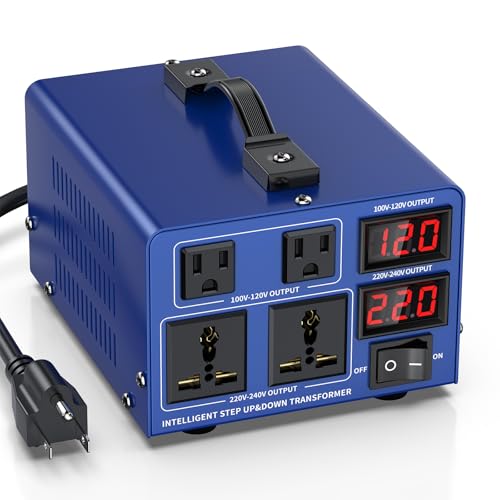
This heavy-duty transformer handles 6000W, boosting 110–120V to 220–240V and stepping down 220–240V to 110–120V. It features a 90% efficiency and LCD display for voltage readouts. Three American sockets and three universal sockets offer versatile plug compatibility, along with a hard-wired cord and fault-code display for troubleshooting.
Who it’s best for: users needing robust, bidirectional voltage conversion with clear monitoring. Why chosen: high wattage capacity suits power-hungry devices or lab setups. Caution: the unit’s complexity and multiple sockets can complicate connection layouts; follow provided troubleshooting steps for faults.
1 Phase Buck and Boost Step-Down Transformer — 240V to 208V
This unit is designed to step down 240V primary to 208V secondary, offering adjustable current options (26.6, 35.4, or 60 Amps). It’s a practical choice for equipment designed for 208V but wired for 240V mains. Safety guidelines mirror the general transformer policy of non-return after leaving factory.
Who it’s best for: setups needing a 240V to 208V conversion for existing 240V circuits. Why chosen: direct 240V to 208V step-down feature. Limitation: verify load compatibility with the chosen amp rating to prevent insufficient voltage under heavy load.
TR50VA008 Transformer (Industrial) — 480/277/240/208V to 120V

This industrial transformer offers four input voltages (480V, 277V, 240V, 208V) with a 120 VAC output and integrated dual-threaded hub mount. A primary thermal-magnetic circuit breaker provides overload protection. It’s suitable for HVAC controls, thermostats, relays, and other control devices in industrial environments.
Who it’s best for: industrial facilities requiring a flexible input range and reliable 120V control power. Why chosen: strong protection features and four input voltages simplify compatibility. Limitation: installation and wiring should follow stringent electrical codes; consult a professional for proper mounting and wiring.
240V to 24V HVAC Control Transformer

This transformer is designed to convert 240V primary to 24V secondary for Goodman Amana furnaces and other HVAC control components. It’s suitable for parts replacement in residential or light commercial HVAC settings where standard 24V control circuits are required.
Who it’s best for: HVAC technicians and homeowners replacing furnace controls. Why chosen: reliable 24V output for control circuits. Limitation: designed for specific HVAC models; verify compatibility with your system’s control board and wiring.
Buying Guide: Key Considerations for 208V to 240V Transformers
- Load requirements: Match transformer wattage and current rating to the expected load. Undersizing can cause voltage drop or overheating; oversized units may be unnecessary and costlier.
- Voltage compatibility: Confirm primary input and secondary output voltages align with your equipment and mains supply. Some units offer multiple input options or 230V output variants; verify in advance.
- Phase and frequency: Ensure the transformer supports your system’s phase (single-phase vs. three-phase) and frequency (50/60 Hz). Mismatches can damage equipment or reduce performance.
- Safety and maintenance: Note any explicit safety advisories, including non-return policies, protective features (circuit breakers, fuses), and clear installation instructions. Plan for professional installation when required by local codes.
- Physical design and mounting: Consider enclosure, mounting options, and space constraints. Industrial models may include mounting brackets or foot/rail mounts for secure installation.
- Monitoring and troubleshooting: LCD displays and fault codes can simplify maintenance. Ensure you have access to documentation or vendor support if issues arise.
Frequently Asked Questions
- What does 208V to 240V transformer do? -> It increases (boosts) voltage from 208V to 240V to power equipment designed for 240V when connected to a 208V supply, or for applications requiring slightly higher voltage.
- Can I use any transformer for home appliances? -> Only if the device’s voltage and amperage requirements match the transformer’s specifications. Always verify input/output voltages, wattage, and safety guidelines.
- Are there safety restrictions on returns? -> Yes. Some transformer products restrict returns after leaving the factory due to safety and reliability considerations. Check the seller’s policy before purchasing.
- Do these units require professional installation? -> In many cases, yes. Electrical codes, wiring practices, and safety standards often require licensed installation for step-up/step-down transformers, especially in industrial or HVAC contexts.
- What should I consider for load balancing? -> Ensure the transformer’s amp rating aligns with the continuous load and peak demand. Unbalanced loads can cause overheating and voltage irregularities.
- Can a transformer be used for both stepping up and stepping down? -> Some models are bidirectional; confirm the unit’s ability to both step up and step down and use only as rated.