Best 200V DC Power Supply Options for DIY, Testing, and Lab Use
When you need a reliable 200V DC power supply, look for models that offer precise voltage control, current protection, and practical features like memory presets and clear displays. This guide highlights five solid choices ideal for electronics work, battery charging, LED testing, and lab experiments. Each product is evaluated for who it’s best for, with clear pros, limitations, and usage notes to help you compare quickly.
Buyer types to consider:
– Hobbyists and students needing affordable, user-friendly units.
– Professionals requiring higher current capacity and sturdy protection features.
– Lab environments requiring multiple preset memories and reliable CC/CV behavior.
– Builders who value digital controls, encoder knobs, and clear displays for precise tuning.
Summary table of chosen products:
| Product | Max Voltage | Max Current | Notable Features | Ideal For |
|---|---|---|---|---|
| NICE-POWER DC Power Supply Variable, 200V 1A | 200 V | 1 A | Encoder knob, memory storage, RS232/USB control, lock button | Budget lab use, classroom electronics projects |
| NICE-POWER Variable DC Power Supply – 200V 5A | 200 V | 5 A | High-precision encoder, CC/CV auto-switch, built-in cooling | More demanding bench work, power-hungry devices |
| Anvpkun Variable DC Power Supply 0–200V | 0–200 V | 0–1 A | 4-digit color LCD, USB output, encoder knob | Electronics testing with real-time readouts |
| MATRIX Programmable DC Power Supply 150V 5A | 0–150 V | 0–5 A | 1 mV / 0.1 mA resolution, 9 storage groups | Electronics repair and development in a lab |
| NICE-POWER DC Power Supply Variable, 0-400V 1A | 0–400 V | 1 A | Memory storage, encoder knob, output switch, color display | High-voltage projects, safe adjustments with memory presets |
NICE-POWER DC Power Supply Variable, 200V 1A

This model provides a compact, programmable DC output up to 200V and 1A. It includes RS232/USB control for PC-based operation, an encoder adjustment knob for precise tuning, and a memory storage feature to recall common settings. The lock button protects against accidental changes. Best for: hobbyists or educators needing straightforward computer control and reliable memory presets. Limitation: Windows-only software compatibility for full computer control may limit cross-platform use.
NICE-POWER Variable DC Power Supply – 200V 5A
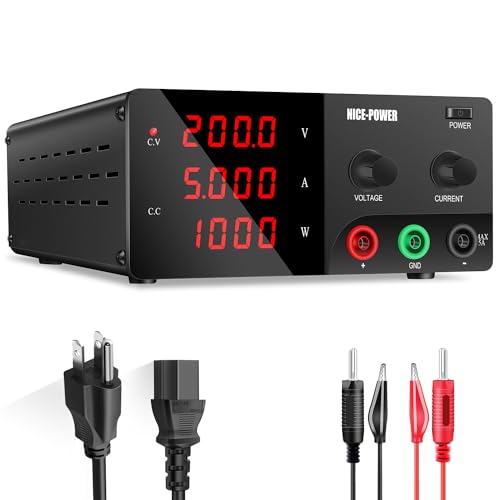
This higher-current unit expands to 200V at up to 5A. It features a high-precision encoder knob, a backlit four-digit display, and automatic CC/CV switching. A built-in cooling fan helps maintain performance during long sessions. Best for: power-hungry prototypes, LED drivers, and lab use where tighter voltage/current control is required. Caution: ensure the load does not exceed current limits to avoid automatic protection triggering during testing.
Anvpkun Variable DC Power Supply 0–200V

Featuring a 0–200V range with 0–1A output, this unit emphasizes a high-definition color LCD, a user-friendly encoder knob, and a USB port for charging or auxiliary power. It’s a solid pick for electronics repair, circuit testing, and projects that benefit from real-time voltage/current monitoring. Best for: detailed bench work where clear readouts are essential. Limitation: current ceiling is 1 A, which may be insufficient for some power-hungry devices.
MATRIX Programmable DC Power Supply 150V 5A

This MATRIX model delivers 0–150V at up to 5A with high-precision 1 mV / 0.1 mA resolution. It offers nine storage presets for quick recall and a dedicated keyboard lock function to prevent accidental changes. Best for: labs and repair shops needing precise control and repeatable test conditions. Caution: maximum voltage is 150V, which is below 200V, so plan for use cases within that range or combine with higher-voltage testing stages when safe.
NICE-POWER DC Power Supply Variable, 0-400V 1A

This high-voltage model extends output up to 400V at 1A with four memory presets and an encoder knob for precise adjustments. The color display enhances readability, and the output switch adds safety during setup. Best for: high-voltage experiments, calibration tasks, and projects where a wide adjustable range is required. Limitation: higher voltage requires careful load selection to prevent overvoltage events.
Buying Guide
What should you check before buying a 200V DC power supply?
Key specs to compare include maximum voltage, maximum current, regulation accuracy, and the type of control interface (encoder knob vs. pot, digital control via USB/RS232). Look for CC/CV mode stability, protection features (over-voltage, over-current, short-circuit), and whether memory presets are included for quick recall of common values.
What makes an encoder knob preferable?
An encoder knob allows precise, repeatable voltage and current adjustments. It’s especially useful for fine-tuning sensitive loads or when you need to dial in a specific value repeatedly. Some models offer multi-digits and push-to-select functions for switching between voltage and current.
Is higher voltage always better?
Higher voltage expands the range of devices you can test, but it requires careful handling of load limitations and insulation. For educational and hobby use, a 0–200V unit is often sufficient. For more demanding applications, a 0–400V model provides greater flexibility while preserving safety features like output switches and lock functions.
What about memory presets?
Memory presets save time by recalling commonly used voltage/current pairs with a single button press. Four to nine presets are common. They are valuable in repetitive testing workflows and when you frequently switch between different load configurations.
What safety features matter?
Essential protections include automatic current limiting, over-voltage protection, short-circuit protection, and thermal management (cooling fans). An output lock helps prevent accidental re-adjustment. Ensure the model you choose has clear display visibility and reliable protection against transients.
Who should consider each model?
- NICE-POWER 200V 1A: Best for beginners or classrooms needing PC control and basic memory presets.
- NICE-POWER 200V 5A: Best for more demanding bench work and devices that require greater current headroom.
- Anvpkun 0–200V: Best for electronics testing with clear readouts and USB power needs.
- MATRIX 150V 5A: Best for labs needing high resolution and multiple stored presets within a 150V range.
- NICE-POWER 0–400V 1A: Best for high-voltage experiments with memory presets and safe operation.
How should you compare overall value?
Balance price against features such as current capability, display readability, memory presets, and protection features. If you frequently run long tests, models with automatic over-temperature protection and cooling fans offer better reliability. If you often work at a bench with limited space, a compact unit with a clear display can improve workflow efficiency.
Quick FAQ
What is CC/CV mode and why is it important?
Constant current and constant voltage mode ensures a load receives a safe, controlled amount of power. The supply switches between CC and CV automatically to protect the device under test.
Can these supplies be controlled from a computer?
Many models include RS232/USB interfaces. Some software is Windows-only. Check compatibility with your system before purchase.
Are memory presets useful for testing?
Yes. They speed up repeatable tests by recalling commonly used voltage/current settings with a single action.
What safety features should I look for?
Over-voltage protection, over-current protection, short-circuit protection, thermal protection, and an output lock are important for preventing damage and accidental changes.
Is a higher voltage always better for testing?
Not necessarily. It expands your range, but ensure your loads and insulation are rated for the higher voltage and that you stay within safe operating limits.
Do these units come with a warranty?
Warranty details vary by model and seller. Check the product page for exact terms and coverage.