Best 200Ah Deep Cycle Battery for RVs and Off-Grid Power
Power reliability matters for off-grid living, RV trips, and solar backup. This guide focuses on 200Ah deep cycle batteries from reputable brands, highlighting AGM and LiFePO4 options. Each selection balances capacity, safety, cycle life, and maintenance needs to help you choose the right solution for your energy system. Below you’ll find five top picks with key features and practical considerations for installation and use.
| Product | Chemistry | Capacity | Best For | Notes |
|---|---|---|---|---|
| Renogy Deep Cycle AGM 200Ah | AGM | 200Ah | Maintenance-free, safe for various uses | Low self-discharge; strong discharge performance |
| yeagulch 12V 200Ah LiFePO4 | LiFePO4 | 200Ah | Lightweight, high energy density | Built-in 200A BMS, long cycle life |
| Rvpozwer 12V 200Ah LiFePO4 | LiFePO4 | 200Ah | Expandable and versatile | 15000 cycles, robust protection |
| Redodo 12.8V 200Ah LiFePO4 | LiFePO4 | 200Ah | High energy density, dependable BMS | 100A BMS, scalable for larger packs |
| RVLithTime 12V 200Ah LiFePO4 | LiFePO4 | 200Ah | High energy density, long life | 40+ protective features, IP65 option |
Note: The selections emphasize long cycle life, safe operation, and practical weights for 12V systems used in RVs, boats, cabins, and solar setups. When evaluating options, consider compatibility with your charging source, space constraints, and temperature conditions.
Renogy Deep Cycle AGM Battery 12 Volt 200Ah

The Renogy Deep Cycle AGM Battery provides 200Ah of maintenance-free energy with an 3% self-discharge rate and high discharge capability. Its AGM design uses thick glass mat separators and valve-regulated technology to prevent acid leaks and reduce maintenance. The battery supports safe charging for a range of appliances in RV, camping, cabin, marine, and off-grid systems. Its low internal resistance enables higher discharge currents, contributing to reliable performance in demanding conditions. A substantial shelf life helps store power for longer periods without significant loss.
yeagulch 12V 200Ah LiFePO4 Lithium Battery

This 12V 200Ah LiFePO4 battery from yeagulch combines a built-in 200A BMS with a compact, lightweight design. Its protection features guard against overcharging, overdischarging, overcurrent, overheating, and short circuits, while automatic high/low temperature cut-offs support safe charging and discharging. The battery is small enough to fit into tight spaces yet offers strong energy density, enabling longer operation in RVs, solar storage, and off-grid applications. With a long lifespan, it supports thousands of cycles with consistent performance.
Rvpozwer 12V 200Ah LiFePO4 Battery
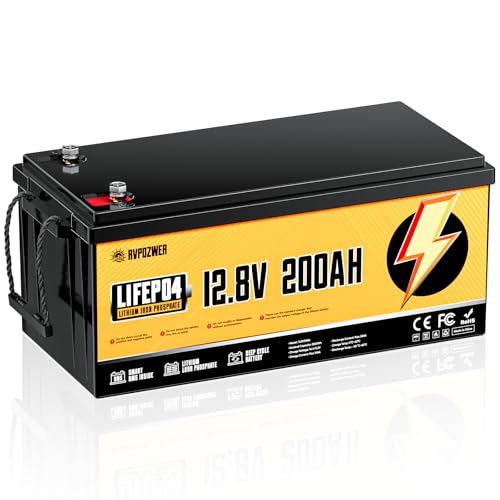
Rvpozwer’s 200Ah LiFePO4 battery emphasizes lifespan and protection. With 15000 deep cycles, a built-in 200A BMS guards against overcharge, over-discharge, overcurrent, and short circuits, ensuring stable power. The battery is designed for use in RVs, trolling motors, boats, solar systems, and off-grid setups. It supports expansion and pairing for higher voltage or capacity, making it adaptable for larger energy storage configurations. Its robust protection makes it a reliable choice for demanding environments.
Redodo 12.8V 200Ah LiFePO4 Battery

Redodo’s 200Ah LiFePO4 battery emphasizes higher energy density and protective circuitry. It features a 100A BMS to manage charge and discharge, with a max energy storage of 2560Wh. The design supports series or parallel configurations (up to 4S4P) to scale voltage and capacity, making it suitable for solar home systems, RVs, boats, trolling motors, and off-grid projects. The product is tested for performance, with a focus on durable cycle life and reliable operation in varied environments.
RVLithTime 12V 200Ah LiFePO4 Battery

RVLithTime offers a 200Ah LiFePO4 battery with built-in 200A BMS and a strong emphasis on energy density. Its design claims a high energy density and a 10-year life with 4000+ cycles. The unit provides a robust protection system to guard against overcharge, deep discharge, overheating, and short circuits, and includes FCC and UL certificates. Suitable for RVs, solar storage, marine use, and off-grid applications, it aims to deliver reliable, long-term performance in challenging conditions.
Buying Guide: Key Purchase Considerations
- Chemistry and safety: AGM batteries are maintenance-free and safe, but LiFePO4 offers longer cycle life, lighter weight, and higher energy density. Consider your tolerance for maintenance and the required lifespan.
- Weight and space: LiFePO4 packs typically weigh significantly less than lead-acid alternatives for the same capacity, which matters for RVs and boats with weight constraints.
- Cycle life and DoD: Look for deep cycle ratings and DoD guidance. LiFePO4 often delivers thousands of cycles at various depths, translating to longer-term value.
- Battery Management System (BMS): A robust BMS protects against overcharge, over-discharge, overcurrent, and temperature extremes. Verify BMS specs align with your charging source and climate conditions.
- Expansion options: If you anticipate scaling up voltage or capacity, choose batteries that support series and parallel configurations without complications.
- Temperature performance: Some batteries perform poorly in extreme cold or heat. Check operating temperature ranges and any thermal protections.
- Certifications and warranty: Look for FCC/UL or other relevant certifications and a clear warranty policy to ensure reliability and support.
- Compatibility with chargers: Ensure your solar charge controller, inverter, and battery charger are compatible with the chosen chemistry and voltage.
- Maintenance and disposal: AGM requires minimal maintenance; LiFePO4 requires proper handling at end of life but generally less frequent maintenance than lead-acid.
When comparing options, balance upfront cost with long-term durability, weight, and compatibility with your overall energy system. For portable or space-constrained setups, LiFePO4 often provides superior performance in a smaller footprint. For simpler, maintenance-free needs, AGM can be a dependable choice, though it may require more frequent replacement over time.