Best 20 Circuit Transfer Switch Options for Home Backup Power
Looking for a reliable way to manage backup power across multiple circuits during outages? This guide highlights five transfer switches that best support 20 circuits or more when paired with appropriate wiring configurations. The selections are suited for homeowners pursuing manual or semi-automatic switching, with clear guidance on ideal use cases, safety notes, and practical trade-offs. Read on to compare capability, installation style, and who each product is best for, so you can choose confidently.
Quick product overview
| Product | Best For | Key Benefit |
|---|---|---|
| Nature’s Generator Manual Transfer Switch 12-Circuits (50A) | Homes with mixed grid stored energy setups | Configurable for 12 circuits; supports stored energy integration |
| Nature’s Generator Manual Transfer Switch 12-Circuits (30A) | Medium-load backup needs | Lower amp capacity with clear manual control |
| DSGSANO 10-Circuit 50A Pro/Tran2 | Whole-house backup or RV/off-grid | Up to 10 circuits; robust 50A rating |
| Connecticut Electric EmerGen 30A 6-Circuit | Compact, indoor/outdoor use | Durable enclosure and backfeeding protection |
| EIIDAR ATS AC120V 20A Auto Transfer Switch | Auto-switching for continuous operation | Rapid switching (<30 ms) and IP65 rated |
Nature’s Generator Manual Transfer Switch 12-Circuits 120/240V 50A

Best for homes that combine traditional grid power with stored energy storage. This 50A manual transfer switch supports up to 12 circuits, configurable as twelve 120V circuits or six 240V circuits, and is compatible with AFCI/GFCI breakers. It enables selective circuit control while preventing backfeeding. Choose this if you plan to run a portion of your circuits on stored energy from a system like MyGrid 10K.
Who it’s best for: homeowners with hybrid grid/storage setups who want manual control over specific circuits and a robust 50A capacity. Limitation: non-automatic operation means you must manually switch power, which may require careful timing during outages.
Nature’s Generator Manual Transfer Switch 12-Circuits 120/240V 30A
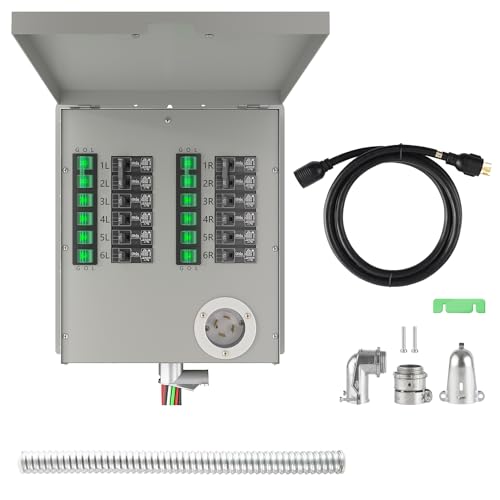
Best for moderate-load backup when you don’t need full 50A capacity. This 12-circuit, 30A variant supports manual switching, with the same emphasis on preventing backfeeding. It’s a solid fit for households seeking reliable transfer control without the higher amperage of the 50A model. Caution: ensure your connected circuits do not collectively exceed 30A to avoid overload.
DSGSANO Generator Transfer Switch, 10-Circuit 50A Pro/Tran2

Best for whole-house backup or RV/off-grid applications where up to 10 circuits are needed. The DSGSANO model supports a 50A capacity and provides marked labeling for easier wiring. It’s a practical bridge between larger, more complex systems and compact setups. Caution: installation requires basic electrical knowledge; miswiring can compromise protection and performance.
Connecticut Electric EmerGen Backup Power Manual Transfer Switch Kit

Best for compact, durable, indoor/outdoor use with dependable backfeeding protection. This 30A, 6-circuit kit emphasizes safe, manual power transfer and a rugged steel enclosure. Choose this if you have a smaller house or a dedicated set of critical circuits and prefer a powder-coated steel build for longevity. Limitation: supports fewer circuits (6), so it’s not ideal for broad circuit coverage.
EIIDAR ATS AC120V 20 Amp Auto Transfer Switch

Best for automatic switching to keep critical loads powered with minimal intervention. This 20A ATS supports fast switching under 30 ms, operates with reliable relays, and carries IP65 protection for indoor or outdoor use. It’s ideal when you want seamless transition between utility and generator power. Caution: 20A capacity limits the number of circuits that can be actively powered simultaneously; plan loads accordingly.
Buying Guide: Key considerations for a 20-circuit transfer switch setup
- Transfer type: Manual vs automatic. Manual models require user action during outages; auto models switch automatically, keeping essential circuits powered with less manual effort.
- Amperage capacity: Match total circuit load. Higher amperage (50A) supports more circuits but may require larger service upgrades and wire sizing.
- Number of circuits: Ensure the unit can handle the critical circuits you want to cover. Some products support up to 12 circuits; others up to 10 or 6.
- Compatibility with storage: Some TRANSFER switches work with hybrid/grid storage setups; verify compatibility with your energy storage system if applicable.
- Backfeeding protection: Essential safety feature to prevent power from flowing back into utility lines during outages.
- Installation complexity: Some units require basic electrical knowledge; others may require professional installation depending on local codes.
- Indoor vs outdoor use: Consider enclosure durability and weather exposure; IP-rated models offer better protection outdoors.
- Support and labeling: Clearly labeled circuits and robust enclosures improve safety and ease of use during emergencies.
Frequently asked questions
- What is a transfer switch and why do I need one?
A transfer switch safely connects a generator or backup power source to your home’s electrical system and prevents backfeeding into utility lines, protecting both your system and utility workers.
- Manual vs automatic: which should I choose?
Manual switches require your action during an outage, while automatic switches switch instantly without intervention. Choose based on how quickly you need power restored and whether you want hands-off operation.
- How many circuits should my transfer switch support?
Plan for your essential circuits first (refrigeration, heating, lights, outlets) and then consider additional circuits as needed. Ensure the total expected load stays within the switch’s amperage rating.
- Can I install a transfer switch myself?
Some models are designed for safe DIY installation with clear labeling. Complex setups or higher amperage systems may require a licensed electrician to meet code requirements.
- Is backfeeding protection included?
Most certified transfer switches include backfeeding protection. Always verify this feature to ensure safe operation during transitions between power sources.
- What maintenance is required?
Regularly inspect wiring connections, test the switch with a safe load, and ensure batteries or energy storage systems are functioning as intended to maintain readiness.