Best 20 Amp Fan Speed Controller for Duct Fans, Routers and More
The best 20 amp fan speed controllers provide precise, adjustable control for brushed AC motors, with built‑in protection and clear readouts. This article highlights five reliable options, explains who each is best for, and offers practical buying guidance to help you choose the right unit for inline duct fans, exhaust fans, routers, drills, and related equipment. Suitable buyers include hobbyists in grow rooms, workshop tinkerers, and professionals needing controllable airflow or motor speed management.
Overview: Top picks at a glance
- CDMALL AC Motor Speed Controller (120V, 15A) — Real-time LED voltage display, overload protection; best for inline duct fans and small workshops.
- EPLZON DC 12-60V PWM Controller (20A) — Suitable for DC brushed motors, compact install; best where DC motors are used.
- matell DC 12-60V 20A PWM Controller — Forward/Reverse control; best for projects needing bidirectional motor operation.
- CDMALL AC Motor Speed Controller (6 ft cord, 120V, 15A) — Extra-long cord and 3‑position switch with speed dial; best for reach and simple control.
- IGEYAPA AC Motor Speed Controller (100V-120V, 15A) — LED display, overload/overvoltage protection; robust for resistive and some mixed loads.
CDMALL AC Motor Speed Controller With LED Display
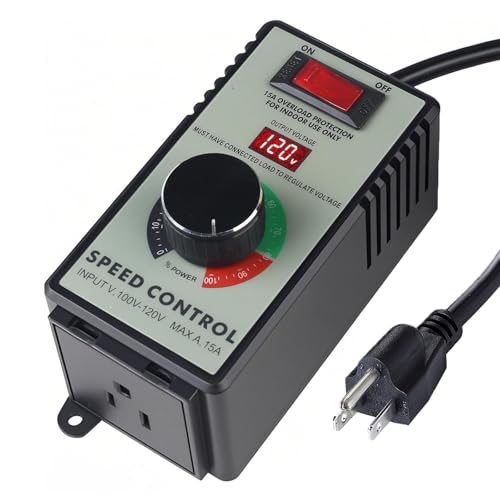
This controller is designed for brushed AC motors and uses voltage reduction for speed control. It features a real-time LED voltage display from 0–120V, helping you dial in precise speeds or brightness. A built-in 15A circuit breaker provides overload protection and can be reset instead of replacing fuses. Best for inline duct fans, exhaust fans, routers, and other AC devices in workshops or grow spaces. Caution: not compatible with brushless or DC motors or devices with circuit boards.
Who it’s best for: hobbyists and small workshops needing clear speed feedback and reliable overload protection for standard brushed motors. Why selected: robust protection, precise voltage readout, and straightforward resettable protection improve usability and safety.
Caution or limitation: suitable only for brushed AC motors; avoid use with DC motors or electronics-heavy appliances.
EPLZON PWM Controller For DC Brushed Motors

This unit is a DC motor speed controller with a 12–60V input and 20A maximum, offering forward/reverse rotation control and a soft start function to reduce inrush current. It’s compact and easy to install in tight spaces, with a 0–100% PWM range for fine speed control. Best for DC brushed motors used in small machines or robotics projects. Caution: only suitable for DC motors; not compatible with AC devices.
Who it’s best for: builders working with DC brushed motors needing bidirectional control and smooth starts. Why selected: strong PWM range, reverse capability, and space-saving form factor.
Caution or limitation: not suitable for AC motors or devices with built-in electronics.
matell DC 12-60V 20A PWM Controller

Matell’s controller provides forward and reverse operation for DC motors with a 12–60V input, suitable for a variety of compact motor projects. It’s designed to deliver bidirectional speed control, making it useful for applications where direction change matters. Best for DC brushed motors in DIY builds and small equipment. Caution: data notes emphasize DC compatibility; verify motor type before purchase.
Who it’s best for: makers who need simple forward/reverse control in DC-powered devices. Why selected: dedicated reverse feature, compact footprint, and 20A capacity align with many hobby projects.
Caution or limitation: primarily marketed for DC motors; ensure you’re not using with AC or motor types requiring different control schemes.
CDMALL 120V 15A AC Speed Controller With 6 Ft Cord

This model features a 3-position switch plus a stepless speed dial, offering Variable, Off, and Full Speed modes. The 6-foot grounded power cord adds reach for hard-to-access installations in attics, crawl spaces, grow tents, or workshops. It’s well-suited for inline duct fans, exhaust fans, and other AC devices where long cord routing is advantageous. Best for: installations requiring extended cord length and simple three-mode operation. Caution: ensure the device being controlled is compatible with an AC speed regulator.
Who it’s best for: users needing extra cord length and straightforward dial-based speed control. Why selected: flexible cord length, three-mode operation, and a clear control scheme.
Caution or limitation: not ideal for devices with electronic control boards or non-resistive loads.
IGEYAPA 120V 15A AC Motor Speed Controller

IGEYAPA’s controller includes an LED display showing the output voltage from 0–120V and provides surge and overvoltage protection. It is designed for resistive and certain mixed loads, with a 15A maximum. Best for controlled operation of resistive devices like fans and heaters in 110–120V environments. Caution: overload protection is essential, and high startup currents may trip the breaker on some devices.
Who it’s best for: users who want a robust LED readout and reliable protection for resistive loads in standard 120V circuits. Why selected: strong protection features, clear voltage readout, and a sturdy ABS housing.
Caution or limitation: not suitable for DC motors or devices with electronic control boards; check load type before use.
Buying Guide: Key considerations for choosing a 20 amp fan speed controller
- Load type: Confirm whether your device is a brushed AC motor or a DC motor. Most 20A controllers shown are best for brushed AC motors; DC motor controllers require PWM schemes and may not support AC loads.
- Voltage and current ratings: Ensure the controller’s input voltage matches your supply (usually 110–120V in the US) and that the continuous current rating fits your motor’s running current plus a safety margin.
- Control method: Decide between stepless dial control, preset switches, or bidirectional (forward/reverse) control. Dial control offers fine speed adjustment; forward/reverse is essential for certain robotics or conveyance tasks.
- Protection features: Look for overload protection (circuit breaker with reset), surge protection, and short-circuit protection to safeguard both equipment and users.
- Readout and indicators: LED voltage displays or meters help you set precise speeds and track performance during operation.
- Cord length and installation: A longer cord provides more flexible placement. Consider panel size and whether a mounted or inline setup better suits your workspace.
- Compatibility notes: Some controllers explicitly disallow use with electronics boards, LED drivers, or non-resistive loads. Verify motor type and device compatibility before purchase.
Frequently Asked Questions
- What does a 20A fan speed controller do?
- Can I use a 20A controller with a DC motor?
- Why would I need a resettable overload protection?
- Is a real-time voltage display important?
- What should I consider when choosing between 6 ft cord and shorter cords?
- Are these controllers safe to use around dust and humidity?
It reduces the voltage or controls the duty cycle to regulate the speed of a motor, typically up to 120V AC brushed motors, with protection features to prevent overload.
Some controllers labeled for DC use PWM to adjust speed, but not all 20A AC controllers are suitable for DC motors. Check the device compatibility and motor type before use.
Resettable protection prevents the need to replace fuses after an overload event and allows quick recovery after tripping, reducing downtime.
Yes. It helps you dial in precise speeds, provide repeatable settings, and document the voltage that yields desired performance for future setups.
A longer cord affords easier routing in larger or cluttered spaces, enabling safer and more convenient connections without extensions.
Controllers typically use flame-retardant shells and insulation to improve safety. However, keep devices dry and shielded from excessive dust to maintain longevity and safety.