Best 2 Volt Lead Acid Battery Options for Low-Voltage Power Needs
Looking for a reliable 2-volt lead-acid battery? This guide highlights five practical choices, focusing on compact energy storage, long life, and maintenance considerations. Ideal buyers include backup power enthusiasts, small robotics and telecom projects, and hobbyists needing compact 2V cells. The featured products vary from high-density X-Cell units to larger BC-Cell configurations and a 12V option for broader context. The table below helps compare key specs and intended use at a glance.
| Product | Best For | Key Point |
|---|---|---|
| Enersys Hawker Cyclon X-Cell 2V/5Ah | High power density, compact packs | Excellent cycle life for 100% DOD at C/5 |
| Enersys Hawker Cyclon D-Cell 2V/2.5Ah | Small systems needing lightweight 2V cells | Good balance of size and cycles |
| EnerSys Cyclon 2V 2.5Ah D Cell (0810-0004) | Standard 2V backup power | Solid sealed SLA performance |
| Enersys Hawker Cyclon BC-Cell 2V/25Ah | Higher capacity 2V unit | Notable amp-hour capacity for longer runs |
| SEFEPODER 12V 7Ah SLA Battery (2 Pack) | Broader 12V system context | Shows maintenance-free SLA design in a common size |
Enersys Hawker Cyclon X-Cell 2V/5Ah

Features emphasize high power density and long-term cycle life. The X-Cell design offers up to 300 cycles at 100% DOD (C/5) and a potential ten-year float life at 25°C. Best for compact, high-demand applications where weight and space are critical. Ideal for backup power in small systems or niche robotics where 2V cells are needed. A caution: ensure system voltage tolerance aligns with a 2V cell configuration, as some setups expect higher voltage bands.
Best for: engineers needing maximum power density from a small 2V cell, with longer cycle life for frequent cycling. Why selected: top cycle life and density figures stand out among 2V options. Caution: check compatibility with your charging regime to avoid overvoltage on parallel strings.
Enersys Hawker Cyclon 0810-0004 D-Cell 2V/2.5Ah
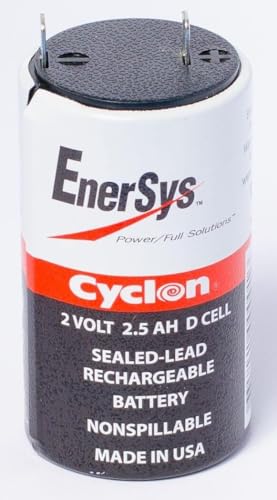
This 2V D-Cell balances compact size with versatile capacity. It is positioned for small, space-constrained systems that require reliable 2V operation. Best for: small backup utilities and custom 2V modules. Why selected: strong emphasis on cycle life with notable resilience for repetitive discharge. Caution: capacity is modest at 2.5Ah; avoid high-demand loads that exceed this rating over time.
EnerSys Cyclon 2V 2.5Ah Sealed Lead Acid D Cell (0810-0004)

Standard 2V sealed lead-acid D-Cell with 2.5Ah capacity. Best for: general purpose 2V backup or specialty equipment where a compact, reliable 2V module is required. Why selected: consistent, predictable performance typical of EnerSys Cyclon line. Caution: verify fit with terminal configuration and mounting space in your enclosure.
Enersys Hawker Cyclon BC-Cell 2V/25Ah
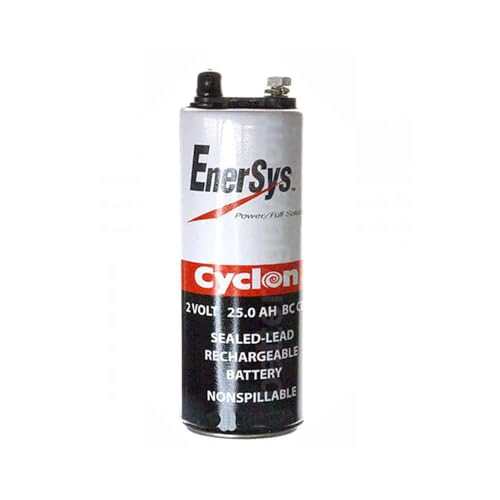
High-capacity 2V BC-Cell designed for longer run times and higher energy needs. Best for: applications requiring more reserve capacity per cell while maintaining 2V architecture. Why selected: significantly higher amp-hour rating expands usage windows without increasing cell count. Caution: heavier and larger than standard 2V cells; ensure mechanical fit and weight handling in your system.
SEFEPODER 12V 7Ah SLA Battery (2 Pack)

While not a 2V cell, this SLA pack represents a common reference point for sealed lead-acid technology in a different voltage tier. Best for: broader system comparisons where a 12V SLA is a familiar baseline. Why selected: demonstrates typical maintenance-free SLA construction and form factor. Caution: not directly interchangeable with 2V modules; use only in compatible 12V circuits and configurations.
Buying Guide
- Voltage and configuration: Confirm your system requires 2V cells or a 2V string. The presented options include single 2V cells and higher-capacity 2V modules; ensure you match your voltage rails and charging algorithm.
- Capacity needs: If your application runs longer between charges, prefer higher amp-hour ratings (e.g., 25Ah BC-Cell) while checking weight and size constraints.
- Cycle life and float life: Look for cells with durable cycle life (several hundred cycles) and long standby life at your operating temperature. This reduces replacement frequency.
- Maintenance and installation: Sealed lead-acid (SLA) designs minimize maintenance. Consider terminal types, mounting orientation, and venting requirements for your enclosure.
- Compatibility: Verify connector types (F1, M6/M8 posts) and terminal spacing match your hardware. Confirm charging profiles align with C/5 or similar rates to optimize cycle life.
FAQ
- What is a typical use for 2V lead-acid batteries?
– They are often used in small back-up systems, telecom feeders, and specialized equipment requiring very low voltage stacks. - Are 2V cells better than 12V for certain projects?
– For compact, modular designs, 2V cells allow flexible series configurations; 12V batteries serve broader, standard systems but may require more space. - What should I consider for cycle life?
– Look for higher full-cycle counts (e.g., up to 300 cycles at 100% DOD and C/5) where the design supports frequent cycling. - Can I mix 2V cells in a string with other voltages?
– Mixing voltages is generally not recommended; ensure uniform voltage across all cells in a string to avoid imbalances. - Do maintenance-free SLA batteries require special handling?
– Sealed lead-acid designs minimize maintenance, but proper enclosure ventilation and safe charging practices remain important.