Best 2 Kw Solar Inverter for Efficient Home Power
Choosing a reliable 2 kW solar inverter is essential for small to mid-size off-grid or hybrid solar setups. This guide reviews top options with 2 kW-class output, highlighting performance, battery compatibility, MPPT capabilities, and ease of use. Each option below supports steady AC power for common household devices, RVs, and backup systems, while offering features like LCD displays, multiple charging modes, and robust protection. Explore practical choices that balance price, efficiency, and expandability for American homes.
Summary of selected products
| Product | Brand | Key Feature | MPPT | Battery Compatibility |
|---|---|---|---|---|
| SUMRY Hybrid Inverter, 4000W | SRGFTS | Glass top, large LCD, high transparency | 140A | Battery-Less or AGM/Lithium |
| SUMRY Solar Inverter Charger, 3600W | SRGFTS | All-in-one inverter charger | 120A | AGM/Lithium |
| Solar Inverter 4200W, 24V DC | PowMr | Built-in all-in-one charger | 120A | Lead-Acid/Lithium |
| Y&H 10.2KW Hybrid Inverter | Y&H | High power, dual MPPT, RGB modes | 160A | Lead-Acid/Lithium |
| Aninerel 12000W Solar Hybrid | Aninerel | Parallel up to 6 units, 12kW base | 2 MPPT | Various batteries |
SUMRY Hybrid Solar Inverter, 4000W

The SUMRY 4000W hybrid inverter provides a robust 4000W rated and 8000W peak output suitable for demanding loads in off-grid or backup scenarios. It features a tempered glass top with a 6.25-inch LCD display and touchable controls for real-time monitoring. The device is designed to deliver a pure sine wave output, minimizing interference with sensitive electronics and extending device lifespans. A built-in 140A MPPT charge controller supports PV arrays up to 5600W at 350VDC, enabling strong solar harvesting in typical American residential setups. This model accommodates battery-less operation or pairing with AGM or lithium batteries, offering flexibility for future expansion.
Key considerations: Ensure your load profile aligns with 4000W continuous output, and verify that your PV array can meet the MPPT controller’s input range. The integrated LCD provides accessible system data, but users should confirm local safety compliance and proper wiring practices. This unit is well-suited for garages, workshops, or small homes seeking reliable hybrid operation with scalable solar charging.
SUMRY Solar Inverter Charger, 3600W

The SUMRY 3600W inverter charger is an all-in-one solution combining a 3600W inverter with a 120A MPPT solar controller and a 100A AC battery charger. Its PV input range spans 60V-500VDC with up to 4200W of PV input power, making it adaptable to a variety of solar arrays. Output is a stable 110V/120VAC pure sine wave, suitable for most household appliances and certain sensitive electronics. It can operate with or without a battery, enabling solar-powered operation directly from PV power when battery voltage is insufficient. This flexibility is valuable for users seeking a battery-free backup option or a staged upgrade path.
Practical notes: Check that your battery chemistry (AGM, Gel, Lead-Acid, Lithium) is compatible. If you plan to operate without a battery, ensure that PV input voltage consistently exceeds 120V to sustain the load. This model is a strong pick for homes and cabins aiming for compact, all-in-one solar energy management.
PowMr Solar Inverter 4200W Hybrid
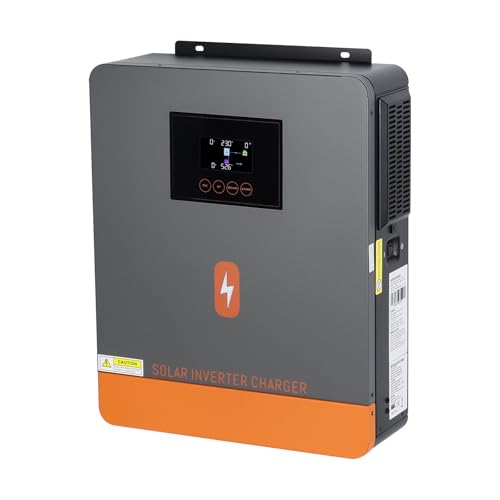
The PowMr 4200W all-in-one hybrid inverter integrates inverter, solar charger, and battery charger in a single unit, rated at 4200W with a 6200W PV input capacity and a 120A MPPT controller. This model supports 220-230V single-phase output and includes a one-click restore default settings feature, which simplifies setup and recovery from configuration errors. A cold start function (23V) enhances reliability in lower-light conditions, and automatic restart after AC restoration helps maintain continuity in critical loads. The device is designed for home, RV, or off-grid applications where a compact, feature-rich solution is desirable.
Considerations: Verify voltage compatibility with your local grid if you plan to connect to a main supply. The unit is well-suited for users needing straightforward operation with reliable performance and protective features to safeguard wiring and connected equipment.
Y&H 10.2KW Hybrid Inverter

The Y&H 10.2KW inverter represents a high-capacity hybrid solution with built-in 160A MPPT charging and dual MPPT tracking. It supports dual PV input and multiple charging modes, including options for PV-first, mains-first, or hybrid charging, with RGB indicators for mode visualization. Although larger than typical 2 kW units, this model illustrates scalable options for those planning significant solar storage or off-grid resilience. It is compatible with both lead-acid and lithium batteries, and its robust design aims to deliver reliable power for homes with substantial energy needs or RV setups seeking extended autonomy.
Selection notes: For consumers specifically targeting 2 kW-class power, this model serves as a reference for how higher-power units manage switching, protection, and mode control. If your demand remains well within 2 kW, you may prefer smaller, lighter units with simpler interfaces and lower heat output.
Y&H 4200W Solar Inverter 24V

This Y&H 4200W inverter features a built-in 120A MPPT controller and a 230V pure sine wave output, making it suitable for backup power and off-grid use with 24V battery banks. It supports battery-free start and includes an air switch, lightning protection, and multiple safeguards to ensure safe operation in home environments. The product is designed to handle a range of loads, from essential appliances to medium-sized tools, while maintaining a stable power supply. The warranty and support ecosystem should be considered when evaluating long-term deployment in busy households or outdoor locations.
Practical guidance: Confirm PV array size and wiring requirements to maximize MPPT efficiency. Users with coastal or lightning-prone regions should leverage the built-in protection features to minimize risk to equipment and wiring infrastructure.
Y&H 6200W Hybrid Solar Inverter
The 6200W hybrid inverter from Y&H targets larger off-grid or backup systems, with a 120A MPPT controller, proprietary protections, and a 230V single-phase output. It supports a wide PV input range up to 450VDC, with a recommended practical operating window around 300-360V for peak performance. The unit is suitable for 48V LiFePO4 or lead-acid systems and allows a mix of battery chemistry options. This model is a strong choice for users who anticipate growth beyond 2 kW or who want to run higher wattage loads during outages or remote area operations.
Buying guide: When selecting a 2 kW class inverter, consider load profiles, battery chemistry, system voltage, MPPT efficiency, and expandability. Key factors include PV input range, surge capacity, efficiency under partial loads, protection features (short-circuit, overvoltage, thermal), and control interfaces (LCD, remote monitoring, mobile apps). For grid-tied or hybrid setups, ensure compatibility with your local electrical code and utility requirements. Evaluate whether you prefer a compact unit with easy setup or a scalable system designed for future expansion, such as parallel configurations or higher MPPT capacity.
Buying Guide: Key Purchase Considerations
- System voltage and battery compatibility: Match the inverter’s DC input voltage (24V, 48V, etc.) with your battery bank.
- MPPT controller capacity: Higher MPPT current and broader voltage range improve solar harvest in varying light conditions.
- Pure sine wave output: Essential for sensitive electronics, compressors, and motors.
- Hybrid versus stand-alone: Hybrid inverters combine charging, inverter, and battery management for streamlined setups.
- Load profile planning: Estimate continuous and peak loads to choose an inverter with sufficient headroom (and consider parallel options for scalability).
- Protection and reliability: Look for overload, short circuit, overtemperature, and lightning protection features, plus clear manuals and warranty terms.
- Monitoring and user interface: LCD displays, remote monitoring, and easy configuration help with maintenance and troubleshooting.
- Ease of installation: Weight, mounting options, venting, and compatibility with existing wiring and AC distribution.
- Local regulations: Ensure compliance with electrical codes, inverter backfeed rules, and safety standards in your area.
- Expansion potential: Consider future battery upgrades or multiple units in parallel for higher total output.