Best 2 AWG Crimping Tool for Heavy-Duty Battery Cables
Finding a reliable crimping tool for 2 AWG battery cables and heavy-duty lugs requires evaluating die quality, ease of use, and durability. This guide reviews five top options designed for automotive, marine, and industrial wiring tasks. Each tool supports 2 AWG and larger lugs, features precision dies, and offers different mechanisms such as hydraulic, hammer, or manual action to suit various work environments.
| Product | Brand | Crimp Range | Mechanism | Notes |
|---|---|---|---|---|
| iCrimp Battery Cable Lug Crimping Tool | IWISS | 8–1/0 AWG | Manual with rotating dies | Hex dies, robust for heavy lugs |
| Solsop Battery Cable Crimping Tool | Solsop | 10–1/0 AWG | Manual with rotating head | Includes copper lugs and heat shrink |
| Brileine 10 Tons Hydraulic Crimping Tool | Brileine | 12–2/0 AWG | Hydraulic | 9 dies; wide versatility |
| AMZCNC Hammer Lug Crimping Tool | AMZCNC | 8–4/0 AWG | Hammer/Indenter | Simple, portable; good for shops |
| YUZES Hydraulic Crimping Tool | YUZES | 12–2/0 AWG | Hydraulic | 9 hex dies; sturdy build |
Below, each product is examined in detail with its key features, typical use cases, and suitability for 2 AWG battery cables and heavy-duty lugs.
IWISS iCrimp Battery Cable Lug Crimping Tool

The iCrimp HX-50BI tool is designed for secure connections on heavy-duty battery cables. It supports crimping 8, 6, 4, 2, 1, and 1/0 gauge lugs, making it suitable for large copper lugs and power terminal connections. The tool uses a rotating die set to simplify die changes and ensure correct die alignment. Its hex-crimping method provides a broad pressure contact area, contributing to low electrical resistance and strong pull-out values. This tool emphasizes accuracy, durability, and ease of verification by embossing the die code on crimps when sizing is correct.
Ideal use scenarios include automotive battery installations, marine electrical systems, and other harsh-duty environments where reliable high-current connections are critical. The tool’s rotating dies reduce downtime during project changes and help technicians maintain consistency across multiple crimps.
Solsop Battery Cable Crimping Tool
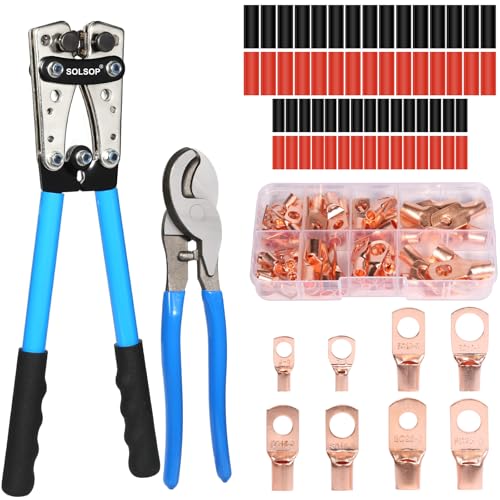
The Solsap tool supports 6 interchangeable dies covering AWG 10, 8, 6, 4, 2, and 1/0. It is designed for heavy-duty battery cables and solar wiring projects. The rotating head makes die changes quick, enabling efficient switching between crimp sizes without loose parts. It uses hexagonal dies to produce a tight, full-contact crimp, reducing electrical resistance and enhancing the integrity of the connection. The tool is built from carbon steel for durability and rust resistance, suitable for professional use in workshops or field work.
This tool is well-suited for automotive, solar, and industrial wiring tasks where multiple lug sizes must be crimped on a single job. The included copper lugs and heat shrink tubing add value for complete installation tasks.
Brileine 10 Tons Hydraulic Crimping Tool

This hydraulic crimping tool provides 10-ton force, a 0.45-inch stroke, and a wide crimping range for 12 AWG to 2/0 AWG copper, aluminum, and stainless steel cable lugs. The kit includes nine hexagonal dies produced via EDM cutting, offering precise crimps for critical electrical connections. The ergonomics and hydraulic mechanism reduce operator fatigue on demanding projects, while the potent stamping and die accuracy support consistent results. It suits battery cables, welding cables, and heavy-duty electrical installations in industrial settings.
AMZCNC Hammer Lug Crimping Tool

The AMZCNC Hammer Lug Crimping Tool is a simple, portable option for crimping lugs on 8 AWG to 4/0 AWG cables. It operates with a manual hammer action suitable for shop benches or field work when a hydraulic tool is not available. The V-groove base helps secure lugs during operation, aiding in precise, consistent crimps. This tool is a practical choice for DIYers and professionals who value straightforward operation and low equipment complexity while working with heavy-gauge lugs.
YUZES Hydraulic Crimping Tool 10 Tons

The YUZES hydraulic crimper offers a 10-ton capacity with nine hex dies for 12, 10, 8, 6, 4, 2, 1/0, and 2/0 AWG, plus a 1/8″ die for stainless steel wire rope. The tool is built with durable materials and hard-wearing dies to ensure solid, repeatable crimps, while its overall construction supports heavy-duty electrical and cable installations. The 360° rotating head enhances access in tight spaces, making it suitable for automotive, marine, and industrial projects that require reliable, high-current connections.
Buying Guide: Key Purchase Considerations
When choosing a 2 AWG crimping tool, consider the following factors to ensure a fit for your tasks and environment:
- Crimp range and compatibility: Verify that the tool supports 2 AWG and larger lugs, plus any specific wire types (copper or aluminum) used in your projects.
- Crimping mechanism: Hydraulic tools offer high force with less manual effort and are ideal for frequent, high-volume use; hammer-type and manual tools are portable and cost-effective for lighter workloads.
- Die quality and dies included: EDM-cut dies or other precision dies provide consistent crimps and allow size verification. A rotating head or interchangeable dies reduces downtime on multi-size work.
- Durability and materials: Look for tools built from hardened steel or copper alloys with rust resistance, especially for outdoor or marine use.
- Ergonomics and space: Consider handle design, grip comfort, and whether a rotating head helps access confined spaces or awkward angles.
- Accessory ecosystem: Some kits include copper lugs, heat shrink tubing, or extra dies—these can add value for complete installations.
- Maintenance: Check for components that may wear over time, such as dies or hydraulic seals, and ensure availability of replacement parts.
- Warranty and support: A solid warranty and responsive customer support can be important for professional use where tool downtime is costly.
For choosing between hydraulic, hammer, or manual options, weigh project frequency, required crimp force, workspace constraints, and travel needs. Hydraulics excel in high-demand environments but add cost and weight; manual tools offer portability and simplicity, suitable for occasional, on-site work. Rotating dies and precise die production improve crimp correctness and repeatability, reducing the chance of mis-crimps and returns.