Best 180V DC Motor Controller Options for DIY Lathes and Small Machines
If you’re shopping for an 180V DC motor controller, you want reliable speed control, clear installation notes, and compatibility with common mini-lathes and DC motors. This guide highlights five solid choices and explains who each is best for, along with practical pros and limitations. Ideal buyers include hobbyists upgrading a small lathe, shop technicians repairing older equipment, and users seeking easy DIY installation with standard DC motors.
Quick product overview for fast comparison:
| Product | Best For | Key Benefit | Limitations |
|---|---|---|---|
| CNCTOPBAOS 110V Mini Lathe Control Board | DIY lathe upgrades | Broad compatibility with CJ0618/CJ18A/WM210V lathes | Requires 110V input and external potentiometer |
| uxcell AC 220V DC 180V Switch Motor Controller | Compact controllers | Simple, compact build with 180V output | Basic feature set, limited documentation |
| Dayton 4Z827 DC Speed Control | Enclosed DC speed control | Chassis enclosure included | Low max amperage (2A) |
| Cosiki DC Motor Speed Controller | Universal mini lathe panels | Wide compatibility with 450‑1100W motors | DIY-friendly installation |
| DC Speed Control 90/180VDC (Dart/Competitors) | Durable 90/180VDC drives | NEMA 4/12 enclosure options | Industrial-style features, may be over-spec for small lathes |
CNCTOPBAOS 110V Mini Lathe Control Board

Best for: DIY lathe upgrades that need flexible output and wide motor compatibility. This board accepts 0-180 VDC and provides up to 8A, with a maximum output around 1000 W. It supports common CJ0618/CJ-0618/CJ18A and WM210V 210-series lathes, making it a practical choice for hobbyists who service or upgrade multiple mini lathe models.
Why selected: It combines a wide DC output range with a built-in AC/DC step-down module, allowing easy integration into existing systems that run on 110–115 VAC. The open-loop, stepless speed control enables smooth tuning with an external potentiometer.
Limitation: It requires a separate potentiometer setup for speed adjustment and may demand some wiring familiarity for proper integration into older lathe controls.
uxcell AC 220V DC 180V Green I/O 2-Position Switch Motor Speed Controller
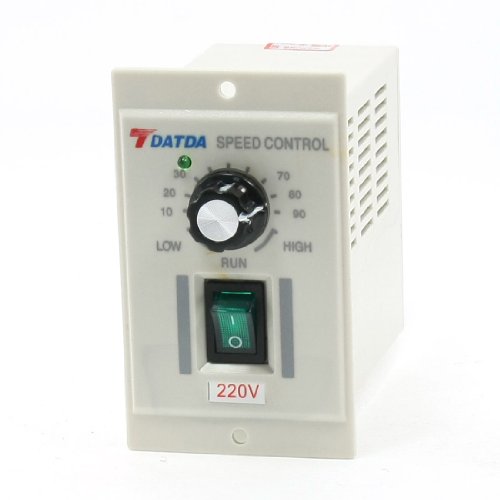
Best for: Small workshop setups needing a compact, plug-in controller with straightforward operation. The unit provides 180V DC output and fits spaces where a slim panel is preferable.
Why selected: Its compact size and simple 3–wire type approach suit hobbyists who want quick installs without extensive wiring. It’s, however, a basic controller, so it’s best for straightforward speed needs rather than advanced control schemes.
Limitation: Documentation is limited, and advanced features or protections may be minimal compared with higher-end modules.
Dayton 4Z827 DC Speed Control

Best for: Enclosed DC speed control needs in a compact chassis. This unit is suitable for projects that require a sturdy, shielded enclosure with DC speed control capabilities.
Why selected: The enclosure helps protect internal components and user wiring, making it a better choice for harsher environments or where panel protection is a priority.
Limitation: Max amperage is not high, at 2A, so it’s best matched to small motors or low-load applications.
KB ELECTRONICS KBMG-212D Reversing DC Drive

Best for: Reversing and regenerating DC drives for compact applications needing bidirectional motor control. This drive supports 0-90/180V DC output and up to 8A DC, with 115/230 VAC input.
Why selected: It offers reversing capability and regenerative braking, useful for tasks requiring direction changes without manual rewiring. It’s compact, suiting tight control panels.
Limitation: The selection emphasizes larger motor compatibility; ensure the specific motor is within the listed 450–1100W range to avoid overloading.
Cosiki DC Motor Speed Controller

Best for: Mini lathe speed control across multiple Eastern-made lathes with universal compatibility for 450–1100W motors. It’s a flexible DIY option for enthusiasts who service various models.
Why selected: It emphasizes broad compatibility and straightforward installation, helping users upgrade aging panels or build new control boxes for several lathes.
Limitation: It is a DIY-oriented panel, so some wiring knowledge is helpful to achieve stable results across different machines.
Buying Guide: 180V DC Motor Controller Essentials
- Motor compatibility: Check the motor wattage (450–1100W commonly), voltage range (DC 0–180V), and whether the controller supports your motor’s stall current and startup behavior.
- Enclosure and mounting: Enclosed units provide protection in shop environments; consider panel-mount vs. chassis-mocket options based on your lathe design.
- Control interface: Decide between external potentiometer, preset switches, or built-in displays. Open-loop vs. closed-loop control affects precision and responsiveness.
- Power input: Confirm input voltage compatibility with your power source (110–115 VAC or 220 VAC) and whether a built-in step-down module is necessary.
- Expansion and safety: Look for features like overcurrent protection, thermal protection, and clear wiring diagrams to reduce risk during setup.
FAQ
- What does 0-180V DC output mean for my lathe?
It indicates the controller can vary the motor supply voltage within that range to adjust speed. Choose a unit that covers your motor’s rated voltage. - Is a higher amperage controller always better for a lathe?
Not necessarily. Match the controller’s continuous current rating to your motor’s running current and the peak load during startup. - Should I prefer an enclosed or panel-mount controller?
Enclosed units protect against dust and moisture, while panel-mount units save space in compact setups. Pick based on environment and accessibility. - Can I use any DC motor with these controllers?
Compatibility depends on motor wattage, voltage range, and wiring. Verify the motor’s specifications align with the controller’s output and input requirements. - Do these controllers require professional wiring?
Some require basic wiring and safety precautions. If you’re unsure, consult a qualified technician to avoid harm or damage.