Best 1800 Watt Power Station for Home Backup, Camping, and Off-Grid Power
Power stations with around 1800W continuous output are versatile solutions for home backup, RV life, and outdoor adventures. This guide highlights five top options that balance strong output, battery longevity, fast charging, and expandability. Each entry includes key specifications and practical considerations to help you compare performance and reliability across scenarios such as outages, remote worksites, and weekend camping trips.
| Product | Brand | Battery | Output | Expansion | Charge Speed |
|---|---|---|---|---|---|
| Anker SOLIX C1000 | Anker | LiFePO4 | 2400W surge | Yes | UltraFast: 43 min 80% |
| EF ECOFLOW Delta 2 | EF ECOFLOW | LiFePO4 | 1800W | Yes | 0-80% in 50 min |
| BLUETTI Elite 100 V2 | BLUETTI | LiFePO4 | 1800W | Yes | 70 min full charge |
| Anker SOLIX C1000 Gen 2 | Anker | LiFePO4 | 2000W | Yes | 49 min recharge |
| BLUETTI AC180 | BLUETTI | LiFePO4 | 1800W | Yes | 1 hour charge |
Anker SOLIX C1000 Portable Power Station

The Anker SOLIX C1000 delivers 1800W continuous output with a 2400W surge capability and a LiFePO4 battery rated for high cycle life. It supports rapid recharging to 80% in about 43 minutes and full charging in under an hour using UltraFast recharging. This model emphasizes home backup and outdoor use, including a robust surge capacity for powering diverse appliances through multiple ports.
Key features include a long-lasting LiFePO4 cell with an estimated 3,000 charge cycles over a decade, and SurgePad technology to maximize compatibility with a wide range of devices. The system is designed for reliability during power outages, camping trips, and RV living, with a practical balance between speed, capacity, and portability.
EF ECOFLOW Delta 2 Portable Power Station

The Delta 2 offers 1024Wh LiFePO4 capacity with 1800W continuous output and 100W USB-C. It supports 7x faster charging—0-80% in about 50 minutes and 0-100% in around 80 minutes with AC input. The system is expandable up to 3kWh by adding extra batteries and is suitable for home backup, camping, RVs, and off-grid living, with ample ports to power most appliances.
Considerations include the ability to scale capacity for longer outages, the reliability of LiFePO4 chemistry for longevity, and the balance between rapid replenishment and total energy storage. It serves well in situations requiring a quiet, fuel-free power source with substantial output and diverse charging options.
BLUETTI Elite 100 V2 Portable Power Station

The Elite 100 V2 provides 1024Wh LiFePO4 capacity with 1800W continuous output and a 2700W peak, plus 11 ports for powering a broad range of devices. It is advertised as 35% smaller and lighter for easier transport, with a fast 70-minute full charge using 1000W solar or 1200W TurboBoost AC charging. Vehicle charging can be integrated via optional accessories for faster top-ups.
Its design focuses on portability without sacrificing power, making it a strong option for camping, road trips, and home backup where space and weight are considerations. The extensive port array supports multiple devices simultaneously, which is advantageous for group outings or work-from-anywhere setups.
Anker SOLIX C1000 Gen 2 Portable Power Station

The Gen 2 model upgrades to 2000W output (3000W peak) with a 1024Wh LiFePO4 battery and UltraFast charging, achieving a 49-minute full recharge. It emphasizes rapid replenishment for outage prep, with the same emphasis on reliability for home backup and outdoor use. The expansion capability remains a core feature, accommodating longer events or higher energy needs.
Users benefit from a compact form factor that is easier to move between spaces or vehicles, while still delivering substantial power for sensitive electronics and essential appliances. The combination of speed, capacity, and portability supports versatile deployment in both urban and remote environments.
BLUETTI AC180 Portable Power Station

The AC180 features 1152Wh LiFePO4 capacity with 1800W continuous output and a 2700W surge. It can be fully charged in about one hour with a high AC input, and solar charging adds flexibility for off-grid use. The unit supports rapid top-offs and is paired with BLUETTI’s app for control and monitoring. Its mix of speed, capacity, and modularity appeals to campers and homeowners seeking dependable power during outages or remote work.
OUPES Mega 1 Portable Power Station
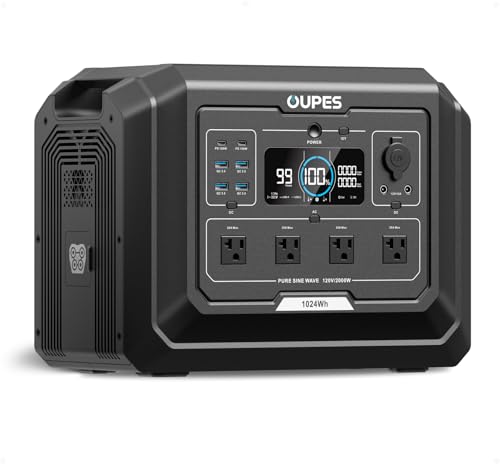
The OUPES Mega 1 offers 2000W continuous output (4500W surge) from a 1024Wh LiFePO4 battery, with expansion options up to 5kWh via modular B2 Extra Batteries. It emphasizes fast charging—0-80% in 36 minutes with AC, and 26 minutes when combining AC and solar inputs. The system supports UPS functionality and is suitable for home backup, camping, and road trips, with scalable energy capacity to match growing needs.
Buying Guide: Key Purchase Considerations
- Power needs and surge handling: For running essential appliances in outages, aim for 1800W–2000W continuous output with a strong surge capacity (2700W–3600W).
- Battery chemistry and cycles: LiFePO4 offers extended cycle life (often 2,000–3,000+ cycles) and stability in varying temperatures, improving long-term reliability.
- Charging speed: UltraFast or high-watt AC charging reduces downtime. Consider models that support simultaneous AC and solar charging for off-grid setups.
- Expandable capacity: If you anticipate longer outages or higher load, look for modular expansion via extra batteries or scalable capacity to reach 3–5 kWh or more.
- Port selection and usability: A broad port mix (AC, USB-C, USB-A, car outlets) enables powering multiple devices at once. A compact form factor aids portability for travel or RV use.
- Solar compatibility: If solar is part of your plan, verify panel compatibility, charging speed under sun conditions, and total solar input limits for faster replenishment.
- Safety and monitoring: Ensure devices have appropriate protection (BMS, overcurrent, short-circuit, high-temperature protection) and user-friendly apps for monitoring state of charge, health, and charging modes.
These options provide a spectrum of choices for different priorities, such as maximum surge capacity, fastest recharge, or greatest portability. When selecting, balance the desired continuous output with battery chemistry, expansion potential, and charging workflow to fit your typical usage patterns and environments.