Best 16 Channel Stage Snakes for Clear, Organized Live Sound
Answering the needs of live sound engineers, studio techs, and stage managers seeking reliable 16-channel stage snakes. These options are ideal for venues, theaters, and rigs that demand clean signal paths and easy channel identification. Best for crews who prioritize compact footprint, clear channel labeling, and robust construction. Below, five top picks are highlighted with quick guidance on who each is best for and why.
| Product | Length | Channels | Best For |
|---|---|---|---|
| Seismic Audio SACB-16x4x25 | 25 ft | 16 send / 4 return | Small to mid-size venues; compact stage footprint |
| PRORECK 16-Channel Low Profile | 50 ft | 16 send / 4 return | Live setups needing longer reach without bulk |
| Seismic Audio 16-Channel 100 ft | 100 ft | 16 send / 4 return | Large stages; long runs with minimal clutter |
| Seismic Audio SARMSS-16×310 | 3 ft trunk + 10 ft trunk | 16 send / 2 TRS on box | Rack-mountable systems; quick, labeled connections |
| Seismic Audio XLR Low Profile 50 ft | 50 ft | 16 send / 4 TRS returns | Studio to stage PA setups; compact stage box |
Seismic Audio SACB-16x4x25 16-Channel XLR Low Profile

Features: Model SACB-16x4x25; Sends 16 XLR Male Connectors; Returns 4 XLR Female Connectors.
Best for: Small stages or practice rooms where space is at a premium and you still need 16 send channels and 4 returns. The low-profile design helps reduce footprint on crowded stages.
Caution: Ensure your stage box and mixer provide compatible XLR gender orientations to avoid awkward adapters. This model emphasizes a compact form factor, which may limit some expansion scenarios.
PRORECK 16-Channel Low Profile XLR Send Snake
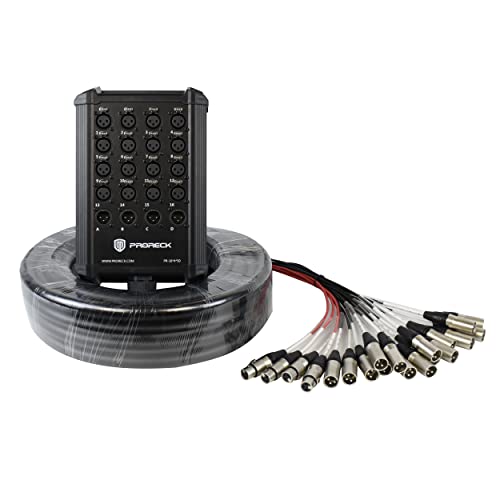
Features: 16-Channel Snake; 50 ft length; 4 XLR female returns; 16 XLR male fantails; Numerically designed; Circuit board for solid connections and reduced external noise.
Best for: Live productions requiring longer runs without sacrificing channel clarity or ease of setup. The numbered connectors help with quick, accurate patching on busy stages.
Limitation: The longer length increases weight and handling considerations; plan cable management for mobile shows.
Seismic Audio 16-Channel 100 ft Low Profile

Features: Low Profile; Circuit Board Snake; XLR Splitter Cable; 100 Feet; Returns with nickel-plated XLR connectors; clearly labeled stage box and fantail ends.
Best for: Large venues and touring setups where long cable runs are needed while keeping a compact stage footprint and robust signal integrity.
Caution: The extended length adds potential for signal loss if the run is not properly terminated or if there is excessive run complexity; route for minimal cross-talk.
Seismic Audio SARMSS-16×310 16-Channel XLR/TRS Combo Splitter

Features: 2 Space Rack Mountable; 16-channel splitter; XLR/TRS 1/4″ combo jacks on the box end; labeled; 100% individually shielded pairs; 22 gauge conductors.
Best for: Stage setups that require quick routing from the stage box to both XLR and TRS destinations; excellent for venues using both mic and line-level equipment.
Limitation: Combines XLR and TRS paths; verify compatibility with your console’s inputs to avoid impedance mismatch on some channels.
Seismic Audio XLR Low Profile Snake With 4 TRS Returns

Features: 16 XLR male sends; 4 TRS returns; 50 feet length; compact stage box; color-coded fantail; 25 gauge conductors; heavy-duty steel stage box; one-year warranty.
Best for: Studios or performance rigs needing both mic-level and line-level returns within a compact, color-coded system. Great for efficient patching on small to mid-size stages.
Caution: While compact, ensure the TRS returns meet your equipment’s expected input format to avoid unnecessary adapters.
Buying Guide
Key considerations for choosing a 16-channel stage snake:
- Length vs. footprint: Choose a length that matches stage depth and stage-box location; longer runs save wire clutter but add weight.
- Channel layout: Confirm the number of send channels versus returns and whether you need XLR only or also TRS returns.
- Build and durability: Look for low-profile stage boxes, robust connectors, and shielded conductors to minimize interference.
- Labeling: Numerically labeled trunks and boxes speed up setup and reduce mispatches in live settings.
- Return configurations: Decide between XLR returns, TRS returns, or a combo to align with your mixer or PA system inputs.
- Versatility: Combo jacks or circuit-board-fed paths can offer better noise rejection and easier maintenance.
Comparison Snapshot
- Best for compact stages: Seismic SACB-16x4x25, Seismic XLR Low Profile 50 ft
- Better for long runs: Seismic 100 ft variant, PRORECK 50 ft
- Best for hybrid setups: SARMSS-16×310 with XLR/TRS combos
Frequently Asked Questions
- What is a stage snake and why do I need one?
It consolidates multiple mic and line signals into a single, organized run from stage to mixer, reducing cable clutter and simplifying setup.
- What should I consider when choosing length?
Consider stage depth, booth location, and the distance to the mixer; longer runs help in large venues but demand careful wiring.
- Are TRS returns common on 16-channel snakes?
Some models include TRS returns for line-level signals; check your mixer’s input options to ensure compatibility.
- Is a low-profile stage box better?
Low-profile boxes save stage space and reduce footfall hazards, especially on crowded stages.
- Do I need shielded conductors?
Yes, shielded pairs reduce interference and noise, delivering cleaner signal paths for live sound.