Best 150Ah Deep Cycle Battery Options for 12V Systems
Choosing a reliable 150Ah deep cycle battery is essential for RVs, trolling motors, solar setups, and off-grid living. This guide reviews five prominent 150Ah batteries, highlighting chemistry, BMS protection, weight, and lifecycle expectations to help you compare options for long-term power reliability. Each entry includes a quick look at key features to aid decision making for American buyers.
| Product | Brand | Chemistry | Approx. Weight | Key Benefit |
|---|---|---|---|---|
| Mighty Max Battery 150Ah SLA | Mighty Max Battery | Sealed Lead Acid (SLA) | About 21-28 lbs | Maintenance-free; wide operating temps |
| LIPULS 150Ah Lithium (LiFePO4) | LIPULS | LiFePO4 | Lightweight; built-in 200A BMS | Smart monitoring; cold protection |
| ECO-WORTHY 150Ah LiFePO4 | ECO-WORTHY | LiFePO4 | About 42 lbs | Bluetooth monitoring; 120A BMS |
| Lampword | LiFePO4 | ~32-33 lbs | High safety and IP65 rating | |
| TechCella 160Ah LiFePO4 | TechCella | LiFePO4 | ~31.0-32.0 lbs | 150A BMS; Bluetooth |
The following sections highlight each product, with emphasis on battery chemistry, protection features, monitoring options, and practical considerations for installation and use in 12V systems.
Mighty Max Battery 150Ah SLA Replacement Battery

The Mighty Max ML150-12 is a 12V 150Ah sealed lead acid (SLA) rechargeable battery designed as a maintenance-free option. It is UL certified and features a compact 19.09 x 6.69 x 9.49-inch profile. It does not include wire harness or mounting accessories. SLA chemistry offers reliable deep discharge recovery and broad operating temperature ranges, making it suitable for steady, long-duration power needs where weight is a consideration.
LIPULS 12V 150Ah LiFePO4 Deep Cycle Battery

This LiFePO4 battery includes a built-in 200A BMS and supports real-time monitoring via a smartphone app. It also offers low-temperature protection for safe charging in cold environments, ideal for trolling motors, RVs, off-grid cabins, and marine use. The combination of higher energy density and robust protection makes it a versatile power source for extended trips and remote deployments.
ECO-WORTHY 12V 150Ah LiFePO4 Battery with Bluetooth

The ECO-WORTHY 150Ah LiFePO4 battery features a rugged metal case and a built-in 120A BMS. Bluetooth 5.0 enables real-time capacity and status monitoring via a mobile device. With a lighter weight (around 42 lbs) and up to 15,000 cycles, this pack is aimed at solar, RV, and marine applications where longevity and maintenance-free operation are priorities.
Lampword 150Ah LiFePO4 Deep Cycle Battery
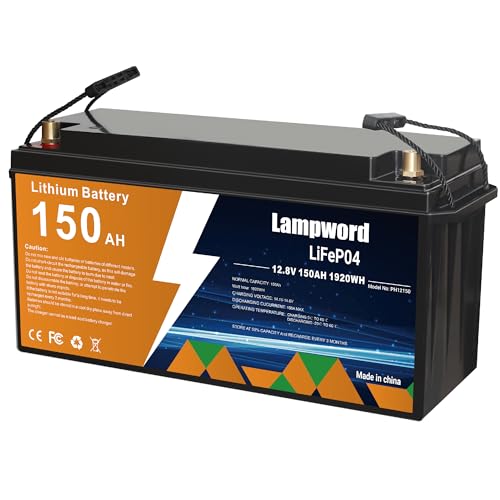
The Lampword 150Ah battery provides 12.8V and 1920Wh, with a built-in 150A BMS. It supports up to four batteries in series or parallel for higher voltages or current. It weighs around 32.4 pounds, is IP65 water/dust resistant, and carries safety certifications including SDS/UN38.3. This model emphasizes portability and safe operation in diverse outdoor setups, including trolling motors and RV systems.
TechCella 12V 160Ah LiFePO4 Battery

TechCella’s 12V 160Ah LiFePO4 battery features a 150A BMS and built-in Bluetooth for real-time monitoring. It supports 150A continuous discharge with peak capabilities, and an IP65 rating for protection against dust and water exposure. The device includes an automatic temperature cutoff to prevent charging above 60°C or below 0°C, ensuring safety in challenging conditions for trolling motors, boats, RVs, and off-grid systems.
Buying Guide: 150Ah Deep Cycle Battery Considerations
- Chemistry and lifecycle: LiFePO4 (lithium) batteries generally offer higher cycle life, lighter weight, and better safety features than SLA or traditional AGM. Consider expected cycles (thousands vs. hundreds) and your tolerance for weight and replacement frequency.
- Protection and management: Look for a Battery Management System (BMS) that guards against overcharge, over-discharge, short circuits, high/low temperatures, and provides auto-recovery. A higher amperage (e.g., 150A–200A) BMS supports heavier loads and faster responses.
- Temperature performance: Cold-weather operation can affect charging and capacity. Low-temperature protection helps prevent charging in adverse conditions and improves reliability in winter environments.
- Monitoring options: Bluetooth or app-based monitoring lets you track voltage, current, and remaining capacity. Real-time visibility helps prevent unexpected power loss during trips or off-grid use.
- Weight and space: LiFePO4 packs are typically lighter than SLA counterparts, which simplifies installation and vehicle mounting. Ensure the physical dimensions fit your compartment or rack.
- Charge compatibility: Verify that your charger and device ecosystem support LiFePO4 chemistry or SLA, and whether you need a series/parallel configuration for higher voltage or capacity.
- Lifecycle cost: Although LiFePO4 batteries have a higher upfront cost, their longer life and lower replacement frequency often yield a lower total cost of ownership over time, especially in remote or heavily used systems.
- Warranty and support: Check coverage terms, return policies, and customer support responsiveness, as these influence long-term satisfaction and service if issues arise.