Best 15000 Running Watt Generators for Home Backup and Jobsites
When choosing a 15000 running watt generator, look for reliability, fuel flexibility, safety features, and ease of starting. The following models are among the most suitable for American homes and small-to-medium work sites. This guide highlights who each product is best for, plus practical comparisons to help you decide quickly.
| Model | Fuel Type | Running Watts | Peak Watts | |
|---|---|---|---|---|
| GENMAX 15000W Tri-Fuel | Gasoline / LPG / Natural Gas | 11,000W | 15,000W | Home backup with multi-fuel versatility |
| Westinghouse 14500 Peak / 11500 Running | Gasoline / Propane / Natural Gas | 11,500W | 14,500W | Large home backup on a budget |
| Westinghouse 18000 Peak / 14000 Running | Gasoline / Propane | 14,000W | 18,000W | Heavy-load power and longer runtimes |
| Champion 15000-Watt MKE | Gasoline | 12,000W | 15,000W | Electric start and robust outlets |
| Westinghouse 14500 Dual Fuel with CO Sensor | Gasoline / Propane | 11,500W | 14,500W | CO-safety with dual-fuel flexibility |
Buyer note: This table summarizes core capabilities. Always verify current specs before purchase as models update over time.
GENMAX 15000W Tri-Fuel Portable Generator

The GENMAX GM15000ET offers a running power of 11,000W with a 15000W peak, arranged in a tri-fuel system that supports gasoline, LPG, and natural gas. This model features a 10.56-gallon fuel tank for extended runtimes and a Capable control panel with a 2-wire start option for solar charging compatibility. It includes a CO detector for safety and a voltage transfer switch to switch between 120V and 240V. It is best for homeowners needing reliable multi-fuel power and a robust start system. A limitation is that high-load operation may drain fuel quickly on long outages, so plan fuel storage accordingly.
Who this is best for
- Homeowners seeking a versatile, long-run backup option with gas, propane, or natural gas.
- Property owners with solar setups seeking compatible charging options on the panel.
Westinghouse 14500 Peak / 11500 Running

This Westinghouse model delivers 11,500 running watts and 14,500 peak watts on gasoline, with propane and natural gas options. Its heavy-duty 550cc engine supports long runtimes and a built-in fuel gauge; it can run up to 19 hours on a full tank. Best for larger homes that need strong peak performance and multi-fuel capability. A caveat: propane runtimes may be shorter than gasoline at higher loads.
Who this is best for
- Owners who want solid electric-start performance and reliable transfer-switch readiness.
- Medium-to-large homes requiring substantial starting power during outages.
Westinghouse 18000 Peak Watt Dual Fuel
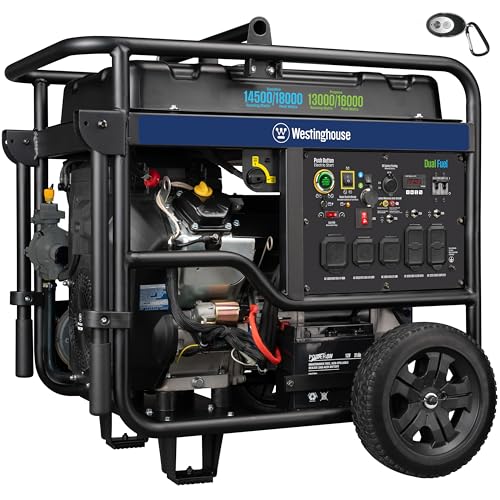
The Westinghouse WGen14500DFc provides 14,500 running watts on gasoline or 13,000 running watts on propane, with an 18,000 peak on gasoline. Its CO sensor enhances safety, and the V-Twin engine supports robust power delivery. It does include a comprehensive display and multiple outlets. Use this model for heavy-duty home back-ups or job sites requiring high sustained power. Limitation: some setups may require a larger space due to the size and weight of the unit.
Who this is best for
- Anyone needing maximum peak power for demanding appliances or tools.
- Users prioritizing CO safety alongside dual-fuel flexibility.
Champion Power Equipment 15,000-Watt MKE Series

This Champion generator offers 15,000 starting watts and 12,000 running watts, with up to 9 hours of run time on a full tank. Features include a Milwaukee 717cc V-Twin engine, electric start with a toggle switch, Cold Start Technology, and multiple outlets including 50A and four 20A GFCI outlets with built-in surge protection. Best for users who want strong performance and user-friendly electric start. A potential downside is audible noise levels around 78 dBA at 23 feet in operation.
Who this is best for
- Those who value fast, reliable electric start and well-protected outlets.
- People needing a balance of power, safety features, and versatility for home or light job-site use.
Westinghouse 14500 Dual Fuel with CO Sensor

This dual-fuel Westinghouse delivers 11,500 running watts on gasoline and 10,500 running watts on propane with a 19-hour runtime at 25% load on a 9.5-gallon tank. The CO sensor adds critical safety for indoor or semi-enclosed spaces. It is best for homes wanting CO protection with accessible fuel options. Limitation: dual-fuel performance can vary by fuel type and ambient conditions, so plan for different runtimes accordingly.
Westinghouse 28000 Peak Watt with CO Sensor

This unit is a powerhouse with 20,000 running watts and 28,000 peak watts. It includes a CO sensor, remote start, and a comprehensive arrangement of outlets. Best for large homes with heavy load demands and the need for multiple circuits. A note: its size and power draw require a secure installation space and proper ventilation.
Buying Guide
What to consider when choosing a 15000-watt generator
- Fuel options: Tri-fuel or dual-fuel units provide flexibility during fuel shortages. Decide if you need natural gas access or propane as a backup.
- Starting method: Electric start with a key, remote, or recoil start. Consider how quickly you need backup power in a storm.
- Run time: Large tanks improve runtime. Match tank capacity to your anticipated outage duration and appliance load.
- Safety features: Look for CO sensors, auto shutoff, and low-oil protection to safeguard equipment and occupants.
- Electrical safety: Transfer switches or sub-panel compatibility help you keep circuits isolated during outages and protect sensitive electronics.
- Outlets and power management: A mix of 120V and 240V outlets, plus GFCI protection, improves compatibility with diverse appliances and tools.
- Noise and footprint: Higher-watt models can be louder and larger. Plan for placement away from living spaces and ensure ventilation.
Practical usage scenarios
- Home backup: Prioritize models with strong running watts and CO safety for essential appliances, furnace, and refrigeration.
- Work sites: Choose high peak watts and robust outlets for heavy tools; consider remote start for convenience.
- Solar integration: If you have solar charging, look for models with a DC charging port or compatibility with solar batteries.
Maintenance and safety reminders
- Regular oil changes, air filter checks, and spark plug inspections extend life.
- Store fuel safely and use stabilizers for long-term storage.
- Always operate outdoors in well-ventilated areas to avoid CO buildup.
FAQ
- What is the difference between running watts and peak watts?
Answer: Running watts indicate steady power delivery, while peak (surge) watts handle short bursts for starting large loads. - Do tri-fuel generators run on natural gas?
Answer: Yes, tri-fuel units can switch between gasoline, propane, and natural gas depending on the model. - Are CO sensors necessary on generators?
Answer: CO sensors improve safety by detecting dangerous fumes and automatically shutting down if needed. - What is a transfer switch and why is it important?
Answer: A transfer switch isolates the generator from household circuits, preventing backfeed and enabling safe, controlled power distribution. - Is higher reliability tied to bigger engines?
Answer: Not always; engine design, fuel management, and safety features also affect reliability under various loads. - Can I run a 15000W generator indoors?
Answer: No. Generators should be used outdoors in open spaces with proper ventilation to prevent CO buildup.