Best 1500-Watt Portable Power Stations for Off-Grid Power and Emergencies
For buyers seeking reliable portable power stations around the 1500-watt mark, these units balance runtime, output, and portability for camping, RV use, or backup power. This guide highlights five solid options and explains who each is best for, plus practical buying tips. The top picks favor models with LiFePO4 batteries for longevity, efficient recharging, and solid surge power to handle common appliances.
Summary Table
- Product: Jackery Explorer 1000 v2 Portable Power Station — 1,070Wh LiFePO4, 1,500W AC
- Product: BLUETTI AC180 — 1,152Wh LiFePO4, 1,800W continuous / 2,700W surge
- Product: VTOMAN FlashSpeed 1500 — 3,096Wh total (extra battery), 1,500W (3,000W peak)
- Product: BLUETTI Elite 100 V2 — 1,024Wh, 1,800W, 10ms UPS
- Product: Anker SOLIX C2000 Gen 2 — 2,048Wh LiFePO4, 2,400W continuous / 4,000W peak
Jackery Explorer 1000 v2 Portable Power Station

The Explorer 1000 v2 delivers 1,500W continuous AC output with a 3,000W surge peak and a 1,070Wh LiFePO4 battery. It weighs 23.8 lbs and includes a foldable handle for portability. Fast charging claims reach from 0% to full in about an hour with emergency charging through the Jackery App, supported by ChargeShield 2.0 for safer, smarter charging. Its 10-year lifespan highlight emphasizes long-term reliability for frequent travelers or backup power during outages.
Best for: Outdoor enthusiasts and campers who need substantial power in a compact, transportable unit and value fast recharging. Also suitable for emergency preparedness kits in homes with limited space.
Caution: The one-hour fast charge relies on activated emergency charging and may vary with input conditions or solar availability.
BLUETTI AC180 Portable Power Station

The AC180 packs a 1,152Wh LiFePO4 battery with 1,800W continuous output and a 2,700W surge capability. It can be charged in 1 hour at 1,440W AC input and offers a solar charging option that can reduce charging time to 2.8–3.3 hours with solar energy alone. A BLUETTI App boost option raises output further for high-demand devices. It’s best for users who prioritize high continuous power and relatively quick top-ups, especially in settings with access to solar input.
Best for: Those who need higher continuous power and fast AC charging, plus the option to scale with solar inputs for outdoor use.
Caution: Solar-only charging times are contingent on sunlight conditions and may be longer in cloudy or short-day conditions.
BLUETTI Elite 100 V2 Portable Power Station

The Elite 100 V2 offers 1,024Wh capacity with 1,800W continuous output and a surge capacity of 2,700W. It charges quickly with up to 1,200W turbo AC charging or up to 1,000W solar input, delivering full charge in about 70 minutes. A built-in 10ms UPS keeps essential devices running during outages, and its compact size supports portability for camping or home backup. The model balances speed, capacity, and reliability for family use or emergency planning.
Best for: Home backup and camping where a balance of fast charging, UPS capability, and quiet operation are valued.
Caution: Battery capacity is lower than some peers, so longer outages may require recharging more frequently or using solar assistance.
Anker SOLIX C2000 Gen 2 Portable Power Station
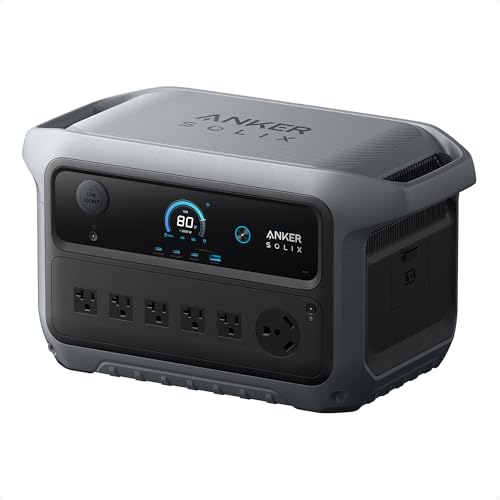
The C2000 Gen 2 features a 2,048Wh LiFePO4 battery with 2,400W continuous output (4,000W peak). It emphasizes fast recharging—fully charged in 58 minutes with both AC and solar options—and supports powering up to 11 ports. The unit is positioned for home backup, remote work setups, and RV use, offering strong versatility for larger loads and longer events away from a power grid.
Best for: Users needing robust power delivery for multiple devices and frequent recharges, including home backup and travel scenarios requiring higher continuous output.
Caution: Higher power output may demand larger battery packs or careful planning for extended outages without grid access.
Buying Guide
Key purchase considerations to help you pick the right 1500-watt portable power station:
- Power needs: List essential devices (fridge, CPAP, laptop, lights). Look for a unit with sufficient continuous wattage and surge capacity to cover startup loads.
- Battery chemistry and lifespan: LiFePO4 cells provide longer cycle life. Consider units advertised with 3,000+ cycles and long lifespan expectations.
- Weight and portability: If you’ll carry the unit on trips, weigh size against payload limits. Some models include compact designs with retractable handles or built-in wheels.
- Charging speed: Fast recharging (AC and, where available, solar) reduces downtime. Check both full-charge time and the efficiency of solar input.
- UPS and reliability features: For home backup, a model with 10ms or faster UPS switchover helps keep networks and devices online during outages.
- Solar compatibility: If you plan to rely on solar, verify solar input capacity and compatibility with additional panels and charge controllers.
- Expandability: Some systems support extra batteries or expansion packs to increase total capacity for longer outages.
Comparison Snapshot
- Best overall balance: Jackery Explorer 1000 v2 — strong mix of power, portability, and quick charging.
- Best for high continuous power: BLUETTI AC180 — higher output with solid expansion potential.
- Best for extreme endurance: VTOMAN FlashSpeed 1500 — large total capacity with extra battery option.
- Best with UPS for home: BLUETTI Elite 100 V2 — reliable backup with rapid charging and quiet operation.
- Best for high-load versatility: Anker SOLIX C2000 Gen 2 — high continuous power and fast recharge, suitable for multiple devices.
FAQ
- What is the advantage of LiFePO4 batteries in portable power stations?
They offer longer cycle life and stability, reducing capacity loss over many charge-discharge cycles. - Should I prioritize higher continuous power or higher capacity?
If you need to run devices that have high startup surges, prioritize higher continuous power; if you plan longer outages, higher capacity helps. - Can these units run a standard home refrigerator?
Many can, but check continuous wattage and surge rating; some units handle fridge startup more reliably than others. - Is UPS protection important for home use?
Yes, a fast UPS (10ms or better) can keep modems, routers, and PCs powered during outages. - Do I need solar charging to use these devices effectively?
Solar charging is beneficial for off-grid use, but it is not mandatory if you have reliable AC charging options. - What maintenance is required for LiFePO4 power stations?
Regular charging cycles and avoiding extreme temperatures help maximize longevity.
Optional buying tips: If you expect frequent road trips or camping with limited charging opportunities, prioritize models with faster AC charging and a robust surge capacity. For emergency home backup, consider a unit with UPS functionality and expandable capacity to cover longer outages. Always verify input and output configurations align with your devices to ensure safe and reliable operation.