Best 14-50 Plug Adapters for EV and Welding Outlets
Choosing the right 14-50 adapters can simplify charging and power transfer for EVs, welders, and generators. This guide highlights five dependable options, detailing compatibility, construction, and safety features to help you pick the best fit for your garage, campsite, or worksite.
| Product | Type | Key Feature |
|---|---|---|
| Nilight EV Charger Adapter Cord | NEMA 6-50P to 14-50R | Pure copper 10 AWG wires; 250V/12500W; flexible, durable jacket |
| Suplevel NEMA 6-50P to 14-50R | 3-prong welder to 4-prong EV | STW 6 AWG, ETL Listed; 12500W; non-RV use |
| MECMO NEMA 6-50P to 14-50R | Welder to EV charger | Not for RVs; 50A 250V; 6 AWG copper |
| Islewire NEMA 14-50P to 6-50R | 14-50P to 6-50R welder adapter | 6 AWG copper; 12500W; rugged STW jacket |
| WenStorm Tesla NEMA 14-50P Adapter | 14-50P to Tesla Gen 2 | Copper alloy; 17.5mm cable; ETL certified |
The following sections provide detailed product insights, rooted in objective specifications and safety features. Each entry focuses on practical use cases, helping you compare performance across common 14-50 configurations.
Nilight 50A to 50A Adapter Cord

The Nilight adapter converts a welder-style NEMA 6-50P to a 14-50R receptacle, enabling a 50A charging path at 250V. It uses three 10 AWG wires to deliver high conductivity, supported by a flame-retardant, heat-resistant PVC jacket for outdoor use. Ground wiring aligns 6-50P ground with 14-50R ground, while hot legs correspond, leaving the 14-50R neutral open. This configuration serves EV charging or high‑current tools in environments where a standard 14-50 outlet isn’t available.
Key considerations: verify the receptacle is NEMA 6-50R, confirm the 14-50R is your target, and ensure the setup remains within 250V, 50A limits. The adapter is not suitable for RVs and does not convert to 120V.
Tesla NEMA 14-50P Adapter, WenStorm
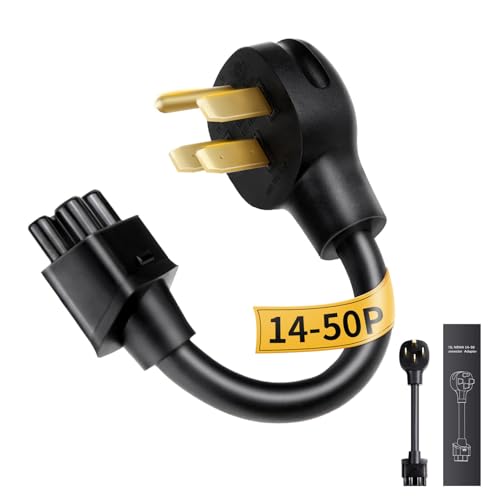
The WenStorm adapter provides a direct 14-50P to Tesla Gen 2 charging compatibility, with a robust 17.5mm cable and copper alloy conductor for improved conductivity. ETL certification underscores compliance with safety standards, along with flame retardant and waterproof features. This adapter focuses on ensuring reliable, safe wall-socket-to-vehicle charging for Tesla models and similar Level 2 setups that require a 14-50P source.
Considerations: confirm charger compatibility with your Tesla Gen 2 or similar equipment, assess cable thickness for heat management, and ensure the adapter’s rating aligns with your charging session length and amperage requirements.
Plugrand 14-50P to 6-20R T-Blade Adapter

Plugrand offers a 14-50P to 6-20R T-Blade combination, enabling a 4-prong 250V connection to a 20A 250V receptacle. The setup is designed for specific 250V environments where a 6-20R outlet is available, translating a 4-prong 14-50P into a 6-20R path. This is a practical option for generators or dryers with 6-20R sockets, and it leverages a straightforward pin-and-blade approach for quick changes in power access.
Usage notes: only operate at 250V and within the 50A rating when applicable, and ensure compatibility with the connected device’s input requirements to avoid overheating or arcing.
Suplevel 6-50P to 14-50R Adapter Cord

The Suplevel adapter transitions a 6-50P three-prong welder plug to a 14-50R four-prong EV charger connector. It’s ETL listed with a 50A, 250V rating and uses 6 AWG copper conductors to minimize heat during long charging sessions. The cord is designed for EV charging but explicitly notes it is not for RV use, enforcing correct application and safety in workshop or home charging scenarios.
Key points: confirm 6-50P and 14-50R receptacles in your setup, monitor amperage and voltage, and abide by the “not for RV” limitation to prevent misapplication.
MECMO 6-50P to 14-50R Welder Adapter

The MECMO 6-50P to 14-50R adapter is designed for welders and EV charging, not for RV use. It supports 50A at 250V and emphasizes compatibility between 6-50P male plugs and 14-50R receptacles. Notably, the product warns against RV compatibility and focuses on safe, dedicated EV/welder charging contexts. This adapter serves as a bridge where heavy-duty welding outlets must be repurposed for specific charging needs without altering infrastructure.
Practical considerations: ensure your power source is a 6-50P outlet and that the destination is a 14-50R receptacle suitable for the intended equipment. Be mindful of limitations that exclude RV applications.
Buying Guide: Key Purchase Considerations
When selecting a 14-50 adapter, evaluate the following factors to balance safety, compatibility, and performance:
- Voltage and current ratings: Confirm the adapter’s 250V, 50A capacity aligns with your devices’ requirements to prevent overheating or outages.
- Connector compatibility: Match the plug (P) and receptacle (R) types (14-50, 6-50, 6-20, etc.) and verify that the device you intend to power supports the configuration.
- Wire gauge and construction: Thicker conductors (e.g., 6 AWG) distribute heat better under load; look for STW jackets and copper conductors for durability.
- Safety certifications: ETL or equivalent certifications indicate compliance with safety standards; flame retardant and waterproofing features add resilience in outdoor environments.
- Not for RV usage: Several adapters explicitly state they are not intended for RV applications; misusing them can damage electrical systems.
- Length and flexibility: A shorter, well-insulated cord reduces exposed connections in busy work areas; flexible copper strands improve handling with gloves.
- Intended use cases: Identify whether you need an EV charging path, welder outlet conversion, or generator-to-outlet adaptation, as different designs optimize for different loads and equipment.
- Safety practices: Always verify outlets, cords, and receptacles for signs of wear, ensure proper grounding connections, and avoid daisy-chaining adapters or using damaged equipment.
In sum, the right 14-50 adapter depends on your devices, receptacle availability, and the operating environment. Consider the above criteria to maximize reliability and safety in home charging, workshop use, or field work.