Best 135 Watt Solar Panel Solutions for Off-Grid Power Needs
Looking for a dependable 135-watt solar panel option to power RVs, boats, camps, or off-grid setups? This guide highlights five strong choices that deliver solid efficiency, shading resilience, and compact form factors. Each product is described with who it suits best, plus practical considerations to help you compare at a glance.
| Product | Brand | Wattage | Key Advantage |
|---|---|---|---|
| RENOGY REGO 120W Solar Panel ShadowFlux Anti-Shading N-Type 16BB | RENOGY REGO | 120W | ShadowFlux anti-shading for better partial shading performance |
| Renogy 100W Solar Panel N-Type, 12V 100W | Renogy | 100W | 16BB N-Type cells for higher efficiency and longevity |
| HOWEASY Solar Generator 135W (270W Peak) | HOWEASY | 135W | Integrated versatility with a compact portable power station |
| Callsun N-Type 120W Bifacial Solar Panel 16BB | Callsun | 120W | Bifacial design to harvest reflected light and shade-tolerant |
| Renogy ShadowFlux Solar Panels 120W N-Type | Renogy | 120W | ShadowFlux anti-shading with high efficiency |
RENOGY REGO 120W ShadowFlux Panel

Best for: RVs, boats, and small off-grid setups with partial shading. Why: ShadowFlux anti-shading technology helps maintain charging voltage in shade from trees, buildings, or foliage, reducing hot spots and improving reliability. The 16BB N-Type cells support higher efficiency and longer life, useful for compact rooftop installs.
Limitations: While efficient in shaded conditions, performance under full sun remains tied to panel area and mounting orientation. Ensure adequate space for optimal tilt and clear exposure.
Key takeaway: Choose this if you need reliable performance in partially shaded environments and space-constrained rooftops.
Renogy 100W N-Type Panel

Best for: Off-grid campers and small boats needing dependable 100W output with durability. Why: 25% efficiency with 16BB N-Type cells minimizes power loss in heat and reduces hot spots, extending lifespan. Higher temperature tolerance helps during hot summer days.
Limitations: It’s a bit lower wattage than 135W models, so you may need more panels for higher power needs. Still, it’s a strong, compact choice for tight spaces.
Key takeaway: Choose this if you want reliable efficiency and a robust build for compact installations.
HOWEASY 135W Solar Generator

Best for: Outdoor enthusiasts seeking an all-in-one portable power solution. Why: This 135W output pairs with a 98Wh power station and a 30W solar panel, enabling charging and operation of multiple devices simultaneously. The PD, USB-C, and USB-A ports support a wide range of devices, making it versatile for camping and emergencies.
Limitation: The built-in 98Wh capacity may require recharging frequently under heavier load or extended blackout scenarios.
Key takeaway: Choose this if you want a compact, multi-port portable power option with solar input.
Callsun N-Type 120W Bifacial Panel

Best for: Small RVs and vans needing more efficient output from a compact footprint. Why: 25% efficiency with 16BB N-Type cells, plus bifacial capability to capture reflected light, which can boost energy harvest on reflective surfaces like decks and white roofs. The dual-side design helps offset shading from partial obstructions.
Caution: Bifacial panels require generous rear-side exposure to realize extra gains; installation should consider reflective backing and mounting angle.
Key takeaway: Choose this if you want enhanced output from a compact panel and can leverage reflective surfaces for extra watts.
Renogy ShadowFlux 120W Panel
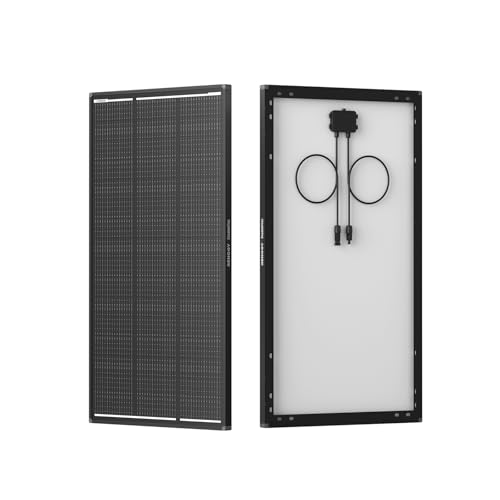
Best for: 12V/24V systems in shaded environments where stable power is essential. Why: ShadowFlux anti-shading technology reduces hot-spot risks and sustains power output in partial shade. The 16BB N-Type cells deliver consistent efficiency and durability for off-grid setups.
Limitation: Real-world gains depend on site shading patterns; optimal positioning remains important for best performance.
Key takeaway: Choose this when shading is a frequent factor and you value stable performance in limited spaces.
Buying Guide: How to Choose a 135-Watt Panel
- Shading tolerance: If your installation faces trees, buildings, or variable light, prioritize panels with anti-shading technology such as ShadowFlux or bifacial designs that harvest reflected light.
- Cell technology: N-Type cells (16BB) offer higher efficiency and longevity compared to standard PERC. This matters for long-term power output and less hotspot risk.
- Weight and form factor: For RVs, boats, or roof setups, a lighter, more compact panel with a robust frame improves ease of mounting and reduces stress on mounting points.
- Voltage and compatibility: Check that the panel’s output voltage aligns with your battery bank (12V for most RV/van setups). Note whether panels are designed for off-grid systems or power stations.
- Durability and weather sealing: Look for tempered glass, corrosion-resistant frames, and IP ratings if you plan to leave panels exposed to the elements.
- Future expandability: If you anticipate needing more power later, choose panels that are easy to combine in parallel or series with compatible controllers and inverters.
Frequently Asked Questions
- What makes a panel “N-Type” and why does it matter?
N-Type panels use high-efficiency cells designed to reduce light-induced degradation and hot spots, producing more consistent output over time, especially in hot climates.
- Is a 120W panel enough for a small RV?
It can be sufficient for basic electrical needs or backup power, but larger loads or multiple devices may require additional panels or a higher-wattage setup.
- What is anti-shading technology?
Anti-shading tech helps panels maintain charging voltage and reduce power loss when part of the panel is shaded, improving overall reliability.
- Should I choose a bifacial panel?
Bifacial panels can harvest light from the rear surface, boosting output in sunny, reflective environments; they require proper back-side exposure to maximize gains.
- Can these panels work with portable power stations?
Yes, most 12V panels are compatible with portable power stations via MC4 or DC input, but ensure the voltage and current ratings match the device specifications.