Best 12V to 48V Battery Charger Options for Versatile Power Needs
Direct answer: if you need a flexible charger that handles multiple chemistries and voltages from 12V to 48V, these five models deliver smart charging, desulfation, and compatibility across cars, boats, RVs, golf carts, and more. This guide highlights who each product is best for, with clear reasons and practical trade-offs.
| Product | Best For | Key Benefit |
|---|---|---|
| TerraXper P48 Professional-Grade Universal Smart Battery Charger | Heavy-duty users needing fast, versatile charging | High efficiency, dead-battery revival mode |
| VEVOR Smart Battery Charger | All-around vehicle fleets and marine use | Seven smart stages, robust protections |
| Beleeb Multi-Voltage Battery Charger (12V–72V) | Single-charger solution for many batteries | Wide voltage range, pulse desulfation |
| Zustov Smart Battery Charger | Budget-conscious buyers needing multi-voltage support | Pulse repair, auto-adjusting current |
| Victron Energy Orion-Tr Smart DC to DC Charger (12/48V) | Dual-battery systems in vehicles/boats | Bluetooth monitoring, isolated charging |
TerraXper P48 Professional-Grade Universal Smart Battery Charger

The TerraXper P48 offers full 6V–48V compatibility, supporting more than 200 battery models including LiFePO4, Lithium-ion, AGM, Gel, and Lead-Acid. Best for users who need one charger for multiple vehicles or equipment such as cars, trucks, motorcycles, golf carts, boats, and RVs. It features a 12A output and a three-stage charging cycle with 98% efficiency, reducing heat and energy waste. A notable advantage is its dead-battery revival mode, using pulse desulfation to recover batteries previously deemed unusable. This is ideal for fleet managers or DIY enthusiasts who want to extend battery life and avoid frequent replacements. Caution: desulfation success can vary with battery condition, and non-LiFePO4 chemistries may have different results in the repair mode.
VEVOR Smart Battery Charger (12A, 6V–48V)

The VEVOR charger supports 6V/12V/24V/36V/48V lead-acid and 12V/24V/36V/48V LiFePO4 batteries with up to 12A output. It provides seven-stage charging, a Maintain mode, a Desulfation mode, and a Force mode to activate a battery below 1V. It includes multiple protections—overcurrent, short circuit, reverse polarity, overheat, low temperature, and overvoltage—and uses thermal compensation for safe charging. Best for fleets, boats, and personal vehicles requiring a resilient, feature-rich charger. Better for users who need explicit protection and a dedicated desulfation process. Limitation: some chemistries may perform best with lithium-specific settings; ensure battery type matches supported profiles.
Beleeb Multi-Voltage Battery Charger (12V–72V)

This Beleeb charger is designed as an all-in-one solution for 12V to 72V batteries, including Lead-Acid, AGM, GEL, Lithium, and LiFePO4. It emphasizes a pulse desulfator “H” mode to revive sulfated lead-acid batteries—great for multi-battery systems in golf carts and boats. A practical feature is the AMPERE knob that lets users select charging intensity, with the device automatically managing voltage and current. Best for households or businesses with mixed battery banks. Limitation: do not use the H mode with lithium-based packs that lack a suitable BMS or are not compatible with high-voltage pulses.
dkplnt DC-DC 48V Battery Charger (12V–56V Output)

The dkplnt charger functions as a DC-DC step-up converter with an input range of 11V–35V and a stable output of 56V DC. It supports AGM, Flooded, Gel, and Lithium chemistries, making it suitable for systems requiring a higher-labeled charging output from a lower-voltage source. Best for users who need to charge 48V packs from 12V or 24V sources, such as certain off-grid or vehicle-based setups. Limitation: the fixed 56V output may not suit all 48V battery configurations or BMS requirements; verify your pack’s voltage and BMS before use.
Beleeb C20 Adjustable Battery Charger

Beleeb C20 covers 12V–48V and supports up to 12A output with selectable modes and dual charging options. It includes a high-voltage “H” mode for quick maintenance and a normal charging mode for everyday use. This makes it a convenient single unit for charging cars, motorcycles, RVs, golf carts, boats, and more. Best for users who want a compact, flexible unit with simple operation. Caution: ensure proper voltage selection for the battery type to avoid improper charging or potential damage.
Victron Energy Orion-Tr Smart DC to DC Charger

The Orion-Tr Smart DC-DC Charger is tailored for dual-battery systems, offering 12/48V compatibility with an 8A output and Bluetooth monitoring via VictronConnect. It’s well-suited for vehicles and boats where the alternator charges the start battery while maintaining a separate service battery. Best for users who want remote monitoring and control, plus an isolated charging stage for safety. Limitations: Bluetooth features require a compatible app and smartphone; ensure your setup supports isolated charging circuits.
Victron Energy Orion-Tr Smart DC to DC Charger (48/12V)
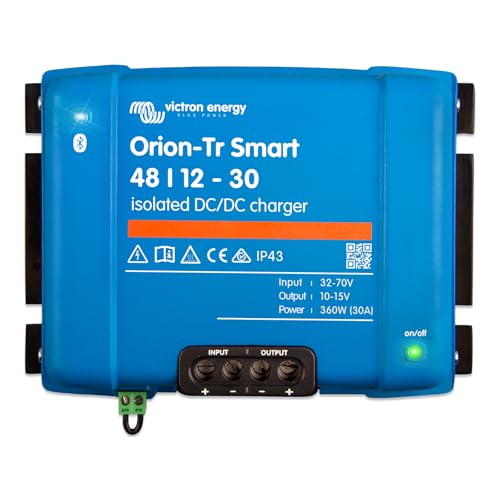
Similar to its 12/48V sibling, this Orion-Tr model targets dual-battery setups with Bluetooth-enabled oversight and three-stage charging. It is best for those who operate with an auxiliary service battery and want easy integration with Victron’s ecosystem. Choose this if you already use Victron components for consistency, remote monitoring, and system-wide diagnostics. Limitation: compatibility depends on your vehicle or vessel’s electrical layout and BMS requirements.
Buying Guide
What should I look for in a 12V to 48V battery charger?
- Voltage range: Ensure the charger covers the batteries you own, from 6V up to 72V options if needed.
- Battery chemistry support: Confirm compatibility with LiFePO4, Lithium-ion, AGM, Gel, Flooded, and Lead-Acid.
- Charging stages and efficiency: Look for multi-stage charging and high efficiency to minimize heat and waste.
- Desulfation/repair mode: Consider models offering pulse repair for aging lead-acid batteries, if applicable.
- Protection features: Overcurrent, short circuit, reverse polarity, overheat, and temperature compensation are important for safety.
- Monitoring and control: Bluetooth or app-based monitoring helps track charging status and adjust as needed.
- Best-use scenarios: Dual-battery systems, fleet management, off-grid setups, or recreational vehicles each have distinct needs.
FAQ
- Do these chargers support both lead-acid and lithium batteries?
Yes, all listed models support multiple chemistries, but verify each product’s exact compatibility for your battery type. - Can a 12V charger charge a 48V battery?
Not directly. Some models step up voltage, but you must confirm output specifications before attempting. - What is pulse desulfation?
Pulse desulfation sends short, high-voltage pulses to reduce lead-sulfate buildup, potentially reviving aging lead-acid cells. - Is Bluetooth monitoring necessary?
It’s optional but convenient for monitoring and adjusting charging remotely in some setups. - Should I choose an isolated DC-DC charger for dual-battery systems?
Yes, isolation helps protect the starting battery and prevents cross-charging issues in dual-battery configurations. - Do these chargers require professional installation?
Most are user-installable, but consult a professional for complex vehicle or marine electrical systems.