Best 12V Power Supply Chargers for Home and Auto Use
If you need reliable 12V charging and power options, these 5 Amazon-listed chargers cover common needs from LED lighting and routers to car batteries and RV systems. This guide helps you pick the right one for your device type and charging goals. Best for small electronics, budget upgrades, or seasonal maintenance, while some are ideal for RV or automotive use. The summary table below highlights each product’s core strengths to aid quick comparisons.
| Product | Best For | Key Benefit |
|---|---|---|
| GuanTing Universal AC Adapter 12V 2A | Small DC devices and LED strips | 11 plug tips and adjustable current |
| Clore Automotive PL2320 | Automatic battery maintenance | 6V/12V with auto operation |
| YONHAN 20A Maintainer | Car and vehicle batteries | Winter mode and repair capability |
| LitStar 12V 2A Regulated Adapter | Versatile 12V devices | Auto amperage identification |
| VEVOR 100A RV Converter | RV and high-demand 12V systems | Multi-stage charging up to 100A |
GuanTing Universal AC Adapter 12V 2A Power Supply Charger
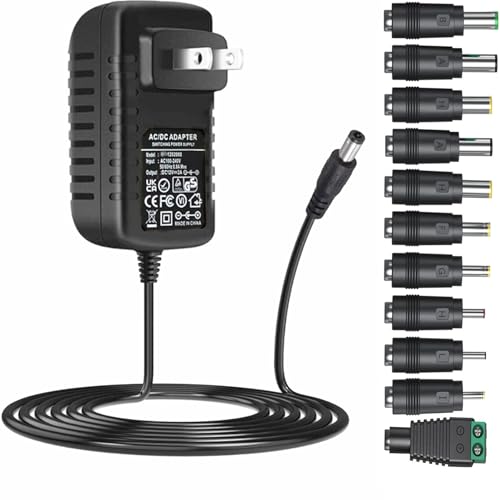
Best for: Small DC devices and LED lighting projects that need stable 12V output. This unit offers adjustable currents from 100mA to 2A with multiple plug tips, which broadens compatibility for devices with different barrel sizes. The included safety features—over-voltage, over-current, short circuit protection, and a fireproof shell—support durable daily use.
Why selected: Its wide adjustable current and 11 interchangeable tips make it a flexible travel- and workshop-friendly charger for many 12V gadgets.
Caution: Ensure your device’s input matches the selected current to avoid under- or over-powering sensitive electronics.
Clore Automotive PL2320 20-Amp Smart Charger

Best for: Vehicle batteries requiring automatic charging control. It supports multiple rates (2/10/20 Amp) and performs fully automatic operation, making it suitable for routine battery maintenance in cars, trucks, and SUVs.
Why selected: The automatic function reduces guesswork and helps prevent overcharging in a variety of 6V and 12V battery scenarios.
Caution: It is not a jump starter; it maintains and charges rather than delivering high cranking power.
YONHAN 20A Battery Maintainer

Best for: 12V and 24V lead-acid and LiFePO4 batteries in cars, boats, and maintenance cycles. It runs 7-stage charging, offers a repair mode, and adapts to temperature changes for winter storage.
Why selected: The high-efficiency repair mode can help bring aging or idle batteries back to life, with protections against reverse polarity and short circuits.
Caution: Not a jump starter; it requires an outlet and a connected battery to function properly. It may not revive completely dead cells.
LitStar 12V 2A Regulated Adapter

Best for: Flexible 12V electronics with automatic current identification. The adapter self-identifies the appropriate current and supports multiple plug options for a DIY-friendly setup.
Why selected: The automatic amperage matching minimizes risk to devices, while the 2A maximum suits many standard 12V gadgets.
Caution: Works best with devices in good working order; older equipment may require testing before use.
VEVOR RV Power Converter, 100 Amp

Best for: High-demand 12V systems in RVs and campers that need a stable supply and multi-stage charging. It provides up to 100A and supports both lead-acid and LiFePO4 batteries with configurable voltages.
Why selected: Its high current capacity and specialized charging modes make it suitable for larger batteries and heavy 12V loads on the road.
Caution: Larger and heavier unit; ensure your vehicle’s electrical setup can accommodate the converter’s input and space requirements.
Buying Guide
What will you power with a 12V charger?
For small electronics such as LED strips, routers, webcams, and garden lights, a 12V 1–2A supply is often enough. Larger devices, RV systems, or car batteries may require higher current or smart charging controls.
Is automatic regulation important?
Yes. Chargers with auto or smart regulation prevent overcharging and manage temperature, which extends battery life and protects devices.
Do you need multiple plug tips?
Yes if you plan to power different devices. Plugs of different barrel sizes are common, especially for legacy or older equipment.
What about safety features?
Look for over-voltage, over-current, short-circuit, and fireproof construction. Heat dissipation without fans can be a plus in quiet environments, but ensure adequate ventilation for higher power units.
Battery type compatibility
Check whether the charger supports lead-acid, AGM, GEL, LiFePO4, or deep-cycle batteries. Some models are specialized; others are versatile across several chemistries.
Portability versus power
Compact adapters are great for travel and small projects. High-amperage RV converters are intended for stationary setups and require mounting space and stable power sources.
FAQ
- What is the difference between a power supply and a battery charger? A power supply provides a stable output to devices, while a battery charger manages charging cycles for batteries and may include maintenance modes.
- Can I use a 12V charger for my car battery? Some chargers are designed for car batteries, especially 6V/12V maintainer types. Check the voltage and current specs and whether it supports lead-acid chemistry.
- Is an automatic charger safer for long-term battery maintenance? Yes. Automatic chargers adjust current and voltage to avoid overcharging and reduce battery wear during extended storage.
- Do I need a high-current charger for every device? Not always. Many household devices operate on 12V at 1–2A. Larger systems (RV, boats) benefit from higher amperage and smarter control.
- What should I check before buying? Compatibility with your device’s plug size, battery chemistry, current needs, and whether you need a maintenance mode or fast charging.
- Are these models safe for long-term use? Most include protections and fireproof construction, but follow manufacturer guidelines and ensure proper ventilation where heat is generated.