Best 12V Delay Relay Solutions for Timed Switching and Control
12V delay relays provide programmable on/off timing for automation, switches, and control circuits. This article highlights five reliable 12V delay relay options, describing their timing ranges, triggering methods, and input/output compatibility. Each product is chosen to cover common DIY and professional scenarios—garage projects, automotive wiring, lighting control, and industrial equipment. Read on for objective specs, practical uses, and a buying guide to help you pick the right module for your application.
| Product | Voltage Range | Timing Range | Key Use | Brand |
|---|---|---|---|---|
| GODIYMODULES 12V Delay Turn On/Off | 12V | 0.1s to 1h | Timed power to loads | GODIYMODULES |
| DROK 12V Timer Relay | 12V | 0.1s to 999min | Automotive and general timing | DROK |
| GRT8-M1 Multifunction Time Relay | 12-240V AC/DC | 0.1s to 10 days | Industrial, multi-function timing | IGEYAPA |
| Ferwooh NE555 Delay Timer | 12V | 0-10s | Automotive control, quick delays | Ferwooh |
| DC12V H3Y-2 Delay Timer | 12V | 0-60s | Industrial automation, component delay | LJJDSLYU |
GODIYMODULES 12V Delay Turn On/Off Switch Module

The GODIYMODULES 12V Delay Turn On/Off switch module provides a compact timer with selectable ranges from 0.1 seconds up to one hour. It includes protection against power reversal with a protection diode, enhancing reliability in fluctuating supply conditions. The unit is designed to handle relatively high current loads, supporting up to 10A for 30V DC or 250V AC, making it suitable for automotive accessories, lighting, and automation tasks. Its simple interface makes it accessible for hobbyists while remaining practical for small-scale projects requiring precise delay activation and deactivation.
DROK 12V Timer Relay with LED Display

DROK’s 12V Timer Relay features a four-mode timer with adjustable delay ranges from 0.1 seconds to 999 minutes. It supports multiple triggering sources—including positive power supply triggering, button, PNP sensor, and PLC signals—covering a wide array of applications. The wide timing range accommodates both short delays for automation sequences and longer delays for controlled processes. The unit’s optocoupler isolation helps resist electrical interference, improving reliability in environments with power fluctuations or nearby motors and relays.
GRT8-M1 Multifunction Time Relay

The GRT8-M1 is a versatile timer relay with a wide input voltage range (AC230V or DC 12-240V) and a 16A contact rating. It offers five time-function controls by power supply voltage and four by control input, plus a latching relay option. With a timing range from 0.1 seconds to 10 days, this module fits industrial equipment, lighting control, heating elements, and motor management where precise sequencing is crucial. LED indicators clearly show power status and active timing, aiding in setup and troubleshooting. It’s especially suitable for multi-step automation and complex delay patterns.
Ferwooh NE555 Delay Timer Module

The Ferwooh DC 12V NE555 delay timer module packs a precise 0–10 seconds delay with a high-precision potentiometer for output timing. It supports control of AC 250V/10A or DC 0–30V up to 10A, enabling a wide range of devices to be sequenced or switched after a short delay. The NE555-based design offers predictable timing and straightforward setup, making it well-suited for automotive sequences, small machinery, and light automation tasks where quick, repeatable delays are needed.
DC12V H3Y-2 Delay Timer
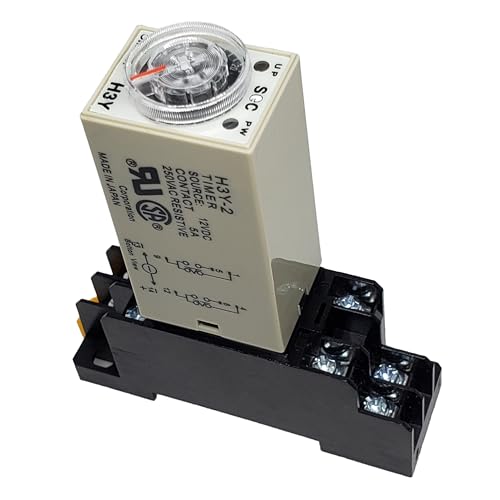
The DC12V H3Y-2 delay timer is a compact 12V module with a 0–60 second timing window and a DPDT contact arrangement (8-pin base). It’s designed for industrial automation, where a short, reliable delay is necessary before enabling a circuit, actuator, or motor. The device supports 240VAC at 5A, enabling safe operation for standard control circuits. The 8-pin configuration makes it easy to integrate into DIN rail installations or compact control boxes where space is at a premium.
Baomain Time Relay TBT7-C1

Baomain’s TBT7-C1 time relay provides 0.1s to 10 days in a single unit with both 12V and 240V compatible operation. It features a SPDT contact (one NO, one NC) and is suitable for DIN rail mounting, making it a solid choice for panel installations requiring a clear off-delay or timed-on sequence. With a broad voltage range and configurable timing, this relay supports diverse automation needs—from lighting to motor control and beyond.
Buying Guide: Key Considerations for 12V Delay Relays
- Timing Range and Resolution: Check whether your application needs milliseconds, seconds, minutes, or days of delay. Some modules offer 0.1s steps, while others provide coarser scaling. Choose a unit that matches the precision your project requires.
- Triggering Method: Consider how the relay will be activated. Options include power-on delay, button or switch, sensor input (PNP/NPN), or PLC signals. Multi-trigger capabilities can simplify integration in complex systems.
- Voltage and Current Ratings: Ensure the relay’s input voltage (usually 12V DC for these modules) and its output contact ratings fit your load. Some models tolerate high currents (10A or more) at DC or AC to drive lights, motors, or solenoids.
- Isolation and Interference: Optocoupler isolation helps prevent control circuits from being affected by load transients. This is important in environments with motors, heavy equipment, or power line noise.
- Power Supply Voltage Range: A unit that accepts a broad voltage range is more flexible in mixed systems. Some relays operate on AC/DC ranges that facilitate DIN-rail installations and broader compatibility.
- Mounting and Form Factor: Consider whether you need DIN rail mounting, enclosure integration, or a compact inline module. Space constraints and cabinet layouts often dictate the best choice.
- Indications and Diagnostics: LED indicators or LCD displays help with setup and troubleshooting. Clear status cues reduce debugging time in field deployments.
- Durability and Environment: For automotive or harsh environments, look for sealed relays or devices with protective features to resist moisture, dust, and vibration.
When selecting a 12V delay relay, balance timing needs with load requirements, triggering flexibility, and installation constraints. The options highlighted here cover short delays for automotive and control panels to longer delays for industrial sequencing. Always verify the exact load ratings and safety specifications before wiring any relay into a live circuit.