Best 12V Deep Cycle Battery 100Ah for RV and Solar
Choosing a reliable 12V 100Ah deep cycle battery is essential for RVs, solar setups, boats, and off‑grid projects. This guide highlights five top AGM options and compares features, durability, and suitability across common applications. Each pick is evaluated for maintenance needs, discharge performance, temperature tolerance, and compatibility with solar charging or trolling motors.
| Product | Brand | Type |
|---|---|---|
| Weize Deep Cycle AGM 12V 100Ah | WEIZE | AGM |
| Renogy Deep Cycle AGM 12V 100Ah | Renogy | AGM |
| UPLUS 12V 100Ah Deep Cycle | UPLUS NEW TECHNOLOGY BATTERY | AGM |
| Interstate Batteries Marine 12V 100Ah | Interstate Batteries | AGM Marine |
| VEVOR Deep Cycle 12V 100Ah AGM | VEVOR | AGM |
Introduction to these five options and their core strengths: AGM chemistry for maintenance-free operation, strong deep-discharge capabilities, and broad compatibility with RVs, boats, solar systems, and camping setups. While lithium options exist, these AGM models provide solid performance at a lower upfront cost and familiar charging profiles for many users. The selections below are organized to help you compare size, weight, connector layout, and max discharge characteristics at a glance.
Weize 12V 100Ah AGM Battery
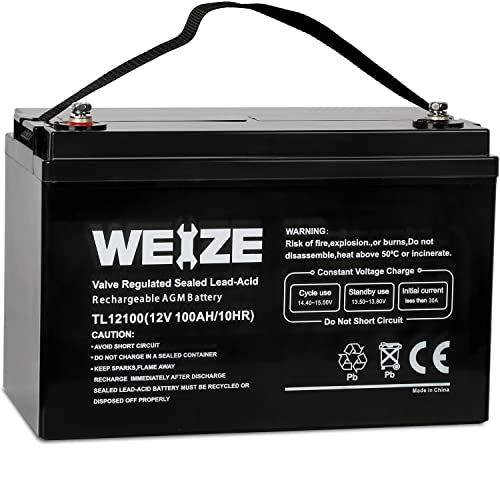
The Weize Deep Cycle AGM 12V 100Ah battery is designed for maintenance-free operation with AGM technology, improving safety by reducing acid leakage risk. Its dimensions (about 12.99 x 6.73 x 8.43 inches) fit typical battery boxes used in RVs, boats, and off-grid setups. The unit supports a robust 1100A max discharge current for short bursts and is optimized for storage with a low self-discharge rate. This model emphasizes stable performance across a wide charging temperature range and is suitable for solar, trolling motors, and marine applications where a compact, reliable power source is needed.
Key considerations: maintenance-free design, storage longevity, and compatibility with standard 12V charging systems. Consider how the quoted operating temperature range aligns with your climate and whether a higher discharge surge is necessary for your gear or equipment.
Renogy 12V 100Ah AGM Deep Cycle Battery

Renogy’s Deep Cycle AGM battery is a trusted name with a strong safety record and versatile connectivity. It is designed to support series or parallel configurations (up to 4P), enabling larger systems for RVs, cabins, or off-grid homes. The safety-focused chemistry and sealed design reduce maintenance concerns and simplify troubleshooting compared with other chemistries. Its popularity comes from a proven track record and broad compatibility with camping, marine, and solar installations, making it a reliable choice for many power systems.
Considerations include the ease of expansion through parallel connections, the reliability of the internal components, and the battery’s compatibility with your existing charging hardware and solar controllers. For users planning a multi-battery array, Renogy’s options can offer scalable performance while maintaining safe operation.
UPLUS 12V 100Ah Deep Cycle AGM Battery

The UPLUS 100Ah AGM battery emphasizes a true maintenance-free experience with a thick AGM separator and a robust 60-amp hour capacity and a wide temperature operating window. The product notes a practical 80% depth of discharge guideline, aligning to longer cycle life when used responsibly. A two-year warranty adds an additional layer of protection for RVs, solar installations, camping, and other off-grid uses. This unit emphasizes safe handling, minimal leakage risk, and compatibility with standard AGM charging practices.
When evaluating UPLUS, consider the recommended charging rate (0.25C) and ensure your charger supports AGM batteries within that range. Its Group 27/27-like dimensions are important for fit in many common battery compartments and cases used in recreational vehicles and boats.
Interstate Batteries 12V 100Ah Marine AGM

The Interstate Batteries 12V 100Ah Marine AGM is a dual-purpose deep-cycle option designed for heavy-duty marine use, with features aimed at sustaining power for trolling motors, electronics, and auxiliary equipment aboard vessels. The design focuses on thick plates to extend life through deep discharge cycles, with an emphasis on durability for continual use in demanding marine environments. The battery is marketed as tough, reliable, and capable of sustaining power over multiple cycles in tough conditions.
Key considerations include its marine suitability, heavy-duty construction, and how it compares to other AGM options in long-term trolling motor and electronics runtimes. Check your boat’s battery compartment size and the compatibility of terminals and mounting hardware with Interstate’s standard configurations.
VEVOR 12V 100Ah AGM Deep Cycle Battery

VEVOR’s AGM deep cycle battery highlights a high discharge rate with a maximum of 800A in 5 seconds, designed for apps that demand robust surge power such as lighting, small appliances, or auxiliary electronics in RVs and off-grid setups. It emphasizes a no-maintenance approach and a compact footprint along with high-temperature resistance. The labeling notes the need for appropriate charging equipment to optimize safety and performance, suggesting a careful pairing with compatible chargers and solar controllers.
Consider the trade-off between high discharge capability and the accompanying weight and dimensions. Ensure your charging system can safely handle the higher surge currents without triggering protection on your equipment or controller.
Buying Guide: Key Purchase Considerations
- Battery chemistry and maintenance: AGM offers maintenance-free operation with sealed design, which reduces leakage risk and water topping up. For longer life in cold or hot climates, review the temperature ranges and recommended charging practices.
- Capacity and discharge: A 100Ah rating indicates energy storage at a certain depth of discharge. For RVs and off-grid systems, consider maximum sustained load and the recommended DoD (depth of discharge) to maximize cycle life. Lithium options may provide higher cycle counts but at a higher upfront cost.
- Compatibility with charging equipment: Ensure your charger, solar controller, and battery management system (BMS) support 12V AGM chemistry with the correct charging profile. A 0.25C charging rate is common for AGM 100Ah batteries; verify your charger’s output.
- Temperature tolerance: Choose a battery with a wide operating temperature range that matches local conditions. Some models list charging and discharging temperatures explicitly; others rely on built-in protections under the BMS or conduction limits of the enclosure.
- Physical fit and terminals: Check dimensions, weight, and terminal type to ensure fit in your battery box or chassis. Some models use standard AGM terminal layouts that fit common RV and marine boxes, while others may have variations in post positions.
- Durability and warranty: AGM batteries vary in warranty length and performance guarantees. Marine and off-grid applications often justify longer warranties due to harsher operating routes and frequent cycling.
- Expansion potential: If your system may grow, consider options that allow parallel connections (for more capacity) or series configurations, especially when integrating with solar setups or higher voltage systems.
- Usage profile: For trolling motors, high surge current capability matters. For solar storage, long-term cycle life and low self-discharge can be more important than peak discharge.
Overall, the five options presented balance maintenance requirements, robustness, and compatibility with common recreational and off-grid power systems. By comparing the specific features—such as max discharge current, self-discharge rate, and temperature tolerance—you can align the best fit to your application, whether it’s powering an RV, a boat, or a remote cabin.