Best 12V DC Automatic Transfer Switches for Reliable Power
Answering the need for seamless power between primary sources and backups, these 12V DC automatic transfer switches help keep essential devices online during outages or unstable power conditions. Best for RVs, off-grid cabins, small data setups, and home backup systems, each option balances fast switching, voltage range, and current capacity to fit different loads. This guide highlights five top picks with clear pros, best-use scenarios, and practical cautions to aid swift decision-making.
| Product | Voltage Range | Current (A) | Best For |
|---|---|---|---|
| Yinhing DC Auto Transfer Switch | 12V–48V | 10 | Simple battery backup for basic setups |
| Frasiu DC Automatic Transfer Switch 8A | 5V–40V | 8 | Routers, Starlink, small off-grid rigs |
| Frasiu DC 5–40V 13A | 5V–40V | 13 | RV, CCTV, higher-demand DC loads |
| OONO F-1080 DC Transfer Switch | 6V–36V | 8 | Compact backup for smart devices |
| Autoro AB20D 60V/20A | 5V–60V | 20 | Large off-grid, RVs, critical systems |
Note: The table reflects listed capabilities and typical use cases. Always verify your exact input sources, battery types, and load requirements before selecting a switch.
Yinhing 12V–48V DC Auto Transfer Switch

This device automatically switches to battery power when the main source is unavailable and reconnection occurs automatically when the main power returns. It uses screw terminals for straightforward wiring. Best for buyers seeking a compact, easy-install power switch for basic 12V to 48V systems. Caution: Only as capable as its rated 10A current for higher-wattage devices; plan loads accordingly.
Frasiu 8A DC Automatic Transfer Switch

Best for routers, Starlink Mini, and small off-grid setups requiring uninterrupted operation. It switches between primary and backup sources in under 300 microseconds and offers a wide 5V-40V input range with a digital display for monitoring. Caution: Higher current models are better for power-hungry devices; this is optimal for modest loads.
Frasiu 13A Dual Power Transfer Switch
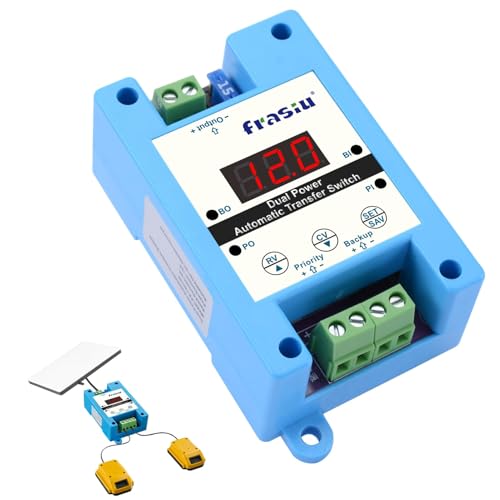
Best for RVs and solar setups needing stronger 13A output and broad 5V-40V DC compatibility. Features include fast switching, wide input voltage, and safety designs like anti-backflow. Choose this if you run higher-demand devices or 12V- to 24V-based systems. Limitation: Not every device will tolerate the 0.3ms switch without transient effects; assess critical equipment tolerance.
Autoro AB20D 60V/20A Transfer Switch

Best for large off-grid systems and RVs requiring robust 20A per channel capacity with a wide 5V-60V input range. It supports LiFePO4 and LiPO batteries, dual-source detection, and anti-backflow protection. Caution: The device may be over-specified for tiny setups; ensure wiring and enclosure fit your installation space.
Autoro AB20B 30V/20A Transfer Switch

Best for 12V and 24V systems needing reliable 20A per channel with a 5V-30V range. It offers seamless 0-second switching and anti-backflow protection. Choose this if you want a balance of affordability and capability for mid-sized off-grid setups. Limitation: 30V ceiling means not suitable for higher-voltage DC systems.
RPTCOTU 5–60V 8A Transfer Switch

Best for IP68-rated indoor/outdoor use with 5-60V input and under 10ms transfer. Suitable for harsh environments and outdoor installations such as near generators or emergency lighting. Caution: The 8A current limit may constrain larger inverters or high-draw devices.
Buying Guide
What is a DC automatic transfer switch and when do you need one?
A DC automatic transfer switch (ATS) detects a primary power loss and automatically switches to a backup DC source, then returns when the main power is restored. It helps prevent downtime for essential devices like routers, cameras, alarm systems, and small inverters.
Key considerations for selection
- Voltage range: Ensure compatibility with your system’s DC voltage (common ranges include 5–60V).
- Current rating: Match or exceed the total load you expect to power; higher current supports more devices.
- Switching speed: Faster switching reduces momentary disruption for sensitive equipment.
- Protection features: Look for anti-backflow, surge protection, and proper isolation.
- Environment: Outdoor-rated enclosures and IP ratings are important for external installations.
- Installation: Check whether the unit uses screw terminals and how compact it is for your cabinet or vehicle.
How to compare options effectively
- Best for high-demand loads: prefer models with 20A per channel and wide voltage ranges.
- Best for sensitive electronics: prioritize devices with microsecond-level switching and robust isolation.
- Best for outdoor use: choose IP-rated enclosures and durable housings.
Installation tips
- Plan your wiring path to avoid voltage drops and ensure accessible screw terminals.
- Label input and output connections for quick future maintenance.
- Verify battery type compatibility (lead-acid, LiFePO4, LiPO) with the chosen switch.
FAQ
- Q: Do these switches work with solar panels?
- A: Yes, many models support solar panel inputs as backup sources, within their voltage range.
- Q: Can I use these with 24V systems?
- A: Several models support up to 60V, which includes 24V configurations; check the exact voltage range.
- Q: Is 0-second switching always guaranteed?
- A: Most models advertise near-instant switching; actual performance depends on load and source conditions.
- Q: Are these suitable for critical data equipment?
- A: Choose units with fast switching and robust isolation, and verify compatibility with the devices’ input requirements.