Best 12V Battery Trolling Motors for Reliable Onboard Power
Answering the need for dependable power while trolling, this guide spotlights 12V battery options that pair well with trolling motors. The best picks suit boaters seeking long-lasting cycles, maintenance-free operation, and safer LiFePO4 chemistry. This overview helps anglers, seasonal boaters, and RV owners choose a compatible power source withoutOverpaying for features they won’t use. The top products below are selected for compatibility with standard trolling motors and common battery boxes.
| Product | Type | Best For |
|---|---|---|
| Newport 12V50Ah Deep Cycle AGM | AGM Lead-Acid | Lightweight, easy install |
| SUPER EMPOWER 12V 100Ah LiFePO4 | LiFePO4 | Long life, deep cycle, high density |
| Litime 12V 100Ah LiFePO4 (Group 31) | LiFePO4 | Low weight, strong protection |
| Litime 12V 100Ah LiFePO4 (2-Pack) | LiFePO4 | Bluetooth monitoring, dual-pack |
| WEIZE 12V 100Ah AGM | AGM Lead-Acid | Maintenance-free, reliable |
Newport 12V50Ah Deep Cycle AGM Battery

The Newport 12V50Ah is a sealed AGM lead-acid battery designed for trolling motors. It weighs about 32 lbs, balancing portability with steady power for extended outings. The sealed construction reduces risk of leaks, making it a solid option for salt or freshwater boats. It is best for boaters who want a straightforward replacement that installs quickly and works with most standard trolling motors. Caution: AGM batteries require proper venting in enclosed spaces and should be secured during rough water.
Who this is best for: anglers and casual boaters who prioritize a lightweight, maintenance-free AGM option with reliable, consistent output. Why selected: the 50Ah capacity provides enough runtime for typical day trips, while the sealed design minimizes maintenance and risk of spills. Use this if you want a simple install with familiar lead-acid chemistry and widely available replacement units.
Limitation: not a high-end energy density option; heavier than LiFePO4 but often more economical upfront and widely compatible with older trolling systems.
SUPER EMPOWER 12V 100Ah LiFePO4 Battery

This 12V 100Ah LiFePO4 pack is designed for deep cycle energy storage and includes an integrated BMS for protection against overcharge, over-discharge, overcurrent, and temperature extremes. It is described as a drop-in replacement for lead-acid setups in marine and RV contexts, with an emphasis on long cycle life (thousands of cycles at various DoD levels). It is best for users who want maximum lifespan and weight savings. Caution: marketed as energy storage rather than engine starting, so verify compatibility with your trolling motor’s power management.
Who this is best for: boaters and RV users seeking a long-lasting, maintenance-free power source with high cycle counts. Why selected: 100Ah capacity and LiFePO4 chemistry offer substantial weight savings and resilience for marine environments. Choose this if you want a heavy-duty, long-life replacement for traditional lead-acid packs.
Limitation: not suitable for starting engines or high-current cranking applications; ensure your system is designed for LiFePO4 storage batteries.
Litime 12V 100Ah LiFePO4 Group 31 Battery
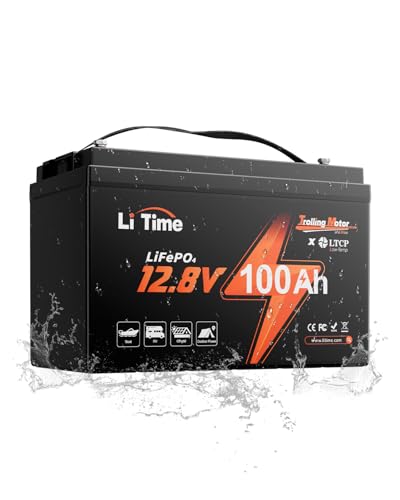
This LiFePO4 model from Litime weighs about 22 pounds, offering significant weight reduction over lead-acid equivalents. It features a built-in 100A BMS, low-temperature protection, and ABYC-compliant safety measures. Best for owners who want a lighter system with robust cold-weather protection. Caution: ensure your charger supports LiFePO4 charging profiles to protect the battery and maximize life.
Who this is best for: motorized boats needing a light, durable power source for trolling motors and auxiliary systems. Why selected: strong protection, 15,000 cycles at optimistic DoD, and compatibility with standard Group 31 compartments make it a versatile option. Choose this if weight reduction and safety features are priorities.
Limitation: higher upfront cost compared to AGM, but longer life and better performance in cold conditions can compensate over time.
Litime 12V 100Ah LiFePO4 Dual Pack

This 2-pack LiFePO4 offering from Litime emphasizes Bluetooth monitoring and a 100A BMS with low-temperature protection. It supports up to 15,000 deep cycles and includes IP65 rating for dust and water resistance—an advantage in marine environments. Best for boaters who want remote status checks and the option of expanding capacity without rewiring. Caution: ensure your trolling motor and charging system can support dual-battery operation and Bluetooth monitoring without interference.
Who this is best for: users who want modern energy management with remote visibility and expandability. Why selected: Bluetooth connectivity and dual pack options provide simple, scalable power for longer trips or higher power needs. Choose this if you plan to run multiple accessories from 12V with a future expansion in mind.
WEIZE 12V 100Ah AGM Battery

The WEIZE AGM is a maintenance-free, sealed lead-acid option with a 100Ah rating and a 1100A max discharge current. It’s positioned as a reliable all-purpose battery for RVs, solar systems, trolling motors, and marine applications. Best for buyers seeking a traditional AGM with solid performance and low upkeep. Caution: AGM batteries can be heavier than LiFePO4 and require proper venting in enclosed spaces.
Who this is best for: boaters who want a straightforward, maintenance-free option with broad compatibility and proven performance. Why selected: strong discharge capabilities and low self-discharge make it a dependable everyday choice for trolling motor setups. Choose this if you value proven technology and wide aftermarket support.
Buying Guide: Key Considerations For Your 12V Trolling Motor Battery
Battery chemistry matters. AGM batteries offer robust, maintenance-free operation and lower upfront cost, while LiFePO4 batteries provide longer life, lighter weight, and faster charging. Consider your boat size, typical trip length, and climate when choosing.
Battery Chemistry And Life
- AGM Lead-Acid: good for traditional setups, generally heavier, lower cycle life.
- LiFePO4: higher energy density, longer cycle life (often thousands of cycles), lighter weight, safer with integrated BMS.
Weight, Space, And Compatibility
- Group size and footprint should fit your battery compartment or box.
- Ensure your trolling motor controller and charger profiles match the battery chemistry.
Protection And Durability
- Look for built-in BMS in LiFePO4 options for overcharge, overdischarge, and temperature protection.
- IP ratings and water resistance are beneficial for exposed marine environments.
Runtime And Depth Of Discharge (DoD)
- Higher DoD ratings extend usable capacity; LiFePO4 often allows deeper DoD with less impact on life.
- Estimate runtime by multiplying amp-hour (Ah) rating by DoD and motor amp draw.
Charging And Wiring Compatibility
- Check your charger’s compatibility with LiFePO4 vs. lead-acid charging profiles.
- Consider whether you’ll upgrade to Bluetooth monitoring or expand to a dual-battery setup.
Cost Of Ownership
- LiFePO4 typically costs more upfront but lasts longer and weighs less, which can save on maintenance and handling over time.
- AGM provides a lower initial investment and solid reliability for standard trolling motor use.
Practical Buying Checklist
- Confirm battery size and group compatibility with your boat’s box.
- Match battery chemistry to motor requirements and charger capabilities.
- Consider future upgrades: single vs. dual battery configurations, remote monitoring.
FAQs
- What’s the main difference between AGM and LiFePO4 for trolling motors?
– AGM is maintenance-free and widely compatible but heavier with shorter cycle life; LiFePO4 is lighter, longer-lasting, and safer with advanced protection, but higher upfront cost. - Can I use any 12V battery for a trolling motor?
– Compatibility depends on the motor’s current draw, voltage, and the charger’s profile. Check the motor’s manual and the battery’s discharge rating. - Is a dual-battery setup better for longer trips?
– Yes, it can provide extended running time and allow separate power circuits; ensure proper wiring and a robust charging plan. - Do LiFePO4 batteries work in cold conditions?
– They typically have enhanced low-temperature protection, but performance can still be affected below certain temperatures; some models stop charging below 32°F (0°C). - What maintenance should I expect with AGM batteries?
– AGM requires minimal maintenance beyond periodic cleaning and ensuring proper venting in enclosed spaces.