Best 12V Battery Charger for Motorcycles: Top Picks for Power and Maintenance
Answering your search for a reliable 12V motorcycle battery charger, these picks cover smart charging, maintenance, and longevity. Ideal buyers: casual riders needing a compact trickle charger; seasonal storage users seeking float maintenance; and endurance riders needing heavy-duty support for deep-cycle or lithium batteries. The list below focuses on 12V options that work well with lead-acid variants and many also support LiFePO4 batteries. Read on to compare features, suitability, and practical trade-offs.
| Product | Best For |
|---|---|
| NOCO GENIUS1: 1A 6V/12V Smart Battery Charger | Compact daily maintainer for bikes and small fleets |
| Foval Automatic Trickle Battery Charger 12V 1000mA | Budget-friendly, versatile for multiple vehicles |
| Unocho 6V/12V Battery Charger Maintainer 1.5A | All-around maintenance with robust safety features |
| NOCO GENIUS2: 2A 6V/12V Smart Battery Charger | Higher-power maintainer for larger batteries |
| Battery Tender Junior 12V, 750mA | Simple, reliable float charging for storage seasons |
NOCO GENIUS1: 1A 6V/12V Smart Charger

The NOCO GENIUS1 serves as a compact charger, maintainer, and desulfator. It supports 6V and 12V lead-acid batteries (including flooded, AGM, Gel, VRLA) and LiFePO4 lithium batteries. An integrated thermal sensor adjusts charging with ambient temperature to prevent overcharging in heat or undercharging in cold, optimizing battery life. Best for riders with a small battery portfolio or those who value space-saving design and automatic protection.
- Best for: riders needing a small, automatic maintainer for both lead-acid and LiFePO4 cells.
- Key advantage: temperature-compensated charging improves battery longevity.
- Limitation: 1A charging rate may be slow for deeply discharged packs.
Foval Automatic Trickle Battery Charger 12V 1000mA
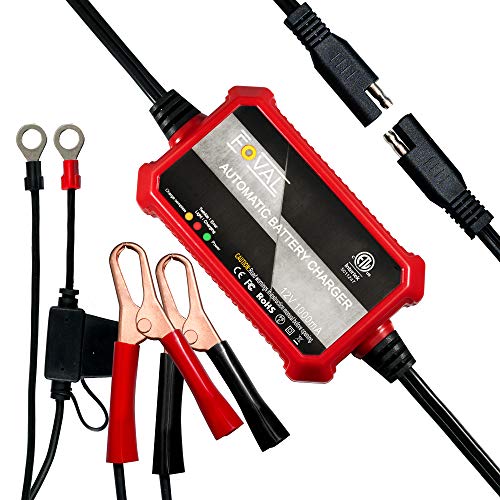
The Foval charger offers automatic 4-step charging (Initialization, Bulk, Absorption, Float) and functions as a maintainer, trickle charger, and desulfator. It ships with long cables and interchangeable connectors for diverse vehicles. Best for riders seeking a versatile, compact unit with broad vehicle compatibility and safe float maintenance.
- Best for: motorcycle owners who want a flexible charger for various vehicles including ATVs and boats.
- Key advantage: 4-step program plus long cables for easy reach.
- Limitation: 1A may not fully charge a deeply depleted battery quickly.
Unocho 6V/12V Battery Charger Maintainer 1.5A

The Unocho model supports 6V and 12V lead-acid batteries, including AGM, GEL, VRLA, WET, and deep-cycle. It runs a 5-stage smart charge, with built-in safety protections (reverse polarity, short circuit, over-voltage, over-current, thermal). It’s a practical choice for seasonal storage or active use across different machines (cars, motorcycles, boats, ATVs).
- Best for: owners needing a versatile, safety-first charger with a built-in timer and fuse.
- Key advantage: strong protection features and multi-vehicle compatibility.
- Limitation: specification may require longer charge times for large, deeply discharged packs.
NOCO GENIUS2: 2A 6V/12V Smart Charger

The GENIUS2 expands on the GENIUS1 with higher power and efficiency. It supports a broad range of lead-acid and lithium chemistries, including Flooded, Gel, AGM, and LiFePO4. A notable feature is Force Mode to manually override sensing and re-charge low-voltage batteries. Best for riders with larger or multiple batteries who need faster, flexible charging in a compact package.
- Best for: riders needing quicker charging and a more powerful 2A option.
- Key advantage: Force Mode for stubborn, low-voltage packs.
- Limitation: higher price point relative to 1A models.
Battery Tender Junior 12V, 750mA

The Battery Tender Junior provides a simple, dependable float-charge for 12V batteries. It follows a 4-step charging program (Initialization, Bulk, Absorption, Float) and is especially popular for long-term storage, with a 12-year legacy in the market. Best for riders who want a hands-off, durable maintainer with minimal setup.
- Best for: vehicles kept in storage or used seasonally, needing steady maintenance.
- Key advantage: long-standing reliability and an easy-to-use interface.
- Limitation: lower amperage means slower recovery from deep discharge than higher-amp models.
Buying Guide: How To Choose The Right 12V Motorcycle Charger
- Battery type compatibility: Confirm lead-acid varieties (Flooded, AGM, Gel, VRLA) and whether LiFePO4 is supported if you own a lithium-based battery.
- Charging rate: Higher amps charge faster but may be unnecessary for small motorcycle batteries. For bikes, 1A–2A is typical; 750mA–1A is adequate for maintenance.
- Smart features: Look for temperature compensation, auto-maintain/float mode, and desulfation capabilities to extend battery life.
- Safety protections: Reverse polarity, short circuit, over-voltage, and thermal protection reduce risk during charging.
- Portability and connectors: Long cables and versatile connectors (rings, alligator clips) improve accessibility for hard-to-reach batteries.
- Maintenance vs. charging focus: If you store bikes for months, prioritize float maintenance and desulfation; if you ride often, consider a higher-current model for quicker top-offs.
Frequently Asked Questions
- What is the difference between a charger and a maintainer?
– A charger adds charge to a battery; a maintainer keeps a battery at full charge and prevents drain during storage. - Can I use a car battery charger on a motorcycle?
– Yes, if the charger supports 12V motorcycle batteries and has proper safety protections. - Is a desulfator important for lead-acid batteries?
– Desulfation helps improve older or idle lead-acid batteries by reducing sulfate buildup, potentially extending life. - Should I choose 1A or 2A for my bike?
– For regular topping-off and maintenance, 1A is sufficient; 2A is better for quicker recovery on larger or deeply discharged packs. - Will these chargers work with LiFePO4 batteries?
– Some models do; verify LiFePO4 support in the product specifications to ensure compatibility.