Best 12v 3ah Battery Charger Options for LiFePO4 and Lead-Acid Applications
Answers for buyers seeking a 12V charger around 3 amps that supports LiFePO4 or traditional lead-acid batteries. This guide highlights five compatible models, who they’re best for, and practical buying tips. Ideal for hobbyists, contractors, or daily drivers who want reliable charging without overspec or underperforming units. The top picks cater to LiFePO4 batteries, standard lead-acid SLA/AGM setups, and mixed-use vehicles. Below is a quick comparison table and concise reasoning to help you decide quickly.
| Product | Battery Type Supported | Key Benefit | Best For |
|---|---|---|---|
| ThePRO 12V 3A LiFePO4 Charger | LiFePO4 (4S 12.6V) | Smart CC/CV charging with automatic shutdown and protections | LiFePO4 users needing safe, optimized LiFePO4 charging |
| 12V 2A Lead-Acid Charger (HECHOBO) | Lead-Acid (12V SLA/AGM, maintenance-free) | LED status indicators and multiple safety protections | Maintenance and restoration of 12V lead-acid batteries |
| 1.75-Amp Car Battery Charger (NEXPEAK) | Lead-Acid and LiFePO4 compatibility (general use) | 7-stage charging with LCD display and desulfation | All-around use for cars, motorcycles, boats needing clear status |
THEPRO 12V 3A LiFePO4 Battery Charger

The THEPRO charger is designed specifically for 12V LiFePO4 (4S 12.6V) batteries. It delivers 14.6V at 3.0A with constant current and constant voltage charging. Automatic shutdown halts charging when full, and multi-level protections guard against overcharge, overheat, and short circuits. This model is best for LiFePO4 packs where battery longevity and stable voltage matter most. A potential limitation is that it is specialized for LiFePO4 and may not be ideal for general lead-acid setups.
12V 2A Lead-Acid Charger and Maintainer (HECHOBO)

This charger is a practical choice for 12V valve-regulated lead-acid batteries found in motorcycles, cars, boats, and ATVs. It includes reverse polarity protection and over-voltage safeguards, plus an ABS shell for fire resistance. It provides automated monitoring to maintain battery health and shows loading status via LEDs. Choose this if you mainly deal with lead-acid batteries and want a simple, protective maintainer. A limitation is its 2A output, which may be slower for larger batteries.
1.75-Amp Car Battery Charger (NEXPEAK)
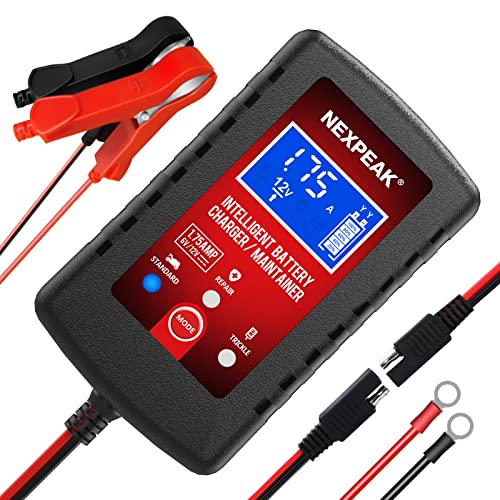
NEXPEAK offers a compact 4-in-1 solution: charger, maintainer, trickle charger, and desulfator. It supports 6V and 12V systems across lead-acid batteries and many LiFePO4 options, making it a versatile option for multi-battery setups. The built-in LCD provides charging status, percentage, and voltage. The 7-stage program includes desulfation to extend battery life. Best for users who want a multitool charger with clear feedback. Limitation: 1.75A is modest for large 12V batteries.
12V 3A Lithium Battery Charger (QKR)

The QKR charger targets 12V LiFePO4 packs (4S 12.8V) with fast, efficient charging at 14.6V and 3A. It provides CE and RoHS compliant protection against overtemperature, reverse polarity, output short circuits, and over-voltage. An indicator LED helps monitor status, and a cooling fan protects against overheating. Best for LiFePO4 users who want robust protections and a clear status indicator. Limitation: data notes do not specify long-term cycling performance under continuous use.
Buying Guide
What should you consider when choosing a 12V charger around 3A?
- Battery chemistry compatibility: If you own LiFePO4, pick a charger labeled for LiFePO4 to optimize charging profile and longevity.
- Charging profile: Look for CC/CV charging, multi-stage charging, desulfation, and temperature compensation where applicable.
- Protection features: Prioritize overcharge, overheat, reverse polarity, and short-circuit protections for safety and battery life.
- Output and charging speed: 3A is steady for small to mid-size packs; larger 12V batteries may require higher amps for faster charging.
- Maintenance vs. charging: If you store batteries long-term, a maintainer function can prevent self-discharge and sulfation.
- Display and usability: An LCD readout or LED indicators help track progress, while a compact form factor aids in space-limited setups.
Frequently Asked Questions
- What is the difference between a LiFePO4 charger and a lead-acid charger?
A: LiFePO4 chargers follow a charging profile tailored to lithium iron phosphate chemistry, while lead-acid chargers optimize charging curves for SLA/AGM/GEL chemistry. Using a LiFePO4 charger on LiFePO4 batteries helps maximize life; using a lead-acid charger on LiFePO4 can reduce performance and lifespan. - Can I use a 12V charger with multiple battery types?
A: Some chargers claim multi-chemistry support, but best practice is to match the charger to your battery type to ensure correct voltage and current. - Is a 3A charger suitable for all 12V batteries?
A: It works well for small to mid-size 12V packs; larger automotive or deep-cycle batteries may charge slowly at 3A. - What protections should I expect?
A: Look for overcharge, overheat, reverse polarity, short-circuit, and over-voltage protections to safeguard both battery and device. - Should I choose a dedicated LiFePO4 charger for LiFePO4 packs?
A: Yes, dedicated LiFePO4 chargers generally maintain optimal voltage (around 14.6V for certain packs) and extend cycle life compared to generic chargers. - Do these chargers include maintenance modes?
A: Several models offer a maintenance or float mode to keep batteries topped off during storage without damaging them.