Best 12V 100Ah Battery Options for RV, Solar and Off-Grid
Choosing a reliable 12V 100Ah battery is essential for RV adventures, off-grid setups, and solar storage. This article reviews five well-regarded options, including AGM and LiFePO4 chemistries, to help you compare lifespan, safety, maintenance, and performance. Each product is evaluated on its compatibility with deep-cycle use, temperature tolerance, and system integration. Readers will find practical guidance for selecting a battery that fits their power needs, space, and budget.
Summary of featured products:
| Product | Brand | Chemistry | Capacity | Notable Feature |
|---|---|---|---|---|
| Weize Deep Cycle AGM 12V 100Ah | WEIZE | AGM | 100Ah | Low self-discharge, maintenance-free |
| 12V 100Ah LiFePO4 — SUPER EMPOWER | SUPER EMPOWER | LiFePO4 | 100Ah | Long cycle life, built-in BMS |
| Renogy Deep Cycle AGM 12V 100Ah | Renogy | AGM | 100Ah | Safe chemistry, versatile connections |
| UPG UB121000 12V 100Ah | UPG | AGM | 100Ah | Maintenance-free, spill-proof |
| VEMDIA 12V 100Ah LiFePO4 Group 31 | VEMDIA | LiFePO4 | 100Ah | Built-in 100A BMS, high temperature protection |
Weize 12V 100Ah AGM Deep Cycle Battery
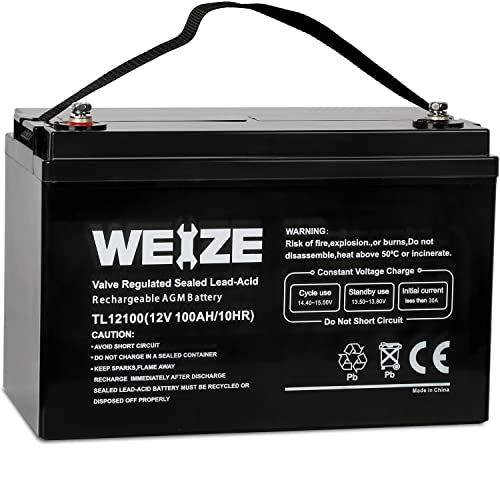
The Weize deep cycle AGM 12V 100Ah battery is designed for low-maintenance operation with AGM technology to minimize acid leakage risks. It features a compact 12.99 x 6.73 x 8.43 inch footprint and a 1-3% monthly self-discharge rate, which supports longer storage between uses. Its 1100A max discharge current (5 seconds) provides strong short-term power for equipment like trolling motors and inverters. The battery operates across a wide temperature range, helping prevent performance loss in outdoor setups. Suitable for RVs, solar storage, and off-grid systems, it balances reliability with manageable weight and size.
SUPER EMPOWER 12V 100Ah LiFePO4 Deep Cycle Battery

The SUPER EMPOWER LiFePO4 12V 100Ah battery emphasizes longevity and safety, offering a claimed 5000+ cycles at 100% DoD and up to 15000 cycles at lower DoD. It includes a built-in BMS for overcharge and over-discharge protection, and it maintains a low self-discharge rate of 1–2% per month. The unit is a drop-in replacement for traditional lead-acid boxes and fits standard Group 24 boxes with M8 terminals. It is designed for RVs, marine use, solar storage, and off-grid power needs, combining high energy density with straightforward integration.
Renogy Deep Cycle AGM 12V 100Ah Battery

Renogy’s AGM 12V 100Ah deep cycle battery is designed for safety and stability. It supports series and parallel connections (no limit for series, up to four in parallel) and is widely used in RV, cabin, marine, and off-grid systems. The sealed design minimizes maintenance and reduces hydrogen gas emission risks during charging. Renogy emphasizes reliability and broad compatibility with multiple configurations, making it a trusted option for users integrating into larger battery banks or standalone power setups.
UPG UB121000 12V 100Ah AGM Battery

The UPG UB121000 12V 100Ah AGM battery is designed as a low-maintenance, spill-proof option. It is rated 12V with 100Ah capacity and offers a straightforward SLA/AGM experience without the need for ongoing electrolyte monitoring. Its dimensions and weight place it as a practical choice for RVs and off-grid storage, fitting standard battery boxes and mountings. Optimal use involves proper ventilation and regular charging to maximize lifespan in varied climates.
VEMDIA 12V 100Ah LiFePO4 Group 31 Battery

The VEMDIA LiFePO4 Group 31 battery combines a built-in 100A BMS with high-temperature protection and a robust deep-cycle design. It supports expanding power capacity by integrating into larger 4S1P or similar configurations, enabling scalable off-grid systems from RVs to home backup storage. The LiFePO4 chemistry provides a longer cycle life, higher energy density, and lower self-discharge compared to AGM options, while maintaining safe operation through automatic protection and balance features.
Buying Guide: Key Considerations For 12V 100Ah Batteries
- Chemistry: AGM batteries deliver robust performance at a lower upfront cost and are maintenance-free, but LiFePO4 options offer longer cycle life, lighter weight, and deeper discharge tolerance.
- Cycle Life And DoD: LiFePO4 often exceeds lead-acid in cycles (thousands vs. hundreds) and supports higher depth of discharge, increasing usable capacity over time.
- Self-Discharge: AGM chemistries typically show modest self-discharge (around 1–3% per month), while LiFePO4 can also be low, depending on temperature and BMS.
- Thermal Performance: Temperature ranges affect charging efficiency and lifespan. Consider batteries rated for the climate where you’ll use them most.
- Weight And Size: LiFePO4 batteries are lighter for the same capacity, easing installation in small spaces. Confirm fit in your battery box or rack.
- Protection And BMS: A strong BMS protects cells from overcharge, over-discharge, and thermal issues. Look for balanced charging and safety certifications.
- Maintenance And Installation: AGM batteries are truly maintenance-free, while LiFePO4 requires appropriate charging equipment and sometimes monitoring hardware for optimal performance.
- System Integration: Ensure compatibility with existing inverters, solar controllers, and battery boxes. Check terminal types (M8, NB, etc.) and connection options.
- Warranty And Support: Review warranty terms and the vendor’s support history to reduce risk in long-term deployments.