Best 120v 3 Phase Motor Options for DIY Projects and Small Machinery
When choosing a 120V 3-phase motor setup for light industrial or home workshop use, the key is to balance voltage compatibility, speed, frame size, and rotation direction. The following selections include true 3-phase motors and reliable VFDs that enable 120V inputs to drive 3-phase outputs, helping you run equipment like air compressors, pumps, and conveyors efficiently. These picks are best for hobbyists, small workshop operators, and farm equipment managers who need dependable performance without high voltage upgrades.
Summary table of selected products:
| Product | Best For | Voltage/Phase | Key Feature |
|---|---|---|---|
| WFLNHB 3 Phase 2HP Air Compressor Motor | Small air compressors | 230/460V, 3-Phase | 1730–1725 RPM, robust steel frame |
| VEVOR 2HP 3-Phase AC Motor | General equipment | 230/460V, 3-Phase | 56C frame, CW/CCW rotation |
| ATO 1HP VFD 110V Input | Motor speed control via VFD | 110V input, 220V output | 0–320 Hz, 1-Phase to 3-Phase support |
| Wisoqu 1500W VFD | Motor speed regulation | 110V input, 220V output | Digital display, wide speed range |
| VEVOR 3HP 1750RPM Motor | Higher-torque air compressors | 230V, 3-Phase | 184T frame, reversible rotation |
WFLNHB 3 Phase 2HP Air Compressor Motor

Best for: Small air compressors and compact shop machines that require reliable 3-phase operation at 230/460V. This 2HP motor runs at 1725 RPM with a sturdy steel frame designed to resist corrosion and heat thanks to multiple cooling holes. Choose this if you need a compact, robust motor for air tools or compressors.
Why selected: Its 3-phase capability at common air equipment voltages and durable construction make it a straightforward upgrade for 2HP setups where steady speed and cooling matter. Caution: Ensure proper cooling in continuous-duty cycles to avoid overheating.
VEVOR 2HP 3-Phase Air Motor 230/460V

Best for: General equipment and agricultural machinery that require a reliable 3-phase drive with reversible rotation. The 56C frame, 5/8″ shaft, and 1.88″ shaft length support common mounting patterns in workshops.
Why selected: It delivers 2HP at 1725 RPM with a sturdy frame and dual rotation, making it versatile. Caution: Check wiring and rotation direction during installation to prevent misalignment or tool damage.
ATO 1HP VFD 110V Input To 220V Output

Best for: Running 1-phase or 3-phase motors on a 110V supply with variable speed control. This VFD is suitable for fans, pumps, and power tools that benefit from speed adjustment.
Why selected: It enables flexible voltage and frequency control, expanding compatible motor options. Caution: Verify motor compatibility with the VFD’s 0–320 Hz output and ensure proper cooling for continuous use.
Wisoqu VFD Inverter 1500W 110V Input

Best for: Precise motor speed control with digital display for easy parameter checks. Works well with single-phase 110V input to produce a stable three-phase output for compatible motors.
Why selected: The digital display simplifies setup and monitoring, while the 1500W rating covers a wide range of small to mid-size motors. Caution: Some loads may require derating at higher Hz settings; follow manufacturer guidelines.
VEVOR 3 HP Electric Motor 1750RPM
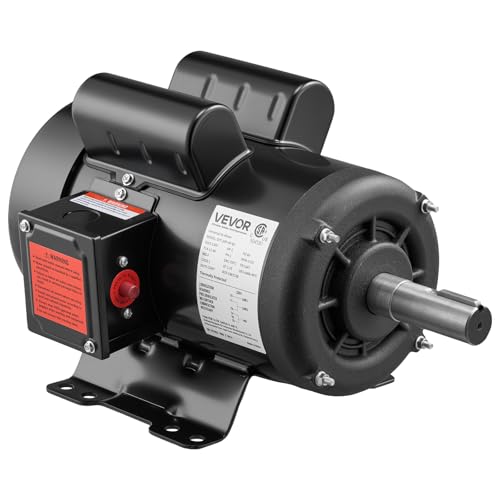
Best for: Air compressors and higher-torque needs where 3HP at 230V with CW/CCW rotation is beneficial. The 184T frame and 1.125″ shaft diameter support larger shafts and heavier loads.
Why selected: Higher horsepower enables faster acceleration and higher torque at moderate speeds. Caution: Ensure compatible shaft and coupling sizes for the equipment you intend to drive.
HY HUANYANG VFD 110V Single Phase Input

Best for: Running 3-phase motors on a 110V supply with remote control options. Ideal for spindle speed control and general-purpose motor rotation control in compact setups.
Why selected: The HY Huanyang VFD supports RS-485 communication and remote potentiometer control, adding flexibility for control systems. Caution: Verify the motor’s compatibility with the VFD’s input/output specs to prevent overloading.
Cuilvu 3HP 3450RPM Three-Phase Motor

Best for: General-purpose three-phase motors with high speed and robust housing for 60Hz operation. The 56C frame and 5/8″ shaft are common in many machine tools and conveyors.
Why selected: Provides a solid combination of horsepower, speed, and frame compatibility. Caution: Ensure the drive system and mounting match the motor’s shaft and frame specifications.
Buying Guide: Key Purchase Considerations
- Motor vs. VFD: Decide between a fixed-speed motor and a variable frequency drive setup. VFDs enable speed control and compatibility with single-phase inputs to drive 3-phase motors.
- Voltage and Phase: Confirm your available power supply (120V, 230V, or 460V) and whether you need 3-phase or single-phase inputs/outputs. Always match frame size and mounting to your machinery.
- Rotation Direction: If your application needs CW or CCW rotation, ensure the model supports dual rotation and that wiring is configured correctly.
- Frame Size and Shaft: Check frame designation (e.g., 56C, 184T) and shaft diameter/length to fit couplings and pulleys.
- Cooling and Duty: For continuous operation, assess TEFC enclosures and cooling features to avoid overheating in dense load scenarios.
- Protection and Control: Look for features like digital displays on VFDs, RS-485 interfaces, and remote control capabilities if needed for your setup.
FAQ
- Can I use a 110V VFD to run a 230V 3-phase motor?
- Yes, some VFDs accept 110V single-phase input and output 220V three-phase to drive compatible motors. Check the VFD’s input/output ratings and motor compatibility before use.
- Does a higher frame size mean better performance?
- Not necessarily. Frame size affects mounting compatibility, shaft size, and torque capacity, but actual performance depends on the motor’s horsepower and design.
- What is CW/CCW rotation, and how is it wired?
- CW/CCW indicates clockwise or counterclockwise rotation. Wiring must correspond to the motor and supply connections; many motors allow reversal via wiring or reverse rotation terminals.
- Which option is best for a small air compressor?
- For 120V operation with 3-phase capabilities, a 2HP motor with a compatible VFD or a 3-phase 230/460V motor paired with a proper controller is ideal, depending on your power supply and desired speed control.