Best 1200 Watt Gas Generators for Reliable Outdoor Power
If you need dependable emergency power or a portable backyard companion, a 1200-watt gas generator is often the right size for essential loads. This guide highlights five top options, who they’re best for, and practical considerations to help you choose. Ideal buyers include campers who need lightweight backup power, homeowners seeking a compact emergency solution, and tailgaters who want quiet, portable operation.
| Product | Peak Watts | Running Watts | Weight | Run Time (approx.) |
|---|---|---|---|---|
| Aceup Energy 1200W Gas Generator | 1200 | 900 | Not listed | Up to 6 hours at half load |
| Aceup Energy 1,200W Gas Powered Generator | 1200 | 900 | 35.3 lb | Up to several hours at half load |
| PowerSmart 1200W Portable Gas Powered Generator | 1200 | 900 | 39 lbs | Up to 5 hours at 50% load |
| Pulsar PG1202SA | 1200 | 900 | Not listed | Up to 5 hours at half load |
| GENMAX GM1200i | 1200 | 1000 | ~25.3 lbs | Up to 6.5 hours at 50% load |
Aceup Energy 1200W Gas Generator — Lightweight Home Backup

Best for: Homeowners needing a compact, budget-friendly backup power source for essential circuits. This model delivers 900 running watts and 1200 peak watts with a recoil start and a 1.1-gallon tank for several hours of use at half load.
Why selected: The unit’s EPA compliance and simple 120V household outlet make it a straightforward option for basic home use and small outages. Its protective features include AC/DC overload protection for lighter electrical loads.
Limitations: No on-board fuel gauge is listed, so monitoring fuel may require manual checks. Runtime is tied to half-load performance, which may vary with load changes.
Aceup Energy 1,200W Gas Powered Generator — Ultralight
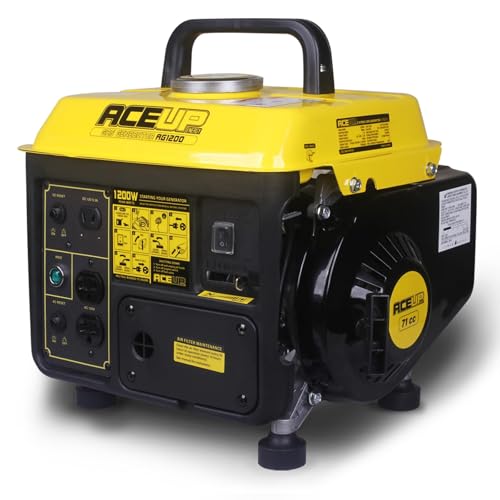
Best for: Outdoor enthusiasts and light-duty homeowners who want ultra-lightweight portability without sacrificing 1200W capability. This generator offers 1200 peak watts and 900 running watts with a 71cc engine and recoil start.
Why selected: It includes both 120V outlet and protective features such as overload protections and separate DC outlets, plus a compact 35.3 lb design for easy transport.
Limitations: As a 2-stroke engine, users should follow fuel mix recommendations, and long runtimes may require more frequent maintenance than larger, four-stroke models.
PowerSmart 1200W Portable Generator — Ultralight

Best for: Campers and tailgaters who prioritize portability and runtime balance. This unit provides 1200 surge watts and 900 rated watts, with a 1.1-gallon tank offering up to about 5 hours at 50% load.
Why selected: Its ultralight 39 lb frame and integrated handle make it easy to move, store, and deploy for short-term outages or outdoor adventures.
Limitations: Being a 2-stroke engine may require more frequent maintenance and fuel mix management compared to four-stroke options.
Pulsar PG1202SA — Carrying Handle 1200W

Best for: Outdoor enthusiasts who need a compact carry-friendly unit for basic camping power. The generator delivers 1200 peak watts and 900 running watts with a durable, portable design.
Why selected: The single-cylinder, two-stroke engine supports a practical balance of weight and power in a compact package. It suits activities where portability is key but continuous full-load operation isn’t required.
Limitations: Running time and fuel economy depend on load. As a two-stroke, it requires proper fuel mixing and regular maintenance for peak performance.
GENMAX GM1200i — Ultra-Quiet 1200W Inverter

Best for: Users needing clean power for sensitive electronics in camping or home backup scenarios. The unit delivers 1200 starting watts and 1000 running watts with inverter technology and low THD.
Why selected: It’s ultralight at about 25 pounds and features ultra-quiet operation with an Economy Mode for improved fuel efficiency, making it a strong choice for noise-sensitive environments.
Limitations: As an inverter generator, the initial cost may be higher, and performance is optimized at moderate loads; full-load discretion is advised for best efficiency.
Buying Guide: 1200W Gas Generator Buyer’s Considerations
What load do you plan to power? Identify essential appliances (refrigeration, lights, communications) and sum their wattage. Look for 1200W surge and 900W running ratings to match typical devices without overloading.
Two-stroke vs four-stroke engines: Two-stroke units like several models here are lightweight and compact but require correct oil/fuel mixing and more frequent maintenance. Four-stroke engines tend to be cleaner and steadier for longer runtimes.
Fuel capacity and runtime: Larger fuel tanks extend operation. If you plan longer outages, prioritize models with at least 1.0 gallon (or equivalent) capacity and runtime at 50% load or similar.
Portability and weight: If you’ll carry it in a car trunk or on camping trips, weight and carry handles matter. Sub-40 lb units are notably easier to transport than heavier options.
Noise level: Quiet operation matters for camping or neighborhoods with noise restrictions. Inverter-based models often deliver the smoothest, quietest performance.
Outlets and safety features: Ensure at least one 120V household outlet is available. Look for overload protection, built-in DC outlets, and intuitive recoil or electric start options.
Compliance: EPA and CARB compliance are important for environmental standards and regulations in many regions. This helps with broad usability and compliance considerations.
Frequently Asked Questions
- What does 1200W mean in practical terms? It represents the maximum load the generator can handle at peak power, with 900W typically available for continuous use.
- Is a 1200W generator enough for a small home outage? It can power essential devices like lights, a fridge, and a modem, but not high-wattage appliances simultaneously. Plan by listing critical loads first.
- Are two-stroke generators worth it for portability? Yes for lightweight transport, but they require careful fuel mixing and maintenance to sustain performance.
- Do I need an inverter generator? Inverter models deliver cleaner power suitable for sensitive electronics and can be quieter, often with better fuel efficiency.
- How long should I run a portable generator safely? Follow manufacturer guidelines; allow for cooldown periods and never run indoors or in enclosed spaces.
- What should I consider for outdoor use? Look for durable housings, weather protection, and proper ventilation to prevent overheating and to comply with outdoor use norms.