Best 120/240 Volt Inverter: Top 5 Pure Sine Wave Models for Off-Grid and Home Use
Answering the search for reliable 120/240 volt inverters, this guide compares five 120/240V models suitable for off-grid solar setups, cabins, RVs, and backup home power. These units deliver true sine wave output, versatile battery compatibility, and split-phase or single-phase options. Best for off-grid homeowners, campers, and small businesses seeking scalable, safe power conversion with strong surge handling and integrated charging or MPPT control.
| Product | Output Power | Best For | |
|---|---|---|---|
| Ampinvt 5000W/15000W (OAE) | 5kW / 15kW peak | Off-grid homes, solar systems | High transfer efficiency, wide battery compatibility |
| Aninerel 12000W | 12kW / 24kW peak | Large loads, parallel systems | Dual MPPT, expandable |
| WZRELB 4000W | 4kW / 8kW peak | Simple setups, RVs, workshops | Compact, high efficiency |
| VEVOR 6400W | 6.4kW | Hybrid off-grid with controller | Built-in MPPT, split-phase |
| POWLAND 12000W | 12kW | Grid-tied or hybrid homes | Battery-free design, high solar harvesting |
Apex Ampinvt 5000W Pure Sine Wave Inverter (OAE)

This 24V DC to 120/240V AC split-phase inverter integrates an inverter, battery charger, and AC auto-transfer switch. It offers transfer efficiency above 90% and isolates input from output to reduce surge interference. Best for small- to mid-size off-grid homes or cabins needing reliable power with robust surge handling. Suitable for SLA, AGM, GEL, Li-ion, and LiFePO4 batteries with customizable charging. Caution: set charging current carefully to avoid overloading the source when charging from high-output solar arrays.
Aninerel 12000W Solar Hybrid Inverter

This 48V DC to 120V/240V AC pure sine wave inverter features dual MPPT controllers and high-current charging up to 220A. It supports up to 6 units in parallel, enabling up to 72kW total output, making it ideal for larger homes, workshops, or RV setups that demand scalable power. It can run with multiple battery chemistries and no-battery operation for solar-to-load use. Choose this if you need robust expandability and strong solar integration. Caution: parallel setup requires proper balancing and wiring to maintain phase alignment.
WZRELB 4000W Split Phase Inverter

This 48V DC to 120/240V split-phase true sine wave inverter delivers 4kW continuous power with 8kW peak. It supports dual 120V outlets plus a 240V hardwire option. The unit includes an LCD display for real-time status and a remote controller for distant monitoring. Best for users who want straightforward, reliable performance for home or workshop projects. Limitation: output on one circuit may reach 2000W per outlet, so plan loads accordingly.
VEVOR 6400W Low-Frequency Hybrid Inverter
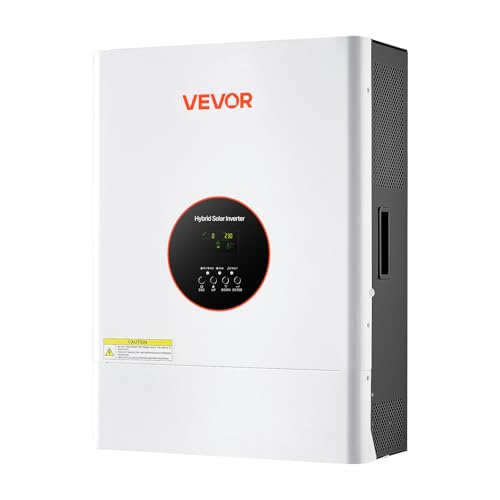
This 6,400W low-frequency inverter includes a built-in 120A MPPT solar charger and supports 110–120V or 220–240V split-phase outputs. It is designed for heavy-duty loads with high efficiency up to 99% depending on conditions. Suitable for off-grid systems with lead-acid, AGM, GEL, or LiFePO4 batteries. Best for users needing a compact all-in-one inverter plus solar charge controller. Caution: low-frequency design may require more cooling under continuous high-load use.
POWLAND 12000W Hybrid Solar Inverter (WiFi)

This 12,000W pure sine wave inverter supports a battery-free design with built-in dual 200A MPPT controllers, parallel up to six units, and optional grid interaction. It handles 90-500VDC PV input and is designed for large homes or RV parks needing high solar harvesting and grid backflow control. Best for grid-tied or hybrid setups where space and load require scalable, high-power output. Caution: battery-free design may require grid engagement for certain loads or higher energy storage flexibility.
Buying Guide
- Output configuration: Decide between split-phase (two 120V lines) or single-phase 120V/240V to match your loads and service panel.
- Power needs: Calculate continuous wattage and peak surge to avoid overload. Parallel-capable models enable future expansion.
- Battery compatibility: Check compatible chemistries (Li-ion, LiFePO4, lead-acid) and charging current settings to optimize life and performance.
- MPPT and efficiency: Higher MPPT input ranges improve solar harvesting, especially in variable sunlight.
- Control and monitoring: Look for LCD displays, remote control options, or WiFi app support for real-time status and alerts.
- Safety features: Ensure built-in protections (overload, undervoltage, short-circuit) and proper isolation between input and output.
- Install considerations: Review heat dissipation, enclosure, and ventilation requirements for continuous operation.
FAQ
- What is a true sine wave inverter and why does it matter? It produces clean AC power suitable for sensitive electronics and appliances.
- Can I mix different inverter brands in one system? Parallel configurations are brand-specific; mixing is not recommended without manufacturer guidance.
- Do these inverters require batteries? Many models support battery charging, though some can operate directly from solar input without batteries.
- What is split-phase output used for? It provides two 120V lines, useful for powering larger residential loads and certain appliances.
- How does MPPT improve solar charging? MPPT optimizes voltage and current from panels for maximum energy harvest under varying light.
- Is remote monitoring essential? It helps manage loads, confirms operation, and alerts of faults or maintenance needs.