Best 12 Volt RV Converter Options for Reliable on-the-Road Power
If you need dependable 12V power for an RV, camper, or trailer, a 12 volt RV converter is essential. This guide compares five top-rated converters that convert 110-120V AC to stable 12V DC with multi-stage charging. Best for full-time campers, weekend caravans, or lithium and lead-acid battery setups, these models emphasize safety, efficiency, and compatibility. Below, find a quick summary table, followed by detailed product sections to help you choose with confidence.
Summary of Selected Products
- 2026 Upgrade WF-9855 55 Amp Power Converter — Xmnbl
- 2026 Upgrade WF-9855, 55 Amp RV Power Converter (WF-9855 Lead Acid) — suplife
- WAVLINK WF-8955-MBA 55Amp RV Power Converter — WAVLINK
- PowerMax PM3-55 RV Power Converter — PowerMax
- Yaheeda New Version Converter — Yaheeda
2026 Upgrade WF-9855 55 Amp Power Converter

Brand: Xmnbl. Output: 55 Amps; Output Voltage: 13.6VDC; Input Voltage/HZ: 105-130 VAC; Power: 950 Watts. This RV power converter replaces the 9800 series and supports multiple WF-9855 variants. Best for RVs that require a robust, 55A replacement with reliable after-sales service and a long warranty. The warranty and replacement options reduce downtime for travelers. A potential limitation is compatibility to 110-130V input ranges depending on regional power supplies.
2026 Upgrade WF-9855 55 Amp RV Power Converter (WF-9855 Lead Acid)

Brand: suplife. Parameters: 950 Watts, 55 Amps, 14.6VDC output, 105-130VAC input, 60Hz. Features a 5-year warranty and three-stage charging suitable for lithium compatibility and replacement of older 55A units. Best for RVs using WF-9800 series or lithium replacements. Limitation: some RV electrical systems may need matching battery chemistry or installation adjustments.
WAVLINK WF-8955-MBA 55Amp RV Power Converter

Brand: WAVLINK. Output: 55 Amps; Adjustable operating range 13.0V-16.5V; Multi-stage charging with indicator lights. Multi-battery compatibility (lead-acid and lithium options). Best for smaller RV battery banks and those wanting adjustable voltage for various battery chemistries. Limitation: some users report the need for precise setting when switching battery types to avoid undercharging or overcharging.
PowerMax PM3-55 RV Power Converter
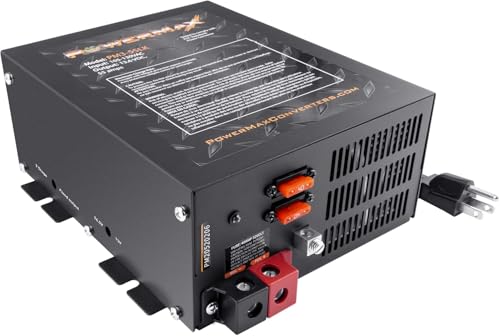
Brand: PowerMax. Features a quiet, controlled operation with a temperature-controlled cooling fan and LED status indicators. Uses a wide voltage range around 13.6V-14.4V for compatibility with multiple systems. Best for RVs that prioritize safety certifications and stable operation. Limitation: some installations may require additional mounting or ventilation due to cooling requirements.
Yaheeda New Version Converter

Brand: Yaheeda. Adjustable input 110V/220V; Output up to 50A peak, 600W; Features one-key on/off, automatic overload protection, EMI filtering. Best for users needing adjustable voltage with strong overload protection and a compact form factor. Limitation: peak current and continuous rating may limit high-demand loads for longer durations.
Buying Guide: Key Considerations
What size RV converter do I need? Assess your total 12V draw and battery bank. Higher amps (e.g., 55A) handle more devices simultaneously, while smaller systems may suffice with 30–40A models. Consider future battery upgrades (lead-acid vs lithium) and ensure the converter supports your chosen chemistry.
Should I prioritize lithium compatibility? If your RV uses lithium batteries, choose a converter with lithium-friendly charging stages and stable voltage settings. Some units advertise compatibility but are best paired with specific WF-9800 series models for optimal performance.
What about charging stages and efficiency? Four- or five-stage charging improves battery longevity and minimizes wasted energy. Look for models with bulk, absorption, float, and equalization steps, or at least multi-stage charging that matches your battery type.
Are safety and warranties important? A longer warranty reduces risk for travelers. Ensure certifications (UL, CUL) and built-in protections like overvoltage, short-circuit, and thermal cutoffs for safe operation on the road.
Installation and compatibility notes. Verify input voltage range (105-130 VAC or similar) and the physical fit for your RV cabinet or wall space. Some units require venting or mounting clearances; plan for installation alongside existing electrical panels.
Frequently Asked Questions
- What is a 12V RV converter? A device that converts 120V AC to stable 12V DC to charge RV batteries and power 12V devices.
- Do I need a lithium-friendly converter? Yes, if you use lithium batteries to ensure proper charging voltages and battery health.
- Can I install a converter myself? Installation is possible for those with electrical experience; otherwise consult a professional.
- What amperage should I choose? Higher amperage supports more devices but may be bulkier; match to your total system load.
- Is a warranty important for RV converters? Yes, a longer warranty protects against early failures during trips.
- Are there safety certifications I should look for? UL/CUL certifications indicate adherence to safety standards.