Best 12 Volt RV Batteries for Reliable Off-Grid Power
This guide highlights top 12-volt battery options ideal for RV use, including maintenance-free AGM models and high-capacity LiFePO4 packs. Each pick prioritizes safety, longevity, and compatibility with RV electrical systems, solar setups, and off-grid camping. Read on to compare strengths, note installation needs, and understand how each option fits typical RV power demands.
| Product | Brand | Type | Capacity |
|---|---|---|---|
| Weize Deep Cycle AGM 12V 100Ah | WEIZE | AGM | 100Ah |
| SUPER EMPOWER 12V 100Ah LiFePO4 | SUPER EMPOWER | LiFePO4 | 100Ah |
| Renogy Deep Cycle AGM 12V 100Ah | Renogy | AGM | 100Ah |
| ELEFAST 12V 330Ah LiFePO4 | Elefast | LiFePO4 | 330Ah |
| ECO-WORTHY 12V 280Ah LiFePO4 | ECO-WORTHY | LiFePO4 | 280Ah |
Note: All models are suitable for RV power systems, including running lights, fans, and low-draw appliances. When selecting, consider weight, installation space, charging source, and desired cycle life to balance upfront cost with long-term reliability.
Weize 12V 100Ah AGM Deep Cycle Battery
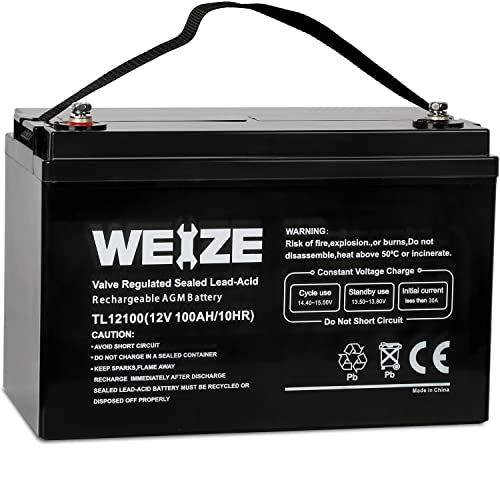
The Weize AGM 12V 100Ah battery is maintenance-free with a sealed AGM design. Its compact dimensions (roughly 13×6.7×8.4 inches) help it fit in standard RV battery boxes. A key feature is low self-discharge, typically 1–3% per month under proper storage, which supports longer idle periods between trips. It offers a robust 1100A peak discharge for high-start loads and is suitable for RV, solar, trolling motors, and off-grid systems. Temperature ranges support a broad operating envelope, though optimum life comes with steady, moderate conditions.
SUPER EMPOWER 12V 100Ah LiFePO4 Battery

Super Empower’s LiFePO4 12V 100Ah battery delivers high deep-cycle performance with a strong energy density and a long lifespan. It includes a built-in Battery Management System (BMS) and claims low monthly self-discharge, which helps maintain charge during intermittent RV use. The pack is UL, FCC, and UN38.3 certified for safety and is positioned as a drop-in replacement for traditional lead-acid setups in RVs, boats, and solar applications. A compact footprint and light weight compared with lead-acid make it attractive for space-constrained compartments.
Renogy Deep Cycle AGM 12V 100Ah Battery

Renogy AGM batteries are widely trusted and designed for safety and durability. The 12V 100Ah model supports series and parallel configurations, enabling scalable storage for larger RV systems. Renogy’s AGM chemistry provides leak-resistant operation, reduced maintenance, and straightforward installation. The internal design emphasizes stability and safety, with sealed construction minimizing user troubleshooting. This makes it a solid choice for RVs that need dependable power without the fuss of regular electrolyte checks.
ELEFAST 12V 330Ah LiFePO4 Battery

Elefast offers a high-capacity 12V LiFePO4 pack at 330Ah, designed for RVs, solar, and off-grid systems. It features a built-in 200A BMS with protections against overcharging, over-discharging, and short circuits, along with low-temperature protection. This makes it well-suited for cold-weather camping where traditional lead-acid batteries struggle. The high energy density helps power multiple devices for longer periods, and the system is compatible with series/parallel configurations for even greater capacity in larger RV setups.
ECO-WORTHY 3584Wh 12V 280Ah LiFePO4 Battery

This ECO-WORTHY unit combines a large 280Ah LiFePO4 capacity with real-time monitoring via Bluetooth-enabled app. It uses a 200A BMS with low-temperature protection to ensure safe charging and discharging in RV environments. The design emphasizes durability and modular integration in off-grid solar systems, making it a strong option for campers who need substantial energy reserves and remote management capabilities. The built-in monitoring helps owners track voltage, state of charge, and current draw from a distance.
Buying Guide: Key Purchase Considerations
- Chemistry choice: AGM vs LiFePO4. AGM batteries are maintenance-free and robust for short trips, while LiFePO4 offers longer cycle life, lighter weight, and deeper discharge capability—advantageous for frequent RV use and solar-dominant setups.
- Capacity and space: Match Ah capacity to your RV’s daily load and available battery space. Higher Ah means longer runtime but more weight and size to fit in your storage area.
- Cycle life and aging: LiFePO4 often delivers thousands of cycles versus hundreds for many AGM designs. Consider total cost of ownership and replacement frequency when choosing.
- BMS protections: Look for built-in BMS features such as overcharge, over-discharge, short-circuit protection, and, for LiFePO4, low-temperature cut-off to safeguard the pack in cold climates.
- Temperature operating range: Extreme RV climates benefit from batteries rated for wide temperature ranges and robust self-discharge performance during long trips.
- Weight and footprint: Weighing factors matter for RV chassis load limits and mounting options. LiFePO4 packs are generally lighter per amp-hour than AGM equivalents.
- Charging compatibility: Ensure your inverter/charger supports the chosen chemistry and that voltage settings match the battery’s requirements to maximize life and performance.
- Monitoring and diagnostics: Real-time apps or built-in indicators help track health, remaining capacity, and temperature for proactive maintenance.
Across these options, users benefit from evaluating the balance between upfront cost, weight, usable capacity, and expected longevity. For RV use, LiFePO4 variants deliver longer life and greater resilience in off-grid applications, while AGM models remain practical for occasional use with straightforward maintenance-free operation.