Best 12 Volt Deep Cycle Batteries for RVs, Marine, and Off‑Grid Power
Finding a reliable 12-volt deep cycle battery is essential for RV comfort, boating adventures, or off-grid power systems. This guide highlights five top options across AGM and LiFePO4 chemistries, with practical details on capacity, safety, charging, and longevity. Each pick focuses on everyday reliability, compatibility with 12V systems, and long-term performance in varied climates. Use this article to compare maintenance needs, discharge rates, and real-world lifespans, helping you choose a battery that fits your power needs and budget.
Summary of Selected Products
| Product | Brand | Chemistry | Capacity | Approx. Discharge Notes |
|---|---|---|---|---|
| Weize Deep Cycle AGM 12V 100Ah | WEIZE | AGM Lead-Acid | 100Ah | 3% self-discharge typical |
| Renogy Deep Cycle AGM 12V 100Ah | Renogy | AGM Lead-Acid | 100Ah | Low self-discharge, safe chemistry |
| Renogy Deep Cycle AGM 12V 200Ah | Renogy | AGM Lead-Acid | 200Ah | Low self-discharge, high capacity |
| Interstate Batteries Marine Deep Cycle 12V 100Ah | Interstate Batteries | AGM Lead-Acid | 100Ah | Extended deep-cycle performance |
| 12V 100Ah LiFePO4 Battery (VATRER POWER) | VATRER POWER | LiFePO4 | 100Ah | High cycle life, temperature protection |
Weize 12V 100Ah AGM Deep Cycle Battery
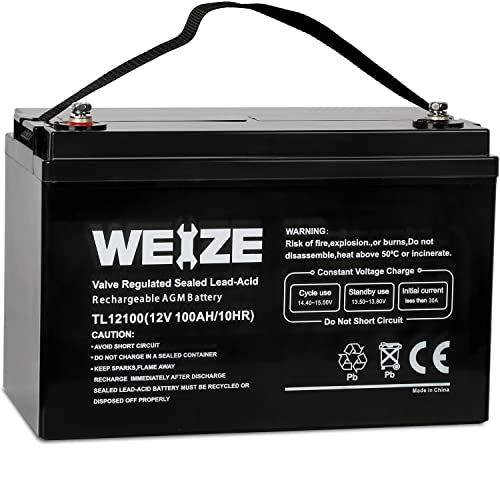
The Weize 12V 100Ah AGM deep cycle battery is designed for maintenance-free operation with an AGM design that minimizes acid leakage and reduces routine upkeep. Its compact dimensions (approximately 12.99 x 6.73 x 8.43 inches) fit many RV compartments and small off-grid setups. A typical self-discharge rate of 1–3% per month supports longer storage between uses, while a robust 1100A max discharge current provides quick bursts as needed. It is suitable for RVs, solar arrays, trolling motors, wind applications, and marine setups where space is at a premium. The terminal layout (Positive on the left, Negative on the right) makes wiring straightforward in most configurations.
Key considerations include operating temperature range, with charging tolerance around 14°F to 122°F and best performance near 77°F. While maintenance-free, proper charging and temperature control can extend service life by reducing deep discharges. The battery is designed for long life when kept charged and used within its specified temperature window.
Renogy 12V 100Ah AGM Deep Cycle Battery

Renogy’s 100Ah AGM deep cycle battery is a proven choice for RVs, cabins, boats, and off-grid systems. Renogy emphasizes safety and stability with an AGM design that minimizes leakage and simplifies maintenance. The battery supports series and parallel configurations (no practical limitations for series and up to four in parallel) to scale capacity for larger setups. Its safety profile and stable chemistry help reduce troubleshooting needs, making it a popular option for users seeking reliable, maintenance-light power. The product’s reputation is backed by robust field performance and a sizable installed-base around the world.
Discharge performance benefits from the high-quality grids and separator technology, delivering consistent power delivery with relatively low internal resistance. This makes it suitable for appliances, inverters, and peripherals that require dependable burst capability and summer-friendly performance. As with all AGM batteries, avoid prolonged deep discharge and extreme temperatures to maximize lifespan.
Renogy 12V 200Ah AGM Deep Cycle Battery

This 200Ah variant from Renogy extends deep-cycle capacity for larger off-grid installs or RV systems with modest space. Equipped with AGM technology, it reduces maintenance needs and leaks while supporting sustained power delivery. The battery emphasizes low self-discharge with an emphasis on durability and resilience in mobile and remote environments. It is well-suited for high-demand RV appliances, cabin power, and comprehensive marine electronics. The safety profile remains strong, thanks to sealed construction and stable chemistry that eases troubleshooting and routine care.
Users should note the higher internal mass and weight of 200Ah packs and plan for appropriate charging equipment and space. The 12V system benefits from parallel configurations if more capacity is needed, and proper ventilation is always a good practice in enclosed compartments. Temperature control supports longer life, especially in varying climates encountered on boats and in remote cabins.
Interstate Marine Deep Cycle 12V 100Ah AGM Battery
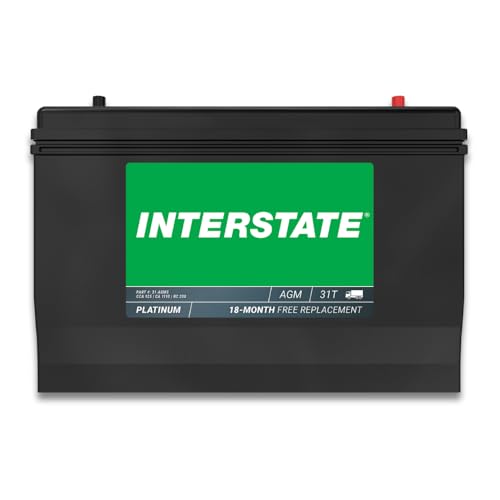
Interstate Batteries deliver a marine-focused 12V 100Ah AGM battery designed for heavy-cycle demands and reliability at sea. The 2-in-1 design supports powering trolling motors, cabin electronics, and onboard appliances while maintaining a robust cycle life through thick plates that withstand repeated discharge and recharge. The company’s emphasis on rugged performance makes this option a staple for anglers, boaters, and fleet operators seeking consistent deep-cycle capability. The deep-cycle power is complemented by strong starting power for mixed-use marine applications.
Considerations include ensuring the battery is used in climates that match its design and maintaining appropriate charging routines to maximize longevity. The AGM design reduces maintenance while enabling readiness after long storage periods. For vessels and campers that demand continuous power, this battery offers dependable performance with straightforward installation and compatibility with standard 12V accessories.
12V 100Ah LiFePO4 Battery (VATRER POWER)

This 12V 100Ah LiFePO4 battery from VATRER POWER delivers a modern alternative to lead-acid options. LiFePO4 chemistry offers higher cycle life, often exceeding several thousand cycles, and a lower self-discharge rate with a built-in BMS that protects against overcharge, over-discharge, overcurrent, and short circuits. It also provides a wide operating temperature range and low self-discharge when stored. The BMS and cell quality contribute to more stable voltage delivery and predictable performance for RVs, trolling motors, boats, and solar applications. It is designed as a drop-in replacement for many 12V lead-acid configurations, requiring attention to charging profiles compatible with LiFePO4 chemistry.
Practical considerations include ensuring the system supports LiFePO4 charging profiles, as some older inverters and chargers are optimized for lead-acid. The 100A BMS helps manage safe charging and discharging, while the expanded 1.28 kWh capacity balances weight and energy density for mobile systems. Regular monitoring of state of charge and a compatible charger will help maximize cycle life and performance in off-grid or recreational setups.
Buying Guide: Key Purchase Considerations
- Chemistry and longevity: AGM batteries offer rugged reliability and maintenance-free operation, while LiFePO4 batteries provide longer cycle life and lighter weight. Consider your power needs, climate, and how often you cycle the battery.
- Capacity and scalability: If you anticipate higher power demands, choose higher Ah ratings or plan for parallel configurations. For large campers or off-grid cabins, 200Ah and above can reduce runtime anxiety.
- Discharge rate and compatibility: A higher max discharge current helps with startup surges and peak loads. Ensure the battery’s discharge profile aligns with your inverter and loads.
- Temperature tolerance: Batteries have optimal temperature ranges. Extreme cold or heat can affect capacity and cycle life, especially for lead-acid chemistries. LiFePO4 generally performs well across a wider range.
- Maintenance and installation: AGM is almost maintenance-free, but LiFePO4 requires compatible charging gear. Consider space, weight, and ventilation in RVs, boats, and cabinets.
- Charging equipment: Match chargers and inverters to the battery chemistry. Some inverters support smart charging with second-stage regulation, which can extend life and efficiency.
- Safety and warranty: Look for sealed designs, proper venting, and reputable brands with solid warranties. This reduces risk during long-term use in vehicles or shore installations.
- Cost of ownership: Upfront cost vs. lifecycle cost varies by chemistry. AGM often has lower upfront cost, while LiFePO4 typically delivers lower total cost of ownership due to longer life.
The selections above cover a spectrum from compact AGM models to high-capacity LiFePO4 options, each suitable for 12-volt systems in RVs, boats, trolling motors, and off-grid setups. When choosing, balance initial price, cycle life, total weight, and compatibility with existing chargers and inverters to optimize your 12-volt deep cycle power solution.