Best 12 Volt Deep Cycle Batteries for Solar Power Systems
When building or upgrading a solar energy setup, choosing a reliable 12-volt deep cycle battery is essential for steady, off-grid power. This guide highlights five solid options known for durability, cycle life, and maintenance-free design. Each entry draws on AGM or LiFePO4 chemistry to deliver dependable performance for RVs, cabins, boats, and remote solar arrays. Read on to compare key features and find the best fit for your solar needs.
| Product | Chemistry | Nominal Capacity | Key Strength |
|---|---|---|---|
| Weize 12V 100Ah AGM | AGM | 100Ah | Low self-discharge; maintenance-free |
| Renogy Deep Cycle AGM 100Ah | AGM | 100Ah | Wide compatibility; strong safety profile |
| Renogy Deep Cycle AGM 200Ah | AGM | 200Ah | Higher capacity; long shelf life |
| GRNOE 12V 100Ah LiFePO4 (2-Pack) | LiFePO4 | 100Ah each | Low weight; built-in BMS; compact |
| Rvpozwer 12V 100Ah LiFePO4 | LiFePO4 | 100Ah | Long lifespan; expandable and cold-tolerant |
Weize 12V 100Ah AGM Battery
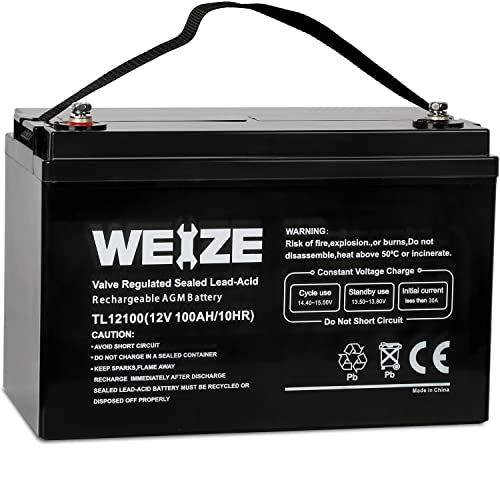
The Weize AGM battery uses absorbed glass mat technology to minimize acid leakage and reduce maintenance. Its compact dimensions (about 12.99 x 6.73 x 8.43 inches) suit many solar storage setups. It features a low monthly self-discharge rate (1-3%), helping extend storage between uses. The unit supports a high short-term discharge and performs within typical operating temperature ranges, making it a practical option for RV, marine, and off-grid systems.
Renogy Deep Cycle AGM 12V 100Ah Battery

Renogy’s AGM 100Ah model is widely trusted for safety and reliability. It supports series and parallel configurations for expandable capacity and is designed to minimize troubleshooting compared with other chemistries. The sealed design helps prevent leaks, making it suitable for enclosed spaces in RVs or cabins tied to solar systems.
Renogy Deep Cycle AGM 12V 200Ah Battery

This larger 200Ah AGM option from Renogy targets heavier solar builds needing extended storage. It emphasizes low self-discharge, robust internal construction, and compatibility with both series and parallel connections for scalable power. It’s positioned for off-grid cabins, larger RV setups, and longer-duration solar storage while preserving safety and maintenance-free operation.
GRNOE 12V 100Ah LiFePO4 (2-Pack)

These LiFePO4 batteries bring high energy density at a lighter weight than traditional lead-acid. Each 100Ah module includes a smart BMS for protection against overcharge, over-discharge, and short circuits. The pair can be used individually or connected in parallel to increase capacity, delivering a durable, long-life solution for solar storage in RVs and boats.
Rvpozwer 12V 100Ah LiFePO4 Battery

Rvpozwer offers a 100Ah LiFePO4 option with a 120A smart BMS that guards against common power risks and supports long cycle life. It’s designed for cold weather performance and expansion through parallel configurations, making it suitable for RVs, trolling motors, and solar storage. The battery’s long lifespan supports ongoing solar investments with minimal maintenance.
Buying Guide: Key Purchase Considerations
- Chemistry: AGM batteries deliver affordable, maintenance-free operation with solid safety profiles and are well-suited for stationary solar storage. LiFePO4 offers lighter weight, longer cycle life, faster charging, and better depth-of-discharge, albeit at a higher upfront cost.
- Capacity and discharge: Match Ah rating to your system’s daily energy needs and peak draw. For larger solar arrays or multi-appliance setups, higher Ah (e.g., 200Ah) reduces cycling frequency and extends runtime.
- Cycle life: LiFePO4 typically delivers thousands of cycles, while AGM or SLA often reach hundreds to a few thousand under favorable conditions. Consider climate, charging regimen, and depth of discharge to maximize lifespan.
- BMS and safety features: A capable BMS protects against overcharge, over-discharge, overcurrent, and short circuits. This is especially important for LiFePO4 to avoid performance degradation and safety risks.
- Temperature tolerance: Cold-weather performance matters for off-grid cabins or winter solar setups. Some LiFePO4 models include low-temperature protection to prevent damage.
- Space and weight: LiFePO4 batteries are typically lighter and more compact than AGM equivalents, beneficial for mobile installations. Weight also influences mounting and transport considerations.
- System integration: Assess compatibility with existing solar controllers, inverters, and the ability to connect in series or parallel to scale voltage and capacity as needed.
- Maintenance: AGM and SLA are generally maintenance-free, while LiFePO4 requires minimal care beyond ensuring a balanced charging strategy and avoiding deep discharges.