Best 12 Volt to 110 Volt Inverters for Vehicles and RVs
Answering the common question, these 12V to 110V inverters convert a vehicle’s or RV’s battery power into standard household AC power. They are best suited for travelers, campers, and anyone who needs to run laptops, small appliances, or chargers while away from standard outlets. The top picks below cover a range of wattages, ports, and protection features to fit different uses and safety needs.
| Product | Best For | Power (Continuous / Peak) | Notable Feature |
|---|---|---|---|
| BESTEK 500W Power Inverter | Camping and road trips with higher-wattage devices | 500W / 1000W | Dual AC outlets, 2 USB ports |
| Pro Chaser 400W Inverter | Family trips needing USB-C/USB-A and two outlets | 400W / 800W | USB-A 3.1A, USB-C PD 65W, long cord |
| FOVAL 150W Car Power Inverter | Compact, lightweight needs for smaller devices | 150W / — | 3.1A dual USB, compact size |
| BELTTT 1000W Pure Sine Wave Inverter | Sensitive electronics and off-grid setups | 1000W / 2000W | Pure sine wave, intelligent LCD |
| WAVLINK 55 Amp RV Power Converter | RV battery charging with multi-stage modes | 55A charging current / — | Smart charging modes, adjustable range |
BESTEK 500W Power Inverter DC 12V to 110V AC Converter
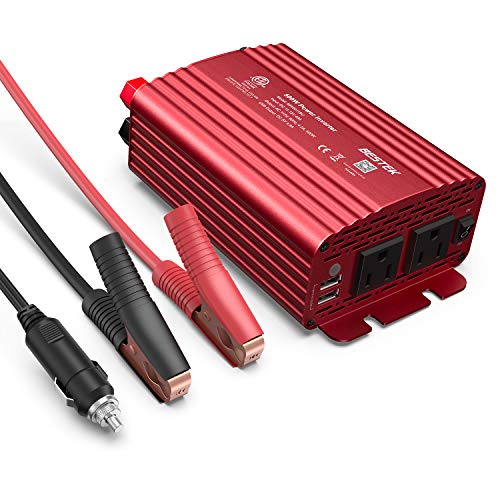
This inverter provides 500W continuous DC-to-AC power with 1000W peak, making it suitable for laptops, tablets, and smaller household devices on road trips or in campers. It includes two 110V outlets and two USB ports for quick charging, supporting a range of appliance needs while driving or camping. The built-in protection includes dual fuses and safe charging technology to guard against overheating, under/over voltage, overload, and short circuits.
Best for: Travelers who need reliable dual outlets and USB charging for mid-wattage devices. Choose this if you frequently power laptops or small appliances and want straightforward safety features. Avoid this if you regularly run high-wattage appliances (over 500W continuous).
Caution: The unit can overheat with sustained high loads; ensure adequate ventilation and don’t exceed 500W continuously.
Pro Chaser 400W Power Inverters for Vehicles

Pro Chaser’s 400W inverter delivers steady 400W with an 800W peak, featuring dual 110V outlets and USB ports (2.0A and high-speed 4.8A total). It targets travelers and families needing to power laptops, tablets, or small kitchen devices during trips. The included 30-inch cord adds flexibility for seating arrangements and comfort in the back seat or passenger area.
Best for: Road trips and family travels that require versatile USB charging along with conventional AC outlets. Choose this if you want both USB-C/USB-A compatibility and better reach from a compact unit. Limitations: Maximum continuous load is 400W; avoid operating very power-hungry equipment simultaneously.
AC to DC Converter 110V to 12V (180W)

This 180W converter converts 110V AC to 12V DC for car devices and home use via cigarette lighter. It is compatible with car vacuums, tire inflators, and small refrigerators, offering protection against overheating, overload, overvoltage, and short circuits. It’s designed for practical use when you need to power 12V devices from 110V sources or rail equipment during outages.
Best for: Users who need a simple 12V supply from AC for smaller car devices or home projects. Choose this if you want a basic, protective adapter rather than a high-wattage inverter. Limitation: It’s not designed for continuous high-load appliances beyond 180W.
BELTTT 1000W Pure Sine Wave Inverter

Bringing 1000W continuous power and up to 2000W peak, this inverter uses a pure sine wave output ideal for sensitive electronics, TVs, and home audio systems. It includes an intelligent LCD showing input/output voltages, battery status, and load, with adjustable output voltage for fine-tuning. The unit is suitable for off-grid setups and RV use where grid-like power quality helps extend equipment life.
Best for: Users needing reliable, clean power for sensitive devices and longer-term off-grid setups. Choose this if you require a high-widelity waveform and monitoring. Limitations: Higher wattage means larger size and weight; plan for secure mounting and ventilation.
WAVLINK 55 Amp RV Power Converter

WAVLINK’s 55A RV power converter focuses on charging an RV battery with multiple smart charging modes and a wide adjustable operating range from 13.0V to 16.5V. It supports multi-stage charging to optimize battery health and performance for recreational vehicles. The rugged design targets RV owners looking for a stable onboard charging solution.
Best for: RV owners who need a reliable, adjustable charging system with smart modes. Choose this if you want tailored charging for different battery chemistries. Limitation: This unit centers on battery charging and may not serve as a high-wattage inverter for heavy AC loads.
Buying Guide: Key Considerations for 12V To 110V Inverters
- Power needs: Match continuous wattage to the devices you plan to run. If you expect to power laptops or small appliances, aim for at least 400–500W continuous with a 800–1000W peak for flexibility.
- Waveform type: Pure sine wave inverters are best for sensitive electronics and home theater gear; modified sine wave units may suffice for simple devices but can cause noise or inefficiency with some equipment.
- Outlets and ports: Consider the number and type of outlets (AC, USB-A, USB-C). USB-C PD ports are helpful for newer laptops and tablets.
- Durability and protection: Look for built-in fuses, overvoltage/overload protection, and thermal protection. Adequate ventilation reduces overheating risk.
- Portability vs. power: Compact units are easy to carry but may limit wattage. Larger units may require mounting or dedicated space in a vehicle or RV.
- Vehicle compatibility: Ensure your vehicle electrical system and battery can safely support the inverter’s draw. Some devices require a dedicated inverter with appropriate wiring.
- Usage scenario: For road trips and camping, consider a unit with a long cord and multiple charging options. For RVs, a power converter with smart charging modes can protect battery health.
Frequently Asked Questions
- What is the difference between a pure sine wave inverter and a modified sine wave inverter?
Answer: A pure sine wave inverter produces a smooth, grid-like waveform suitable for sensitive electronics. A modified sine wave inverter can run many devices but may cause noise or inefficiency in some equipment. - Do I need a high-wattage inverter for a laptop or camera gear?
Answer: Most laptops and cameras operate below 200–300W, but high-wattage devices or multiple devices will require an inverter capable of higher continuous wattage and a higher peak rating. - Can an inverter be used directly with an RV battery?
Answer: Yes, inverters are designed to run off RV or automotive 12V batteries, provided the battery’s capacity and wiring are appropriate for the load. - Is an inverter safer with built-in protections?
Answer: Yes. Features like overvoltage, short-circuit, and temperature protections help prevent damage to devices and vehicles. - What should I consider when powering electronics on the road?
Answer: Check wattage requirements, ensure the inverter supports the needed outlets, and verify that your power source can sustain the load without overheating.