Best 110 Volt Oil Transfer Pumps for Fast, Safe Fuel Handling
If you need a reliable 110V oil transfer pump, these models cover common fuels like diesel, kerosene, biodiesel, and light oils. They’re suited for construction sites, farms, boats, and maintenance tasks. This guide highlights five top options, with clarity on who each pump is best for and why it stands out. Use the quick reference table to compare core specs at a glance.
| Product | Best For | ||
|---|---|---|---|
| BLACKHORSE-RACING Self Priming 110V AC | Heavy-duty on-site transfers | 5.25–15.75 | Unknown |
| TRUPOW 110V AC Self-priming | Gasoline/alcohol-safe transfers | Up to 3.7 | 19 |
| TIGEROAR Oil Transfer Pump 110V | General oil and diesel with durable build | 18 | 49 |
| TOPWAY 110V AC Gasoline Pump | Compact, portable transfers | Up to 10 | 6.5 |
| YOHOME Diesel Transfer Pump 110V | Large flow for bulk transfers | 20 | 60 |
Note: This guide focuses on 110V units commonly used for diesel, kerosene, biodiesel, and light fuels. Check compatibility with specific fuels and local safety guidelines before use.
BLACKHORSE-RACING Self Priming 110V 16GPM Diesel Oil Pump
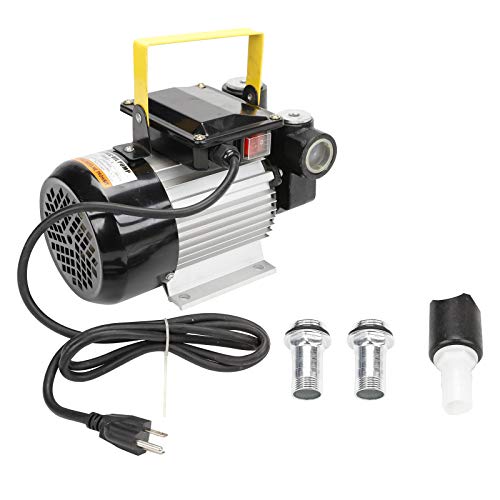
Best for heavy-duty on-site fuel transfers where a robust self-priming design matters. This BLACKHORSE-RACING model lists a 20–60 L/min flow range (roughly 5.25–15.75 GPM) and a 110V AC, 550W motor with self-priming capability. Choose this if you need a higher-capacity pump for frequent transfers and a proven self-priming approach. A potential limitation is the lack of explicit lift specifications in the listing, so verify site clearance requirements before use.
TRUPOW 110V AC Self-priming Pump with Reversible Pumping

Best for versatile fuel transfers where safety features matter. This TRUPOW pump emphasizes high-efficiency operation with up to 3.7 GPM and a solid copper motor windings design. It includes explosion-proof components, a cast iron sealed chamber, and a built-in bypass to prevent backflow. It also supports reversible pumping for added convenience. Use this if you prioritize safety in potentially flammable environments, but be aware the higher flow rates are not as fast as some larger units.
TIGEROAR 110V Oil Transfer Pump

Best for robust, long-lasting builds where lifting height matters. The TIGEROAR pump delivers up to 18 GPM with a lift up to 49 ft, aided by a cast aluminum housing, cast iron head, and anti-corrosion finishing. It comes with G3/4 inlet and G1 adapters. Choose this if you need strong lift performance for transferring from tall containers. A note: ensure compatibility with your specific fuels, as the listing covers diesel/kero/kinds of biodiesel, but check local fuel handling rules.
TOPWAY 110V AC Gasoline Transfer Pump

Best for portable, brushless operation with built-in safety. TOPWAY emphasizes a compact design with an explosion-proof configuration and a portable handle, suitable for boats, RVs, and small-scale refueling. It supports up to 10 GPM and includes multiple adaptors and a bypass, enhancing control and safety. It’s a strong pick if mobility and compactness are priorities, but the pump’s maximum lift is modest compared to high-reach setups.
Calenon 110V Fuel Transfer Pump

Best for heavy-duty, continuous diesel transfers with a robust cast iron build. Calenon offers up to 18 GPM with a 1/2 HP motor and a self-priming design for steady suction up to 49 ft lift and 16 ft suction. It’s well-suited for tractors, trucks, generators, and farm tanks where durability matters. A limitation to watch is the potential for higher power consumption; ensure your electrical setup can handle the load safely.
Buying Guide
What to consider when choosing a 110V oil transfer pump
- Fuel compatibility: Confirm the pump supports the fuels you use (diesel, kerosene, biodiesel, gasoline blends). Some models emphasize diesel or light oils, others list multiple fuels.
- Flow rate vs lift: Higher GPM helps move fuel faster, but lift height determines how well the pump can draw from tall containers. Match to your containers and tanks.
- Self-priming and safety features: Self-priming is convenient for on-site tasks. Explosion-proof components, automatic shutoff, and bypass features improve safety with flammable liquids.
- Construction and durability: Cast iron or aluminum housings, corrosion resistance, and robust seals extend service life in dusty or outdoor environments.
- Portability and mounting: Handle design, base stability, and mounting provisions affect where you can deploy the pump.
- Electrical requirements: Ensure your power source provides stable 110V with sufficient amperage for continuous use.
Best-fit scenarios
- Best for large-volume sites: Pumps with higher GPM and strong lift, such as models with 18–20 GPM capacity.
- Better for portable tasks: Compact pumps with handles and lighter builds suit boats, RVs, and job-sites with limited space.
- Choose this if safety is a priority: Pumps with explosion-proof components and bypass features reduce risk when transferring flammable liquids.
Usage tips for safe operation
- Always verify the liquid’s compatibility with the pump seals and materials.
- Use proper hoses and fittings rated for the specific fuel and pressure.
- Follow manufacturer wiring and grounding recommendations to prevent electrical hazards.
- Keep the work area ventilated and away from ignition sources during transfer.
FAQ
- Q: Can I use these pumps for gasoline and diesel interchangeably?
A: Many models support both, but verify fuel compatibility for each unit before use. - Q: What lift height is typical for 110V oil transfer pumps?
A: Lift heights commonly range from several feet up to around 60 ft on certain models. - Q: Are these pumps suitable for bulk transfer at farms?
A: Yes, several models are designed for high-flow, long-duration operation in farm settings. - Q: Do they require any special maintenance?
A: Regular checks of seals, hoses, and electrical connections help ensure longevity; follow the vendor’s guidance. - Q: Is bypass or safety shutoff important?
A: Yes, bypass reduces backflow, and automatic shutoffs can improve safety in flammable environments.