Best 100A Automatic Transfer Switches for Reliable Power Backup
Answering the question, which 100A automatic transfer switch best fits your home or small business backup needs? This guide compares five top options, focusing on ease of installation, weather resistance, and practical use cases. The ideal buyer ranges from homeowners seeking simple whole-house backup to small commercial operators needing robust load management. Below, you’ll find clear, comparison-friendly details to help you pick the right 100A ATS.
| Product | ||
|---|---|---|
| KUTTOLE 100 Amp Automatic Transfer Switch | Residential with outdoor exposure | UL listed, NEMA 3R watertight enclosure |
| Generac 100-Amp Automatic Smart Transfer Switch | Generac-equipped systems | Seamless utility-to-gen transfer and weather-rated enclosure |
| IGEYAPA 100A 2P Automatic/Manual Transfer Switch | Dual source setups with quick switching | Auto/Manual modes with quick 0.05-second transfer |
| Digowers Automatic Transfer Switch | Industrial or mixed-use locations | 125A capacity with distribution shell and clear indicators |
| Generac 100-Amp Automatic Generator Transfer Switch (Service Entrance Rated) | Residential standby with service-rated switching | Integrated DPM load management for HVAC |
KUTTOLE 100 Amp Automatic Transfer Switch

Best for outdoor deployments where weather resistance is essential. This 100A transfer switch is UL listed and housed in a NEMA 3R enclosure, making it rust-proof and weatherproof for rain, hail, or wind. It supports single-phase generators and ensures seamless power transfer to maintain continuity during outages. Its integrated load management handles four HVAC loads without added accessories, making it a practical replacement for RXSW100A3 in Evolution or Nexus generator setups. A caution: while robust, verify enclosure clearance and mounting space before installation to avoid clearance violations in tight areas.
Generac 100-Amp Automatic Smart Transfer Switch

Best for Generac-driven systems with Evolution or Power Zone controllers. It features automatic power transfer between utility and standby generator and comes in a weather-rated NEMA 3R enclosure. The design emphasizes reliable home backup and, when combined with the Generac ecosystem, supports smooth transitions during outages. Caution: compatibility is strongest with Generac controllers; non-Generac setups may require additional configuration.
phabcf 100A 3P Automatic/Manual Transfer Switch
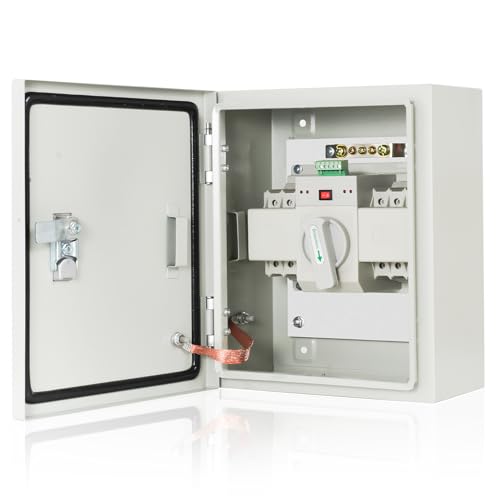
Best for two-source setups requiring both automatic and manual operation with clear status monitoring. This 125A transfer switch provides dual-power transfer for residential, commercial, and industrial applications, and supports automatic source detection with one-touch reset. Visual indicators show real-time power status, and the kit includes mounting hardware for straightforward installation. Consider this option if you need robust monitoring; note that stated capacity exceeds 100A in some listings, so confirm exact rating before purchasing.
IGEYAPA 100 Amp DC 2P Automatic/Manual Transfer Switch

Best for dual-source configurations with rapid automatic switching. This 100A 2P device handles AC 110V automatic transfer and supports four wiring options for mains, generator, or photovoltaic sources. It switches within 0.05 seconds to ensure continuous power, with clear LED indicators for status. A caution: the description emphasizes automatic operation but ensure your wiring matches the four-terminal setup to avoid miswiring during installation.
Generac 100 Amp Automatic Generator Transfer Switch (RXG16EZA3 Replacement)

Best for Generac RXG16EZA3 replacements or compatible 16-circuit backup setups with an integrated load center. The rugged aluminum-NEMA 3R enclosure supports indoor or outdoor installation and includes a heavy-duty contactor for reliable switching between utility and generator power. Use this option when matching an RXG16EZA3-compatible Generac system. Caution: verify circuit count and enclosure compatibility with your existing panel before purchase.
Buying Guide
- Enclosure rating: Prioritize NEMA 3R for outdoor viability or indoor/garage installations. This affects durability against weather and dust.
- Electrical compatibility: Ensure the switch suits your generator brand and controller (Evolution, Nexus, Power Zone, etc.). Look for open-transition or transfer modes that match your system.
- Load management: If you have multiple HVAC units or essential circuits, choose a model with integrated load management or DPM features to avoid overloading.
- Transfer speed: Most residential ATS units switch in milliseconds. Consider faster switching if you rely on sensitive electronics or critical equipment.
- Installation considerations: Confirm wiring configurations (1P2W, 2P, or 3P) and mounting space. Some models include installation kits; others require separate accessories.
- Manual vs automatic mode: Automatic mode is standard for most homes, but a manual option can help with testing or in areas with irregular grid reliability.
FAQ
- What does a 100A automatic transfer switch do?
It automatically transfers power from the utility to a standby generator when the primary power source fails, helping maintain continuous power to connected circuits.
- Do I need a service-entrance rated ATS?
Service-entrance rated units are designed for installations where the ATS is part of the service equipment and must meet utility-grade requirements for safety and reliability.
- Can these switches manage multiple loads (like HVAC)?
Some models include integrated load management to handle several HVAC or other heavy loads without extra hardware. Check the product’s load capacity and features.
- Is outdoor installation safe for these switches?
Yes, models with NEMA 3R or equivalent weather-rated enclosures are designed for outdoor or semi-outdoor use, subject to proper clearance and mounting.
- What is the typical transfer time?
Most 100A ATS devices switch within a few milliseconds to ensure minimal interruption in power to critical circuits.
- Do these units require a professional installation?
Given electrical safety concerns, professional installation is recommended, especially when integrating with home generators, panels, or complex load arrangements.