Best 10,000 Watt Generators for Reliable Home Backup and Outdoor Power
Power reliability matters for emergencies, job sites, and outdoor events. The following 10,000-watt generators offer strong peak output, solid running watts, and features that suit home backup, RVs, and portable power needs. Below you will find five well-rounded options with dual-fuel or electric start capabilities, transfer-switch readiness, and practical runtime data. Use the buying guide to compare fuel options, startup methods, and ease of use to fit your power strategy.
| Product | Fuel Type | Key Strength | Starting/Running Watts |
|---|---|---|---|
| WEN DF1100T | Gasoline / Propane | Dual fuel flexibility with electric start | 11,000 surge / 8,300 running (gas); 9,500 surge / 7,500 running (propane) |
| Westinghouse 10000 | Gasoline | Remote start with CO sensor and multiple transfer-ready outlets | 10,000 peak / 7,600 running |
| Generac GP8000E | Gasoline | PowerRush tech for strong startup; long runtime | 8,000 running? (Note: listed as 7,715 GP8000E; see description) |
| Pulsar GD10KBN | Gasoline / Propane | Dual fuel with RV readiness | 10,500 peak / ~8,000 running |
| A-iPower AP10000E | Gasoline | Electric start plus robust control panel | 10,000 starting / 8,000 running |
WEN 11,000-Watt Dual Fuel with Electric Start
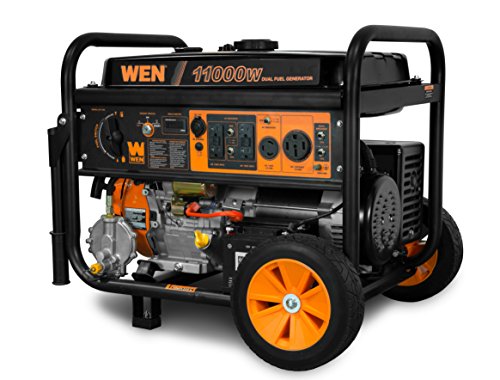
The WEN DF1100T provides dual-fuel operation, switching between gasoline and propane with a simple dial. It delivers 11,000 surge watts on gasoline and 8,300 running watts, with propane offering 9,500 surge and 7,500 running watts. An electric start powers a large 457cc four-stroke OHV engine, enabling quick startup with the turn of a key. The unit also supports a 120V/240V output range for transfer switches and backup power. It is a practical choice for homeowners seeking flexible fuel options and reliable power during outages or remote work sites.
Key considerations include fuel availability, noise levels, and the ease of moving a wheeled unit. The WEN model is designed for portability with wheels and a handle, making it suitable for garage-to-driveway power transfers or job sites where fuel choice matters. When evaluating, compare the total wattage needs against running watts to prevent overload on sensitive devices. Dual-fuel capability can improve readiness in areas with propane as an alternative to gasoline.
Westinghouse 10000 Peak Watt Portable Inverter

This Westinghouse model combines high peak output with a compact inverter system, delivering up to 10,000 peak watts and 7,600 running watts on gasoline. It includes remote electric start via key fob and a digital readout that updates voltage, frequency, and run time. The unit comes with a 5.28-gallon tank for extended runtime and multiple transfer-switch-ready outlets, including 120V and 120/240V options. A CO sensor helps manage safety by monitoring ambient conditions, making it a solid option for home backup where safety concerns are paramount.
Runtime and fuel efficiency are essential for outages or remote work. This Westinghouse model emphasizes transfer-switch readiness, heavy-duty engine construction, and protective features like rubber outlet covers. Users should assess their home electrical load profiles, ensuring that essential circuits can be supported when the main power is interrupted. The remote start feature adds convenience for frequent testing and outages, reducing the effort needed to power critical devices.
Generac GP8000E Portable Generator

Generac’s GP8000E features PowerRush Advanced Technology, delivering enhanced starting capacity for heavy electrical loads. It uses an OHV engine and offers a long runtime thanks to a sizable fuel tank and efficient design. Easy electric start is supported by a battery, simplifying operation during outages. The model emphasizes reliability for home backup, RV use, and job sites where consistent power is required and where manual cranking is impractical.
Key evaluation points include startup reliability, runtime at 50% load, and overall quiet operation. The GP8000E is well-suited for emergencies where quick power restoration is critical. An extended runtime helps when outages exceed a day, and the sturdy frame supports portable use across locations. For potential buyers, verify compatibility with your transfer switch and ensure your electrical panel can handle the generator’s output without overloading circuits.
Pulsar GD10KBN Dual Fuel Generator

The Pulsar GD10KBN offers dual-fuel flexibility and a substantial power profile with 10,500 peak watts. It is paired with a 10500-watt capability and features a digital multimeter for real-time data, including voltage, frequency, and run time. The unit is RV-ready with a 15-50R outlet, expanding its suitability for campers and outdoor enthusiasts who need reliable power on the go. Wheel kit and electric start improve portability and ease of use in field conditions.
Prospective buyers should evaluate fuel availability and maintenance requirements, as dual-fuel units often have more complex carburetor systems. The RV-ready feature is a clear advantage for outdoor events and mobile setups. While powerful, it’s important to balance noise levels, fuel consumption, and the practicality of transporting a larger generator to work sites or campsites.
A-iPower AP10000E Electric Start 10000W Generator

The A-iPower AP10000E provides 10,000 starting watts and about 8,000 running watts, powered by a robust 420cc OHV engine. It features an organized control panel with a digital monitor for voltage and runtime, plus multiple outlet options for 120V and 240V appliances. The unit includes durable wheels and a folding handle for portability, making it practical for job sites, home backup, and outdoor events where quick setup is essential.
Consider how the panel layout suits your needs, especially if you require several outlets or a dedicated 240V circuit. Electric start adds reliability in outages, and a strong engine helps handle high-draw appliances. Users should compare the total continuous running watts against their most power-hungry devices to avoid overloads, and plan for fuel supply during extended outages.
Buying Guide: Key Purchase Considerations
Fuel type and availability: Decide between gasoline, propane, or dual-fuel options. Dual-fuel models offer flexibility during shortages or storage challenges. Consider where you will power most often—home, RV, or job site—and how you’ll source fuel over time.
Starting method and ease of use: Electric start reduces manual effort and is preferable for frequent outages or cold-weather starts. Look for battery compatibility, easy recoil backup, and diagnostic indicators on the control panel to simplify operation and maintenance.
Power output and suitability: Compare peak watts to running watts, and map them to your essential devices. Ensure the unit can support the initial surge of motors and compressors while maintaining stable operation for sensitive electronics. Consider whether you need 120V-only or 120/240V capability for a transfer switch.
Runtime and fuel capacity: Larger tanks yield longer runtimes, which is crucial during outages. Evaluate the expected runtime at typical loads. In outdoor settings, longer operation without refueling adds convenience and reduces interruptions.
Safety features: CO sensors, automatic shutdown for low oil, and rubber outlet covers contribute to safer operation. A digital hour meter or VFT display provides ongoing visibility into maintenance needs and output reliability.
Portability and build: Wheel kits, handles, and robust frames affect ease of movement. A well-built generator with corrosion-resistant components is worth the investment for frequent transport and outdoor usage.
Transfer-switch readiness: If you plan to connect to a home electrical system, confirm that the generator has transfer-switch compatible outlets or is explicitly transfer-switch ready. This ensures seamless, safe power during outages without backfeeding the utility lines.
Warranty and service: Consider manufacturer support, availability of replacement parts, and local service options. A longer warranty often reflects durability and confidence in performance over time.