Best 1000 Watt HPS Grow Lights for Indoor Growing
This article highlights five 1000 watt high-pressure sodium (HPS) grow lights that are well-suited for indoor gardening, hydroponics, and flowering stages. Each option emphasizes intensity, spectrum optimization, and durability to support robust yields. The selections balance single-ended and double-ended designs, lumen output, and longevity to help growers choose a dependable lighting setup for bloom cycles.
Overview of selected products:
| Product | Brand | Key Features | Base |
|---|---|---|---|
| GRUOTVSZAK HPS 1000 Watt Grow Light Bulb 2-Pack | GRUOTVSZAK | 1950μmol/s PAR, 136000lm, 60% more RED spectrum | E39 |
| SunStream 1000W SE HPS Grow Light Bulb | SunStream | Double-ended design, 1000W, efficient energy use | DE |
| Vegelumax 1000W HPS Grow Light Bulb | Vegelumax | 2100K CCT, 140000lm, enhanced red/orange spectrum | E39 |
| iPower Hydroponic 2 Pack 1000W HPS Bulbs | iPower | 140000lm, optimized red & orange spectrum | E39 |
| GRUOTVSZAK 2150umol HPS 1000W DE 2 Pack | GRUOTVSZAK | Over 2100μmol/s PAR, DE design | DE |
GRUOTVSZAK HPS 1000 Watt Grow Light Bulb 2-Pack

Features emphasize high yield with 1950 μmol/s PAR and 136,000 lumens, designed to maximize bloom-stage performance. The red spectrum is targeted to boost photosynthesis during flowering, providing 60% more PAR focus on red wavelengths. The bulb is rated for a long life, with over 24,000 hours of total life and high output maintenance for the first 5,000 hours. This option is a 2-pack, offering growers an easy, scalable upgrade for bloom cycles.
SunStream 1000W SE HPS Grow Light Bulb

This double-ended HPS bulb delivers a high-intensity spectrum with an emphasis on even light distribution. The SE design is reported to provide superior lighting uniformity across grow areas, supporting strong canopy development. The model claims energy efficiency advantages relative to single-ended bulbs, contributing to heavier harvests and potentially lower operating costs over time.
Vegelumax 1000W HPS Grow Light Bulb

Designed for professional hydroponic cultivation, this 1000W HPS bulb produces about 140,000 lumens and a CCT around 2100K. It emphasizes a red and orange spectrum with high PAR to promote flowering, fruiting, and abundant yields. The lamp is engineered for stable performance with minimal lumen depreciation, maintaining a high portion of initial output after thousands of hours of use.
iPower Hydroponic 2 Pack 1000W HPS Bulbs

These bulbs are compatible with electronic and magnetic ballasts and offer a balanced spectrum tuned for flowering. With 140,000 lumens and a CCT around 2100K, the lamps provide an optimized red and orange spectrum to support robust flower development and fruiting. The design promotes high PAR and energy efficiency, while recommending periodic replacement to maintain optimal performance.
GRUOTVSZAK 2150umol HPS 1000W DE 2 Pack
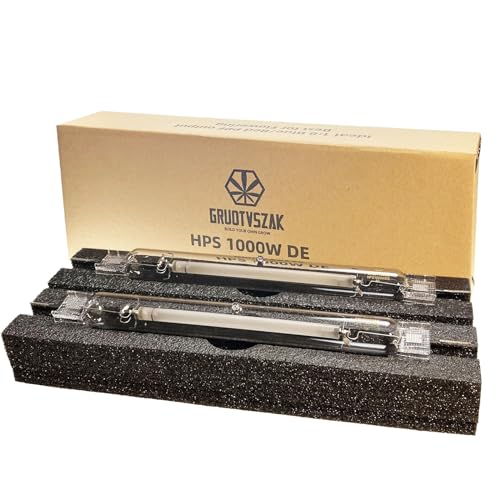
This double-ended (DE) setup delivers a high PAR output for flowering, with over 2100 μmol/s, aimed at maximizing bloom intensity. The spectrum is engineered for a strong red-dominant output, supporting rapid flower development and yield potential. The DE format is compatible with suitable fixtures, and the kit is suitable for growers seeking a powerful, high-efficiency bloom solution.
Buying Guide: Key Purchase Considerations
- Lamp type and compatibility: Decide between single-ended (SE) and double-ended (DE) designs. DE bulbs often provide higher PAR and more uniform distribution but require compatible ballasts and fixtures.
- PAR and lumen output: Higher PAR (μmol/s) and lumen numbers generally correlate with stronger bloom potential. Compare lamps within the 1000W category for the best balance of intensity and efficiency.
- Spectrum and color temperature: Look for bulbs optimized for flowering (red/orange emphasis) and a CCT around 2100K–2200K to boost flowering and fruiting stages.
- Fixture compatibility: Check ballast type (electronic or magnetic) and the fixture design to ensure safe operation and optimal cooling.
- Durability and life: Consider lamps with longer rated lifespans and stable lumen output to reduce replacement frequency and maintenance costs.
- Energy efficiency: Double-ended models can offer energy efficiency advantages, potentially reducing running costs over time.
- Maintenance and replacement scheduling: Plan for regular bulb replacement to preserve light quality and crop outcomes, especially in flowering cycles.
- Coverage area and positioning: Ensure your grow space’s footprint aligns with the lamp’s recommended coverage (e.g., 5×5 sq ft or similar) and adjust spacing to prevent hot spots.
Across these options, growers can evaluate whether to prioritize higher PAR for larger flowering buds, or a balanced spectrum for general maintenance during different growth stages. The choice between SE and DE designs should align with fixture compatibility and wants for light distribution uniformity. Longevity and consistent output are critical for sustained bloom cycles and harvest consistency, while energy considerations influence long-term profitability for indoor gardens.