Best 1000 Watt Charge Controllers for Off-Grid Power Systems
When selecting a 1000-watt charge controller, the goal is to efficiently manage power from wind and solar sources while protecting batteries. This guide highlights five top options suited for off-grid homes, RVs, boats, and street-lighting setups. Each pick targets specific needs, such as hybrid wind/solar input, advanced MPPT tracking, or broad battery compatibility. Use the comparison table below to quickly assess who each product is best for.
| Product | Best For | Key Strength | Limitations |
|---|---|---|---|
| VQP 2000W Wind Solar Hybrid Charge Controller | Hybrid wind/solar systems needing boosted MPPT | Boost MPPT for wind, PWM for solar, dual input up to 1000W each | Complex setup for wind-only users |
| ELUSH Upgraded 100A MPPT Solar Controller | Versatile 12/24/36/48V systems with LCD control | High tracking efficiency, multiple operating modes | More features may require learning curve |
| iSunergy 1000W Wind Solar Hybrid Controller | Compact wind/solar packages needing simple integration | PWM solar charging, LCD display, wind/solar integration | Lower overall MPPT efficiency than top-tier MPPT-only units |
| POWLAND 100A MPPT Solar Controller | Broad battery chemistries with robust protection | High MPPT efficiency, multiple protections | Some setup complexity for new installers |
| Renogy Rover 40A MPPT Charge Controller | Smaller 12/24V off-grid systems with lithium compatibility | Reliable MPPT operation, broad battery compatibility | Lower current rating than 100A options |
2000W Wind Solar Hybrid Charge Controller
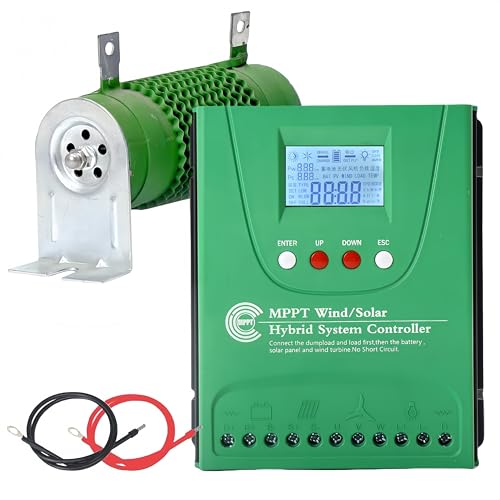
Brand: VQP
- Versatility: Supports 12V/24V batteries with wind input up to 1000W and solar input up to 1000W, ideal for hybrid lighting systems in homes, boats, and street lamps.
- Boost MPPT for wind: Enhanced charging efficiency at low wind speeds.
- PWM charging for solar: Safe, efficient charging from solar panels.
Best for: Buyers installing a wind/solar hybrid system who need a single regulator to manage both inputs. This controller is chosen for energy capture improvements in windy locations and for users prioritizing solar safety with PWM charging. Caution: the hybrid setup may require careful wiring to manage dual input protection and dump-load placement.
Upgraded 100A MPPT Solar Controller

Brand: ELUSH
- Superior MPPT Technology: Recognizes 12V/24V/36V/48V systems with dual USB ports; tracking efficiency at least 99.5%.
- Versatile Design: Multi-function LCD with backlight; seven operating modes including time-based controls.
- Comprehensive Voltage Protection: Over-voltage, over-current, overheating, and reverse connection safeguards; real-time voltage display for monitoring.
Best for: Off-grid setups that require precise control, timers, and robust protection across multiple battery chemistries. Choose this if LCD visibility and time-based automation matter. Caution: The feature set is extensive, so setup may be more involved for straightforward solar-only systems.
iSunergy 1000W Wind Solar Hybrid Controller

Brand: iSunergy
- Hybrid control: Integrates wind and solar control for a unified system.
- Series MOS PWM solar charging: Stable charging with low power draw.
- LCD display: Clear voltage and state of charge information; user-friendly controls for environment-specific adjustments.
Best for: Small to medium hybrid systems where a simple, readable interface and balanced wind/solar management are priorities. Caution: PWM solar charging may be less efficient than full MPPT in high-dynamic solar environments.
POWLAND 100A MPPT Solar Controller

Brand: POWLAND
- 100A MPPT with 12V/24V/36V/48V compatibility; 150V max input; LCD display for status.
- Four-stage charging and intelligent MPPT algorithm to optimize energy capture and battery health.
- Multiple protections: over-voltage, short circuit, reverse connection, and load protection.
Best for: Users seeking a high-efficiency MPPT regulator capable of handling diverse battery systems and larger solar arrays. Caution: Higher feature set means design considerations for installations with limited space.
Renogy Rover 40A MPPT Charge Controller

Brand: Renogy
- Dual-Peak MPPT with 99.9% multi-peak efficiency; 12V/24V auto-detection.
- Compatibility with gel, sealed, flooded, and lithium batteries; storm-ready protection features.
- Four-stage charging (Bulk/Absorption/Float/Equalization) and lithium recovery capabilities.
Best for: Off-grid users seeking proven Renogy reliability for RVs, boats, or small home systems with lithium or lead-acid batteries. Caution: Rated at 40A, it is not a fit for larger solar arrays requiring higher current.
Buying Guide: Key Considerations for 1000W Charge Controllers
- System voltage compatibility: Ensure the controller supports your battery bank voltage (12V, 24V, 36V, or 48V). Higher voltages can reduce current and heat in longer runs.
- Power handling vs. input sources: Distinguish whether you need a single-source MPPT controller or a true wind/solar hybrid that can combine inputs up to about 1000W each. Hybrid units save space but require careful wiring.
- MPPT vs PWM: MPPT maximizes energy harvest, especially in variable conditions; PWM is simpler and often adequate for smaller or steady solar setups.
- Battery chemistry and protection: Check compatibility with lead-acid, LiFePO4, and other chemistries. Look for protections against overcharge, deep discharge, short circuits, and reverse polarity.
- Monitoring and control: LCD displays, backlighting, and time-based controls help long-term management. Bluetooth synchronization or app control can be a plus for large systems.
- Expansion and future-proofing: If you plan to scale, select controllers with higher input tolerance, modular expansion, or multi-controller synchronization capabilities.
- Installation considerations: Physical size, cooling needs, and wiring complexity should fit your space and skill level. Some units include easier setup modes, while others demand technical setup.
Frequently Asked Questions
- What is the difference between MPPT and PWM in charge controllers?
MPPT controllers maximize energy harvest by adjusting the electrical operating point of the PV array, allowing higher efficiency in varying light conditions. PWM controllers are simpler and typically less efficient but adequate for smaller or steady systems. - Can a 100A MPPT controller handle 1000W of solar panels at 12V?
Yes, but current levels will be higher (approx. 83A for 1000W at 12V). Ensure the controller’s rated current matches or exceeds the system’s expected charging current and that wiring and fusing are sized appropriately. - Are wind inputs common on 1000W charge controllers?
Some models combine wind and solar inputs in a single regulator for compact, hybrid off-grid setups. These are best when you have both wind and sun resources and want centralized management. - What battery types should I consider with these controllers?
Most support a range including lead-acid, AGM, and LiFePO4. If lithium support is crucial, verify lithium-specific protections and recovery features. - Is Bluetooth or app monitoring available on all models?
Not all models include Bluetooth or app integration. Check the product’s features if remote monitoring is important for your setup. - Do I need a dump load for wind or solar systems?
Dump loads are common in wind-heavy or high-voltage setups to dissipate excess energy safely when batteries are full or during transient surges. Verify compatibility with your controller model.