Best 100 kWh Solar System Solutions for Home Use
Finding a reliable off‑grid or hybrid solar setup demands a balance of capacity, efficiency, and scalability. This article highlights five Eco‑Worth y and compatible options that together offer a broad view of how a 100 kWh-scale or higher daily output can be approached. Each option covers different needs—from compact off‑grid kits for cabins to larger, more flexible systems for homes or cabins—so you can compare configurations, components, and potential expandability at a glance.
| Product | Brand | Key Capacity |
|---|---|---|
| ECO-WORTHY 48V Off Grid Solar System Complete Kit | ECO-WORTHY | 4.68 kWh/day (1200W solar, 6 panels) + 48V 50Ah LiFePO4 |
| ECO-WORTHY Home Off-Grid Solar Power System: 10KW | ECO-WORTHY | Up to 10 kW continuous; 15.36 kWh battery capacity |
| ECO-WORTHY 9.36KWH 2340W System | ECO-WORTHY | 9.36 kWh/day; 2340W solar panels; 5000W inverter |
| [Ultra] ECO-WORTHY 1200W 24V System | ECO-WORTHY | 5.52 kWh/day; 6 x 195W panels; 28V–60V battery support |
| DOKIO 800W Mono Panels Pack | DOKIO | Off-grid 24V compatibility; 3 m MC4 leads per panel |
ECO-WORTHY 48V Off Grid Solar System Complete Kit

The kit combines 6 x 195W N-Type bifacial panels, a 48V 50Ah LiFePO4 server rack battery, and a 3500W inverter with built‑in MPPT and WiFi monitoring. It supports parallel connection of up to six units, enabling scalable output toward higher daily energy generation. The N-Type cells deliver high efficiency and heat resilience, while the inverter provides 110/120 VAC output with a 7000W surge, suitable for running air conditioners, refrigerators, and other essential loads under daylight and steady sun.
Features include: 195W bifacial panels with 25% efficiency, 18 busbars for improved current transfer, and an 80A MPPT controller. This kit is designed for home, shed, or cabin use, aiming to deliver consistent AC power for everyday appliances and devices. Its modular design supports future expansion for larger households or hobby farms seeking increased independence from the grid.
ECO-WORTHY Home Off-Grid Solar Power System: 10KW

This larger off-grid kit offers a 10 kW continuous inverter output and a 410W solar panel array, designed to support single-phase and split-phase outputs. The 15.36 kWh UL‑certified lithium battery pack provides substantial storage, and the system emphasizes plug-and-play usability with compatible CAN/RS485 communication for easy integration with popular solar inverters. The battery assembly is UL1973/UL9540A certified, combining safety with practical space efficiency when mounted in a server rack or similar enclosure.
Ideal for remote homes, workshops, or cabins where a dependable off-grid power source is essential. Buyers can expect robust daytime generation and reliable nighttime storage, with scalability through additional panels or parallel inverter units as energy demands grow.
ECO-WORTHY 9.36KWH 2340W System
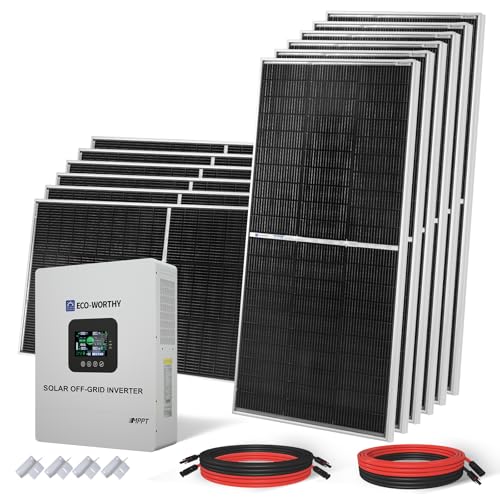
This kit provides a high daily output with 2340W of solar panels paired with a 5000W all-in-one inverter and 12 x 195W N-Type panels. It is designed for serious home energy backup and off-grid flexibility, featuring dual‑axis tracker options for increased energy capture in certain models. The 30-year panel lifespan and high-efficiency cells ensure long-term performance, while the integrated inverter offers multiple charging modes to balance solar, grid, and battery inputs efficiently.
With a 9.36 kWh daily target, this system is suitable for larger households, cabins, or small farms desiring credible energy independence without compromising on comfort or essential appliance reliability during outages or in remote locations.
[Ultra] ECO-WORTHY 1200W 24V System

Designed for mobile or compact off‑grid applications, this package includes six 195W panels and a 28–60V battery compatibility range, enabling use with LiFePO4, AGM, or Gel options through compatible charge controllers. The system emphasizes a lightweight, modular approach for RVs, trailers, sheds, or small cabins, with a focus on straightforward solar charging for 24V battery banks and a simple path toward expanded capacity with additional panels or higher voltage storage options.
ECO-WORTHY Power Box For Solar Tracker System

This power box is designed to complement ECO-WORTHY solar tracker setups. It includes a 10W monocrystalline panel and a 6Ah 12V LiFePO4 battery with BMS protection, providing a turnkey power source for garden and outdoor installations. It emphasizes easy installation, compatibility with single or dual-axis trackers (including expanded versions), and the ability to operate independently for several days on a full charge. This option is well-suited for maximizing energy production in expandable tracker configurations or as a reliable, small-scale backup for outdoor spaces.
Buying Guide: Key Purchase Considerations
- System scale and energy goals: Determine your daily energy needs in kWh and plan for both daytime generation and nighttime storage. Consider future growth and whether you want a grid-tied, off-grid, or hybrid setup.
- Battery technology and capacity: LiFePO4 offers safety, stability, and long cycle life, but total storage costs vary. Match battery capacity to expected load and desired autonomy during outages.
- Inverter type and capacity: Choose inverters with sufficient continuous power and surge ratings for appliances like air conditioners. Consider pure sine wave inverters for sensitive equipment and the option for parallel units to scale output.
- Charge controller and MPPT performance: A robust MPPT controller improves efficiency, especially in partially shaded conditions. Review voltage ranges, amperage, and communication options for system monitoring.
- Modularity and expansion: If future expansion is likely, select modular kits that support adding panels, batteries, or additional inverters without major rewiring.
- Monitoring, safety, and standards: Look for systems with WiFi or cloud monitoring, UL or equivalent safety certifications, and protections such as overcharge, short circuit, and temperature monitoring.
- Physical footprint and installation: Evaluate panel dimensions, mounting options, and whether components (batteries, inverters) can be safely installed indoors or require outdoor enclosures.
- Climate and warranty considerations: Panels with higher tolerance to heat and humidity can perform better in hot climates. Review product warranties for panels, inverters, and batteries.
Ultimately, the right choice balances daily energy needs, available space, and the desire for future expansion. The featured options demonstrate a spectrum from compact off-grid kits to larger, high-capacity configurations, each with distinct advantages for different American homes, cabins, or remote locations.