Best 100 Amp Solar Panel Kit for Off-Grid Power
Answering the question of which 100 amp solar panel kit fits an off-grid lifestyle, RVs, boats, or sheds, this guide highlights five top Amazon picks. Each option is suitable for different buyers: weekend campers and RV users may prefer compact, easy-install kits; off-grid homeowners might opt for higher output bundles; and marine setups benefit from weatherproof components. The comparison table below helps you quickly identify what each kit prioritizes, such as safety features, warranty, and installation ease.
| Product | Best For | Key Benefit | Notes |
|---|---|---|---|
| Renogy 100W Starter Kit | RV/Camper Starters | EL-tested panels, long service plan | Great starter value with solid safety ratings |
| SOLPERK 100W Kit | All-Weather Maintainers | 30% more power with MPPT | Completely waterproof controller |
| Renogy 400W Premium Kit | Grid-Style Off-Grid | Higher output with MPPT and Bluetooth | Includes mounting hardware and wiring |
| Hoysicy 100W Kit | Budget-Friendly Boats/RVs | Solid efficiency with LCD monitor | Includes battery-friendly controller |
| Renogy N-Type 100W Panel | High-Temperature Areas | 25% efficiency with advanced 16BB cells | Extra resilience in hot climates |
Renogy 100W Starter Kit for RVs and Off-Grid

The Renogy Starter Kit provides a compact, 100W monocrystalline panel paired with a 30A LCD PWM charger controller. It includes adaptor kits, tray cables, and Z brackets for easy RV or camper installation. Best for buyers seeking a dependable entry into solar with straightforward setup. A notable limitation: PWM controllers are generally less efficient than MPPT in varying sunlight, so peak daily output may be lower in some conditions.
Renogy 100W Starter Kit (Variant)
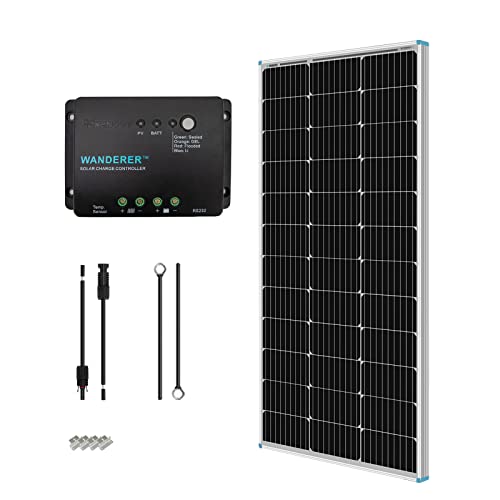
This kit emphasizes robust safety with UL 61730 and CSA certifications and a strong wind/snow load rating. It’s a reliable pick for those who want long-term service assurance—20+ years of panel output warranty is highlighted, making it a safer bet for remote installations where service access is limited. The trade-off is kit-level simplicity over advanced monitoring features.
Renogy 100W N-Type 12V Solar Panel

This N-Type panel uses 16BB cell technology for higher efficiency and improved hotspot mitigation. Best for hot climates where performance can dip with standard designs. Choose this if you operate in high-temperature environments and need sustained output. A potential limitation is the higher price point associated with advanced cell architecture.
Renogy 400W Premium Kit with MPPT

Designed for higher daily energy needs, this kit includes four 100W panels, a 40A MPPT controller, Bluetooth module, and mounting hardware. Best for grid-like off-grid cabins or larger RVs where substantial daily power is required. The MPPT controller improves efficiency by tracking maximum power, though it adds setup complexity for first-time installers.
Hoysicy 100W Solar Kit with LCD Controller

The Hoysicy kit pairs a 100W panel with a smart charge controller that includes an LCD display and USB charging. It’s well-suited for boaters and RVers who want easy monitoring directly from the controller. A limitation is the absence of integrated Bluetooth or advanced remote monitoring compared to premium MPPT kits.
Buying Guide: 100 Amp Solar Panel Kit Essentials
What to evaluate when selecting a kit: overall system voltage compatibility (12V vs 24V), panel efficiency, weather resistance, and controller type (PWM vs MPPT). Consider installation complexity, included mounting hardware, and whether the kit provides ready-to-use wiring or requires extra components. For hot climates, look for low temperature coefficients and robust heat resistance. If you need remote monitoring, prioritize kits with Bluetooth or app support. For boats or marine use, ensure IP-rated connectors and waterproof enclosures are present. Finally, confirm warranty terms for panels and controllers to ensure long-term service.
Key buyer considerations
- Energy needs: estimate daily consumption and target daily production in watt-hours (Wh).
- Site conditions: sun exposure, weather, and temperature influence performance.
- Controller choice: MPPT offers higher efficiency but may be pricier; PWM is simpler and sufficient for smaller loads.
- Ease of installation: pre-drilled holes, included cables, and bracket hardware save time.
- Durability: look for UL/CSA certifications, weatherproof J-boxes, and corrosion-resistant frames.
Quick comparison by scenario
- Best for beginners: Renogy 100W Starter Kit—simple setup, solid safety, good value.
- Best for harsh environments: SOLPERK with fully waterproof MPPT controller.
- Best for high daily energy: Renogy 400W Premium Kit with MPPT and Bluetooth.
- Best for hot climates: Renogy N-Type 100W Panel with 16BB cells.
- Best budget-friendly marine setup: Hoysicy 100W Kit with LCD controller.
FAQs
- What does 100W mean in a solar panel?
It is the panel’s power rating under standard test conditions, indicating the maximum power output in watts. - Do I need MPPT or PWM controllers?
MPPT controllers extract more power, especially in variable sunlight; PWM controllers are simpler and cheaper but less efficient. - Can a 100W kit run a full RV’s needs?
It depends on daily usage. A 100W kit often covers small appliances and charging needs but not heavy loads without multiple panels or storage. - Are these kits weatherproof?
Most kits include weather-rated components; verify IP ratings for connectors and J-boxs in marine or snowy environments. - Will I need batteries?
Yes. A solar kit shows charging capability, but a compatible 12V/24V battery bank is required to store energy for use when the sun isn’t shining.