Best 100 Amp Charge Controller Options for Off-Grid Power
Discover top 100A MPPT solar charge controllers designed for 12V to 48V systems. These regulators help maximize PV energy, protect batteries, and support various battery chemistries. The following picks balance efficiency, features, and adaptability for homes, RVs, and off-grid setups.
Summary of Selected Products
| Brand | Model | Voltage Range | ||
|---|---|---|---|---|
| POWLAND | 100A MPPT Solar Charge Controller | 12/24/36/48V (Auto), up to 150V input | Lead-Acid, LiFePO4 | 4-stage charging, high efficiency MPPT, multiple protections |
| LiTime | MPPT Solar Charge Controller (Bluetooth) | 12/24/36/48V | LiFePO4, Lead-Acid | 99% MPPT, Bluetooth app monitoring, quiet die-cast cooling |
| HQST | 100A MPPT Solar Charge Controller | 12/24/36/48V | LiFePO4, Sealed, AGM, GEL, Flooded | Bluetooth APP with LCD, low-temp cut-off, high efficiency |
| Renogy | 100A Rover MPPT Controller | 12/24/36/48V | Lead-Acid, Gel, Sealed, Flooded, Lithium | 99.9% MPPT, self-diagnostics, temperature compensation |
| PowMr | 100A MPPT Solar Charge Controller | 12/24/36/48V | Lead-Acid, LiFePO4, Lithium | Parallel up to 12 units, multi-stage charging, updated parallel support |
POWLAND 100A MPPT Solar Charge Controller

The POWLAND controller supports 12V/24V/36V/48V battery banks with an auto-detecting 100A MPPT charger. It uses a four-stage charging algorithm—bulk, boost, float, and equalize—to optimize charging speed and battery longevity. An input rating up to 150V enables flexible PV array configurations. It includes short circuit, open circuit, reverse, and overload protections. The device emphasizes high MPPT efficiency and broad compatibility for solar RVs and home systems.
LiTime MPPT Solar Charge Controller (Bluetooth)

LiTime offers 99% MPPT tracking efficiency with real-time app monitoring via Bluetooth. It supports 12/24/36/48V systems and handles LiFePO4 and lead-acid batteries. A rugged die-cast aluminum heatsink and optional silent fan keep operation cool, while app connectivity lets users verify system status and adjust parameters from a distance. This model suits enthusiasts seeking remote monitoring without compromising performance.
HQST 100A MPPT Solar Charge Controller
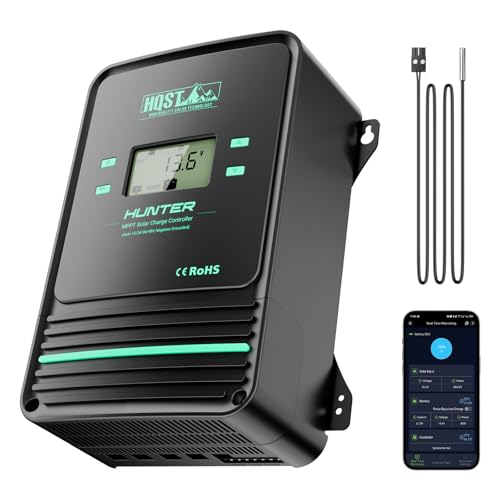
This controller includes Bluetooth APP control and a dedicated LCD display for local monitoring. It supports low-temperature cut-off for LiFePO4 batteries and offers high MPPT efficiency up to 99% with a peak conversion around 98.7%. It works with four battery chemistries—lithium (LiFePO4), sealed, AGM, GEL, and flooded—making it adaptable for various off-grid configurations and climates.
Renogy 100A Rover MPPT Controller

Renogy’s Rover 100A MPPT controller auto-detects 12V/24V/36V/48V systems and provides robust protection against reverse polarity, overload, and short circuits. It emphasizes advanced charging technology with a four-stage approach and temperature-compensated charging, suitable for RVs, boats, and off-grid installations. The unit includes thermal management features and external sensors for optimized performance in diverse environments.
PowMr 100A MPPT Solar Controller

PowMr’s 100A MPPT unit supports parallel operation—up to 12 controllers—to scale larger solar installations. It features dual cooling with a turbofan for heat management and is compatible with a wide range of batteries, including lead-acid, LiFePO4, and lithium variants. The three-stage charging (bulk, boost, float) and pre-set parameters help streamline setup for larger systems and multi-battery configurations.
PowMr 100A MPPT Solar Controller (Update)

This model highlights parallel expansion and multi-stage charging with a 12-unit parallel capability. It accommodates 12V/24V/36V/48V systems and supports various battery types, including LiFePO4 and lithium. It emphasizes operational flexibility and easier scaling for larger off-grid arrays, with user-configurable absorption, float, and low voltage cutoffs.
ELUSH 100A MPPT Solar Charge Controller

ELUSH presents a high-efficiency MPPT regulator with dual USB charging ports and a universal LCD display. It auto-detects 12V/24V/36V/48V, supports LiFePO4 and other chemistries, and delivers a tracking efficiency of at least 99.5%. The device includes multiple voltage protections and a clock-enabled display for precise timing control and parameter management.
Buying Guide: Key Purchase Considerations
When selecting a 100A MPPT controller, consider the following:
- Voltage compatibility: Ensure the controller supports your system voltage (12V, 24V, 36V, 48V) and accommodates multi-stage charging.
- Battery compatibility: Check if it supports your battery types (LiFePO4, Li-ion, AGM, Gel, Flooded) and whether it offers low-temperature cut-off if you operate in cold climates.
- MPPT efficiency: Higher MPPT tracking efficiency translates to more energy harvested, especially under partial shading or cooler conditions.
- Protection features: Look for short-circuit, reverse polarity, overcharge, over-discharge, and over-temperature protections, plus anti-reverse current capabilities.
- Parallel expansion: If you plan a larger system, verify the number of controllers that can be paralleled and any required synchronization steps.
- Monitoring options: Bluetooth, LCD, or external sensors help you monitor performance and adjust settings as needed.
- Heat management: Die-cast aluminum housings and fans reduce thermal losses; consider noise if placed near living spaces.
- Ease of installation: Auto-detection, user-friendly apps, and clear wiring diagrams streamline setup and maintenance.
For most users, selecting a model with robust MPPT efficiency, broad battery compatibility, and easy monitoring provides the best balance of performance and long-term reliability. Parallel-capable units are ideal for expanding systems, while Bluetooth-enabled models suit remote monitoring needs. Always follow manufacturer guidelines for installation, wiring, and safety to maximize system life and energy yield.