Best 10-Circuit Transfer Switch Kit for Home Backup Power
If you’re shopping for a 10-circuit transfer switch kit, you want reliable performance, easy installation, and clear guidance on which setup fits your needs. This guide highlights five well-matched options for different home and small-business power needs. The selections cover a range from residential-grade units to more robust outdoor-ready kits, each chosen for compatibility with common generators and practical wiring layouts. The buyer types most likely to benefit include homeowners seeking essential-load reliability, hobbyists installing weekend backup systems, and small commercial setups needing simple, code-aligned transitions between utility and generator power.
| Product | Best For | Key Benefit |
|---|---|---|
| Reliance Controls 31410CRK Pro/Tran 10-Circuit | Residential backup with mid-range power | Fast installation with 18-inch conduit whip |
| VEVOR 50-Amp 10-Circuit Kit | Households needing higher load capacity | Built-in CS6375 inlet and watt meter |
| MUJURUR 30 Amp 10-Circuit Kit | Smaller generators, essential-load outages | Pre-wired circuits, labeled for easy install |
| Connecticut Electric EmerGen 30 Amp 10-Circuit | Outdoor-ready with flexible indoor/outdoor use | NEMA L14-30 receptacle and 10-foot cord |
| VEVOR 30-Amp 10-Circuit Transfer Kit | Balanced, weatherproof outdoor setup | Integrated watt meter and NEMA 3R enclosure |
Reliance Controls 31410CRK Pro/Tran 10-Circuit
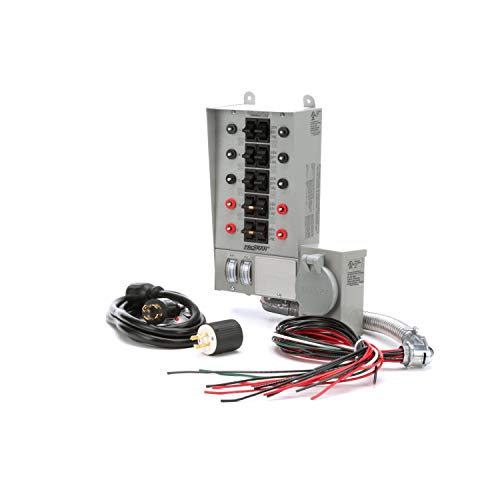
The Reliance 31410CRK Pro/Tran 10-Circuit kit is designed for generators up to 7,500 running watts. It facilitates multi-circuit wiring in residential and light commercial settings. Best for homeowners who need a straightforward installation path and dependable performance for essential circuits, such as lights and critical outlets. A potential limitation is its maximum wattage, which may not cover very high-demand appliances during an outage. The 18-inch flexible conduit whip helps streamline load-center connections, supporting a cleaner install.
VEVOR Manual Transfer, 50-Amp 10-Circuit

Best for households with higher power needs, this 50-amp manual transfer kit supports up to 10 circuits and generators up to 12,500W. It includes a prewired CS6375 inlet box and an integrated mechanical watt meter for real-time load monitoring, helping to prevent overloads. Its NEMA 3R weatherproof enclosure suits outdoor installations. A caution is that higher amperage demands may require careful wire sizing and professional installation to ensure safe operation.
MUJURUR 30 Amp 10-Circuit Kit

Choose this kit if you operate a smaller generator and want a clearly labeled, pre-wired setup. It delivers 6× 15-amp 1P circuits and 2× 20-amp 2P circuits, with the option to convert some 20-amp 2P circuits to 4×20-amp 1P circuits by removing tie bars. Rated up to 7,500W, it is well-suited for essential appliances. A limitation is that larger appliances may push the system toward its max, so plan loads accordingly.
Connecticut Electric EmerGen 30 Amp 10-Circuit
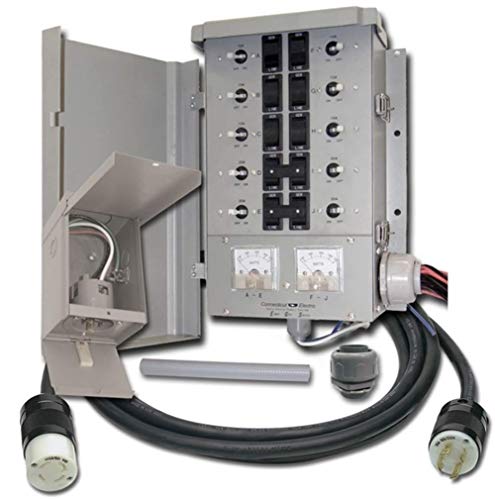
This kit is designed for portable generators with up to 30-amp output, featuring a NEMA L14-30 receptacle and four 2-pole 240-volt circuits. It’s flexible for well pumps and sump pumps, and the tie bars can be removed to add four more single-pole circuits. Best for users needing both 240V capabilities and portability, with outdoor-friendly use due to its NEMA 3R rating. Note that complex installations should follow local electrical codes to ensure safe, compliant operation.
MUJURUR 50 Amp 10-Circuit Kit
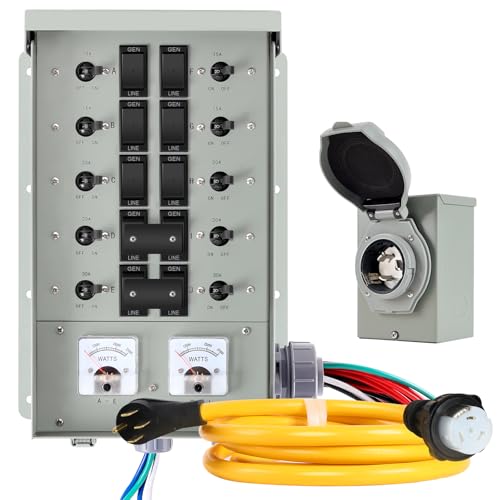
Best for larger loads in outdoor environments, this 50-amp kit covers a wide circuit range with 4×15 A 1P, 2×20 A 1P, and 1×20 A 2P circuits plus a 1×30 A 2P circuit. It includes a 10-foot cord and a 50-amp inlet, with pre-wired circuits for easier installation and PVC tubing for clean run. A limitation is that managing a 12,000W capacity requires careful planning of which circuits are connected during an outage to avoid overloading the generator.
Buying Guide
What should you consider when selecting a 10-circuit transfer switch kit?
- Power rating: Match the generator’s wattage to the kit’s capacity. Higher-capacity kits support more critical loads but require appropriate generators.
- Number and type of circuits: Ensure the kit’s circuit layout fits your home’s essential loads (lighting, fridge, sump pumps, etc.).
- Inlet and outlet compatibility: Look for standard NEMA configurations (e.g., L14-30, 14-50) that match your generator and cord sets.
- Enclosure protection: NEMA 3R enclosures offer outdoor use; indoor setups may not require weatherproofing, depending on location.
- Watt meter availability: Built-in watt meters help monitor load and prevent generator overloads.
- Wiring and installation: Decide between pre-wired kits and those requiring field wiring. Professional installation improves safety and code compliance.
How to plan your installation?
- Identify essential circuits you want to power during an outage (lights, HVAC, refrigerators, well pumps).
- Assess your generator’s continuous and surge wattage to avoid overloading after startup or simultaneous loads.
- Check local electrical codes and whether permits or professional installation are required.
FAQ
- What is a 10-circuit transfer switch kit used for?
It enables a generator to power up to ten predefined circuits in your home or small business, providing a safe, controlled transfer between utility and generator power.
- Do all 10-circuit kits support outdoor installation?
No. Some kits use weatherproof enclosures (NEMA 3R), while others are intended for indoor use. Check the enclosure rating before outdoor installation.
- Is a built-in watt meter important?
Yes. A built-in watt meter helps monitor generator load in real time, reducing the risk of overloading and extending equipment life.
- Can I install a 10-circuit kit myself?
Installation complexity varies. Some kits are prewired and easier to install, while others require electrical expertise. Always follow local codes and consider professional help for safety.
- What should I consider when choosing between 30A and 50A kits?
30A kits suit smaller generators and essential loads; 50A kits handle higher power and more circuits. Choose based on your generator rating and the critical loads you want to support.
- How many circuits should I plan for if my needs grow?
Start with essential circuits and consider a kit with extra capacity or modular expansion options to accommodate future needs.