Best 1 GPM Water Pump for 120V Systems and More
When selecting a 1 GPM water pump for 120V or nearby voltages, reliability, safety, and ease of use matter most. This guide highlights five suitable options, with clear reasons for who each pump is best for, plus practical cautions. The picks cover RVs, boats, cabins, and off‑grid setups, emphasizing pumps that deliver steady flow, self-priming features, and durable construction. Use this overview to compare compatibility with portable or fixed installations and to choose the pump that best fits your water-demand profile.
| Product | Best For | Key Benefit |
|---|---|---|
| SEAFLO 21-Series Water Pressure Diaphragm Pump (12V DC, 1.2 GPM) | RVs, boats, off-grid systems requiring low-voltage operation | High reliability with a 4-year warranty and NSF/UL potable-water compliance |
| SEAFLO 33 Series (110V/115V, 3.3 GPM) | Homes, cabins, larger freshwater needs | Smart pressure switch and NSF/UL compliance for potable water |
| ECO-WORTHY 33-Series (110V AC, 4.0 GPM) | Off-grid ready setups that run on standard AC | Adjustable pressure range with self-priming and thermal protection |
| bayite 12V DC Fresh Water Diaphragm Pump (1.0 GPM) | Compact, low-velocity needs where 12V is preferred | Low noise and efficient, but non-self-priming and not submersible |
| CRESTWAVE 7GPM Fresh Water Pump (110V AC, 70 PSI) | High-flow needs in RVs, boats, and homes | Upgraded five‑chamber design with built‑in pressure switch |
SEAFLO 21-Series: 12V 1.2 GPM Diaphragm Pump

Best for compact, low-voltage systems where space and power are limited. This SEAFLO model operates at 12V DC, delivering 1.2 GPM with a 35 PSI shut-off pressure. It is self-priming up to 4 ft and features a 4-year warranty, providing long-term reliability for RVs, boats, and off‑grid freshwater systems. The unit is NSF/ANSI/CAN 61 & 372 compliant for potable water and UL‑recognized, making it a solid choice for drinkable-water installations.
Who it’s best for: travelers and tiny households that rely on a compact, quiet pump with dependable performance and strong warranty coverage. Why selected: it balances modest flow with reliability and potable-water safety standards. Caution: not ideal for applications exceeding 140°F (60°C) water or high head requirements.
SEAFLO 33 Series: 110V/115V 3.3 GPM

This model suits larger, fixed installations where 110–120V power is standard. It delivers 3.3 GPM at 45 PSI and includes a smart pressure switch for automatic control. The diaphragm design and EPDM/Santoprene components offer robust performance for RVs, cabins, or light industrial uses. It comes with a 4-year warranty and is NSF/UL listed for potable-water safety in North America.
Who it’s best for: users needing higher flow without extra equipment and with reliable automatic operation. Why selected: fits many 120V systems while maintaining potable-water compliance. Caution: higher flow means greater water pressure on plumbing lines; ensure fittings and hoses are rated accordingly.
ECO-WORTHY 33-Series: 110V 4.0 GPM
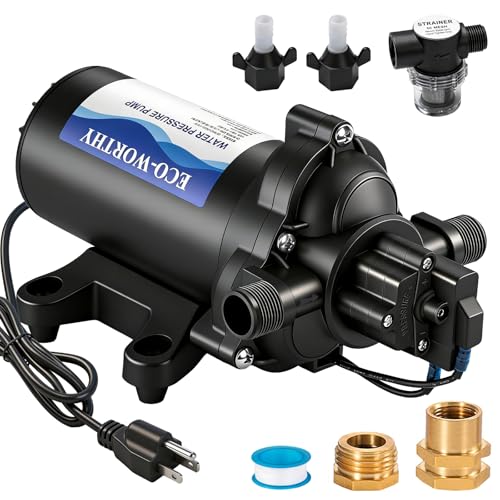
Designed for robust freshwater demands, this 110V AC pump delivers 4.0 GPM with a 50 PSI cut-off and a self-priming lift of up to 9.8 vertical feet. It operates with a smart pressure switch and includes thermal protection to guard the motor. The unit is suitable for RVs, boats, cabins, and off-grid setups where AC power is available.
Who it’s best for: buyers needing higher flow in an AC-powered system without a battery-based setup. Why selected: strong flow, automatic operation, and built-in protection features. Caution: may draw more power and require adequate electrical supply and appropriate wiring for long-term use.
bayite 12V DC Fresh Water Diaphragm Pump

Best for compact systems needing a modest 1.0 GPM flow at 12V. It features a 3/8″ hose barb, a 5 ft vertical suction lift, and a default 80 PSI cut-off. The pump uses a balanced motor with a thermal breaker for protection. It is not submersible and requires a clean, dry installation. Data notes: non-self-priming design means prime is user-dependent.
Who it’s best for: small setups where space and low current draw matter, and where installation can accommodate a non-self-priming pump. Why selected: reliable 1 GPM capability in a compact package. Caution: do not submerge; not ideal for wet or damp areas.
CRESTWAVE Fresh Water Pump: 7 GPM, 70 PSI

This 110V AC pump targets higher-demand scenarios with a 4–7 GPM range and a 70 PSI setting. The upgraded five-chamber design supports stable flow, and a built-in pressure switch enables automatic operation. It fits RVs, homes, marine vessels, and industrial settings where larger water delivery is needed. It supports vertical or horizontal mounting and includes a strainer and barbed adapters for flexible connections.
Who it’s best for: users needing stronger water delivery and automatic operation in larger systems. Why selected: higher flow with reliable automatic control. Caution: over-pressurizing older plumbing may require assessment of fittings and seals.
Buying Guide: Key Purchase Considerations
What flow rate do you need? If your primary goal is around 1 GPM, prioritize models with 1.0–1.2 GPM and verify the shut-off pressure aligns with your system’s demands. For higher daily water usage, 3–4 GPM units reduce cycle times and improve comfort.
What voltage is available? For portable or off-grid setups, 12V pumps fit battery-powered systems but may be limited by head and run-time. For fixed homes or cabins with AC power, 110V–115V pumps provide higher flow with fewer power constraints.
Is self-priming important? Self-priming pumps are easier to install in distributed systems where the pump might sit above the water source or out of the tank. Non-self-priming models require careful priming during initial setup.
What certifications matter? Look for NSF/ANSI/CAN 61 & 372 for potable-water safety and UL/CSA listings for electrical safety. These indicate compliance with drinking-water standards and electrical reliability.
Durability and warranty: a longer warranty (e.g., 4 years) signals confidence in build quality. Check motor protection features like thermal overload to avoid damage in hot or demanding environments.
Frequently Asked Questions
- What is the typical life of a diaphragm water pump?
Diaphragm pumps are designed for long-term reliability, with many units backed by multi-year warranties; actual life depends on usage, water quality, and maintenance.
- Can a 12V pump work with an AC system?
Directly, no. A 12V pump requires an appropriate power source such as a battery or inverter to operate safely. Use models rated for the available supply.
- What is self-priming and why does it matter?
Self-priming pumps can start pumping even when the pump is not fully flooded with water, making installation easier and reducing manual priming steps.
- Is higher GPM always better?
Not necessarily. For small fixtures or long piping runs, a higher GPM can overwhelm lines or fixtures. Match pump capacity to pipe size and demand.
- Which certifications should I look for in a potable-water pump?
NSF/ANSI/CAN 61 & 372 and UL 778 listings help ensure safety and compatibility with drinking water systems and electrical standards.