Best 0-10v to 4-20mA Converter for Industrial Signal Conversion
Industrial automation often requires translating a voltage signal (0-10V) into a current signal (4-20mA) for reliable long-distance transmission and robust instrumentation feedback. The following article highlights five dependable modules that convert 0-10V to 4-20mA or closely related 4-20mA-to-voltage options, enabling seamless integration with PLCs, ADCs, and control systems. Each product includes practical use cases, key features, and integration notes to help engineers and technicians select a suitable transmitter or converter.
Summary of chosen products:
| Product | Brand | Signal Conversion | Typical Use |
|---|---|---|---|
| NOYITO Voltage to Current Module 0-10V to 4-20mA | NOYITO | 0-10V -> 4-20mA | Signal source, PLC debugging, instrumentation test |
| Acxico 4Pcs Current to Voltage Converter Module 0/4-20mA to 0-3.3V 0-5V 0-10V | Acxico | 4-20mA/0-20mA -> 0-3.3/0-5/0-10V | Microcontroller sensing, data acquisition |
| 2PCS Current to Voltage Module 0/4-20mA to 0-3.3V 5V 10V | GODIYMODULES | 4-20mA -> 0-3.3/5/10V | Voltage readouts in control panels |
| NOYITO Current to Voltage Converter 4-20mA to 0-3.3/0-5/0-10V | NOYITO | 4-20mA -> 0-3.3/0-5/0-10V | Sensor interface, ADC input |
| KNACRO 4-20mA to 0-10V | KNACRO | 4-20mA -> 0-10V | Industrial sensors, data loggers |
NOYITO Voltage To Current Module: 0-10V To 4-20mA

The NOYITO device converts a 0-10V voltage signal into a 4-20mA current output, enabling reliable current-based transmission over long runs and through noisy environments. It supports inline adjustment to scale the current output, making it suitable for signal sources, valve control, inverter applications, and PLC debugging. The module adheres to industry-standard voltage-to-current conversion, with a linear output suitable for direct connection to analog-to-digital converters or microcontroller interfaces. Its compact form factor and embedded microcontroller approach make installation straightforward in constrained spaces.
Key points: easy integration with AD converters, stable linear response, and a simple 0-10V to 4-20mA mapping. The device can act as a versatile signal source for test rigs, instrumentation checks, and LED test rigs where a current loop is preferred. While designed for 0-10V input, it is important to ensure a clean supply and proper grounding to prevent offset drift in sensitive setups.
Acxico 4Pcs Current To Voltage Converter Module

This 4-piece module set converts current signals (4-20mA or 0-20mA) into voltage signals (0-3.3V, 0-5V, or 0-10V). It is designed for end-of-signal transmission where the receiving device (microcontroller or ADC) needs a voltage input. The board features a wide supply voltage range and adjustable zero and full-scale outputs, providing flexibility for different control architectures. A high-precision current-sense resistor minimizes drift and maintains stability, especially over varying temperatures, which is critical for industrial data integrity. The module emphasizes industrial-grade reliability for automation projects and instrumentation benches.
Considerations include choosing the preferred voltage range to align with the ADC reference and ensuring the current loop source can drive the converter without impedance issues. This option is particularly attractive for multiple-channel testing or when you need several identical converters for a consistent measurement chain.
2PCS Current To Voltage Module 0/4-20mA To 0-3.3V 5V 10V

This pair of current-to-voltage modules provides a practical solution for converting 4-20mA (or 0-20mA) into voltage outputs with multiple selectable ranges (0-3.3V, 0-5V, 0-10V). Their design emphasizes wide supply compatibility and automatic zero/full-scale adjustment, which helps reduce calibration overhead in field deployments. The high-precision sensing resistor ensures low drift and improved accuracy in real-world environments where temperature and supply variations can affect readings. The boards are compact, making them suitable for enclosure-mounted panels or instrumentation racks.
When integrating these modules, verify the current range supported by your source and ensure the voltage range is compatible with the ADC or MCU’s input tolerance. These units shine in testing setups or embedded projects that require quick conversion from a current loop to a voltage signal for subsequent processing.
NOYITO Current To Voltage Converter: 4-20mA To 0-3.3/0-5/0-10V

The NOYITO current-to-voltage converter accepts a 7-36V supply and supports 4-20mA (or 0-20mA) input with selectable voltage outputs of 0-3.3V, 0-5V, or 0-10V. It’s designed to preserve current loop advantages during transmission, helping reduce signal loss along long runs. The device provides high accuracy through a high-precision color-ring resistor, minimizing drift and temperature effects. This makes it well-suited for sensor interfaces, data loggers, and control systems that rely on stable voltage readings from a current signal.
Considerations include ensuring clean power supply and proper decoupling to maximize accuracy. This model is especially useful in projects where the same module may be deployed across multiple channels, offering consistent performance across a sensor network.
KNACRO 4-20mA To 0-10V Converter

KNACRO offers a compact 4-20mA to 0-10V transmitter module with DC power supply in the 7V to 30V range. The device converts a standard current loop to a voltage signal suitable for direct input to analog stages or data acquisition systems. Its small form factor and straightforward wiring make it an attractive option for space-constrained panels or retrofitting legacy systems that rely on 4-20mA loops. The module’s output range supports common ADC references, enabling reliable monitoring and logging without complex signal conditioning.
Deployment notes include ensuring the current loop source can provide adequate drive current, and verifying that the receiving ADC or MCU can tolerate the selected 0-10V output. This option benefits multi-channel setups where a single design needs to cover various sensors and controllers with minimal recalibration.
Pxiryanlow Blue Current To Voltage Module
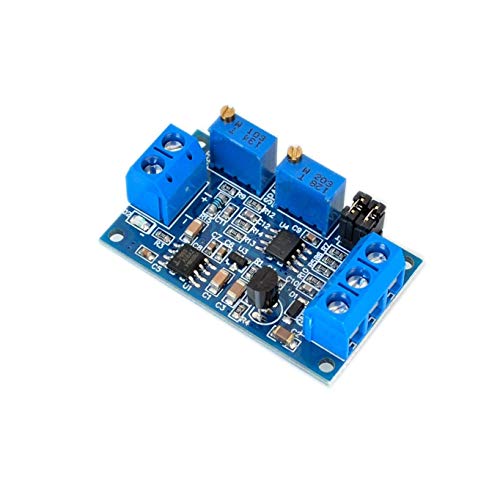
This blue current-to-voltage module converts 0/4-20mA signals to voltage outputs with selectable ranges of 0-3.3V, 0-5V, or 0-10V. It emphasizes standard industrial interfaces for easy integration with various control and monitoring systems. The design focuses on precision output with stable signal characteristics, making it suitable for process control, data acquisition, and instrumentation projects where consistent voltage readings are required from a current loop.
When evaluating this module, consider the control system’s input impedance and the ADC’s voltage reference. The multiple voltage ranges help tailor the interface to different measurement chains, reducing the need for additional signal conditioning hardware.
Buying Guide: Key Purchase Considerations and Comparisons
- Signal compatibility: Ensure the converter supports 4-20mA input and provides the voltage range your ADC or PLC expects (commonly 0-3.3V, 0-5V, or 0-10V).
- Supply voltage: Check the module’s operating voltage range (often 5–36V or 7–36V) and confirm your system can provide a stable supply without causing drift.
- Accuracy and drift: Look for high-precision sense resistors and low temperature drift, especially in environments with temperature fluctuations or long cable runs.
- Calibration options: Some modules offer automatic zero/full-scale adjustments. This can reduce setup time and maintain accuracy across changes in supply or wiring.
- Output impedance and load driving: Ensure the chosen module can drive the ADC input or PLC analog channel without significant loading effects. Verify the current loop integrity across cable lengths.
- Physical footprint and mounting: For panel-mount or enclosure installations, confirm dimensions and mounting options fit your enclosure and space constraints.
- Quantity and cost considerations: If you need multiple channels, evaluate multi-pack options (e.g., Acxico 4Pcs) to simplify procurement and ensure consistent performance across channels.
- Environmental robustness: Industrial-grade modules that withstand dust, vibration, and humidity will reduce maintenance and downtime in harsh environments.
- Documentation and support: Prefer devices with clear datasheets, wiring diagrams, and supplier support to ease integration and troubleshooting.
In choosing among these options, align the signal path with your control system’s expectations: match input/output ranges, confirm supply compatibility, and assess long-term stability. For projects emphasizing quick testing and flexible lab setups, modules with automatic zero and full-scale adjustments can save time. In permanent installations, prioritize rugged designs, consistent temperature performance, and proven field reliability to minimize calibration drift over the system lifecycle.