Best Solar Panels for RV: Top 5 Choices for Off-Grid Travel
Travelers and campers using RVs rely on reliable, space-efficient solar solutions to power essentials on the road. This guide highlights five highly compatible options for RV setups, including rigid and flexible designs, to help you compare performance, durability, and installation flexibility. The selections emphasize N-Type and high-efficiency cells, space-saving form factors, and robust build quality to withstand outdoor use.
| Product | ||
|---|---|---|
| Renogy Solar Panels 200 Watt N-Type | 25% efficiency, 24V system, compact design | Class B vans, RV rooftop, marine |
| ECO-WORTHY 200 Watts Kit | High-efficiency monocrystalline cells, PWM controller | RV, camper, off-grid cabins |
| Renogy 200W Flexible Solar Panel | Flexible 240° bend, 22% efficiency, lightweight | Curved surfaces on RVs, boats, cabins |
| Renogy 200W 24V N-Type Panel | 25% efficiency, durable frame, IP65 box | Rooftops, off-grid power systems |
| Renogy ShadowFlux 200W N-Type | Anti-shading, 25% efficiency, compact | Shaded areas, rooftops, vans |
Renogy 200W N-Type Solar Panel For RVs

The 200W N-Type panel from Renogy delivers a compact, space-saving design suitable for Class B vans and other tight RV spaces. It weighs less and is smaller than earlier models while maintaining the same power output, helping to fit rooftop dimensions without sacrificing capacity. The panel uses 16BB cell technology to reach about 25% efficiency, improving energy conversion in hot or cloudy conditions and reducing microcrack risks. Compatible with both 12V and 24V battery banks, it offers flexible installation options for off-grid RV systems. Bypass diodes help maintain performance when partially shaded, and the durable aluminum frame supports long outdoor life.
ECO-WORTHY 200 Watts Solar Panel Kit

This ECO-WORTHY kit combines a 200W monocrystalline solar panel with a high-efficiency cell design and a 30A PWM charge controller, creating a ready-to-install off-grid power system for RVs and campers. The panel delivers up to 21.5% higher efficiency in good light, and its corrosion-resistant aluminum frame is built to endure decades of exposure to wind and weather. The IP65-rated junction box provides reliable protection, while the kit’s overall dimensions suit typical RV roof spaces. It’s designed for multiple off-grid applications, including sheds, cabins, and small boats when paired with appropriate storage or inverter equipment.
Renogy 200W Flexible Solar Panel

Renogy’s 200W flexible panel is designed for curved surfaces on campers, boats, and RV rooftops. Weighing about half the weight of rigid panels, it offers a near-invisible appearance with an all-black, glare-free finish. The panel uses half-cut PERC cells to improve light capture and overall efficiency, especially in partial shade or low-sun scenarios. Its 240-degree bending capability broadens installation opportunities on rounded surfaces, enabling power-on-the-go without bulky mounting hardware. This makes it a strong option for space-constrained RVs or caravans seeking portability and concealment.
Renogy 200W 24V N-Type Panel For RV/Rooftop
This 200W Renogy panel emphasizes reliability and long service life with an advanced encapsulation that reduces hot spots and optimizes performance. The panel features an IP65-rated junction box, a corrosion-resistant aluminum frame, and a strong positive output tolerance of 0–3%. The durable construction allows extended outdoor use and endurance against wind and snow loads up to 2400Pa and 5400Pa, respectively. It’s compatible with various inverters for both on-grid and off-grid systems, making it suitable for RV rooftops, remote cabins, and other off-grid installations.
Renogy ShadowFlux 200W N-Type Panel

Renogy’s ShadowFlux 200W panel brings anti-shading technology to the RV solar setup. The N-Type cells with 16BB design deliver 25% efficiency and reduce hot spots and micro-cracks, extending the panel’s lifespan. The ShadowFlux design also emphasizes a compact, lighter footprint—about 7% smaller and 10% more compact than typical PERC panels—ideal for small roof areas or vans requiring a tighter fit while preserving power output in partial shade or complex rooftop layouts.
Renogy 200W 12V Adventurer Kit
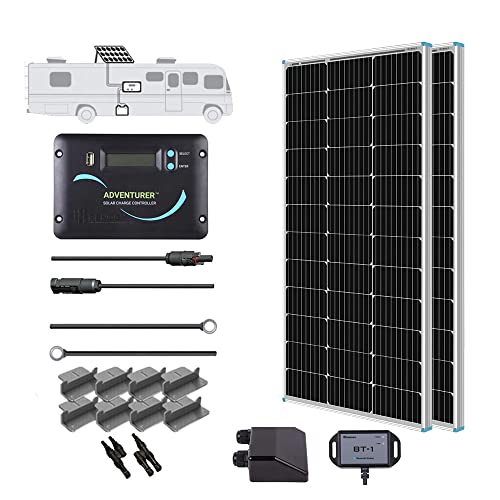
This kit pairs a 200W solar panel with a 30A PWM charge controller in a compact package designed for RV, boat, or cabin applications. It supports a variety of off-grid configurations and features protection against overcharging, overvoltage, discharge, and short circuits. The corrosion-resistant frame and robust mounting hardware help ensure dependable performance in harsh outdoor environments, with practical protection for long-term battery health and system stability.
Buying Guide: Key Purchase Considerations
- Panel type and efficiency: N-Type cells offer higher efficiency and better performance in hot conditions. Consider 25% efficiency as a baseline for off-grid RV use.
- Form factor: Rigid panels are sturdy values for flat rooftops; flexible panels are best for curved surfaces but may have different mounting needs.
- System compatibility: Ensure the panel’s voltage (12V vs 24V) matches your battery bank and inverter configuration. Some panels support both 12V and 24V with proper wiring.
- Durability and weather sealing: Look for corrosion-resistant frames, IP-rated junction boxes (IP65 or higher), and shatter-resistant glass for outdoor exposure.
- Shading tolerance: Anti-shading or bifacial features can help maintain energy production in obstructed conditions or reflective environments.
- Installation and weight: Heavier rigid panels require sturdy mounting; lighter, foldable panels offer portability but may need careful securing during travel.
- Controller compatibility: PWM controllers are common in RV kits; MPPT controllers improve efficiency but may add cost. Verify compatibility with your battery type (lead-acid, AGM, LiFePO4, etc.).
- Maintenance and warranty: Check cell technology, like 16BB vs 9BB, and the manufacturer’s warranty terms for long-term reliability on the road.
These considerations help compare options across rigidity, weight, and efficiency. When selecting for an RV, prioritize how and where you’ll install the system (rooftop space, curved surfaces, or portable needs) and ensure the panel’s electrical characteristics align with your battery and inverter setup. The featured products provide a range of capabilities—from compact, space-saving designs to robust, shade-tolerant options—supporting various RV lifestyles and climates without relying on shore power.